Supporting Cast Launches Subscriber-Only Video Podcasts on Spotify | Podcast Industry Shift
The podcasting business is entering another transformative phase. Subscription podcast platform Supporting Cast has officially expanded beyond premium audio, becoming the first company to enable creators to distribute subscriber-only video podcasts directly through Spotify.
The move represents a major development in the evolving creator economy, where podcast publishers are increasingly looking for ways to deepen audience engagement, increase recurring subscription revenue, and compete in a crowded digital media landscape.
Backed by Slate, Supporting Cast announced the rollout this week, revealing that creators can now deliver premium video content to paying subscribers inside the Spotify ecosystem without requiring audiences to leave the app. The update builds upon Spotify’s Open Access infrastructure and introduces a more seamless experience for both creators and listeners.
The launch also signals a broader industry trend: podcasting is no longer just audio. Video has rapidly become one of the most powerful tools for audience retention, fan loyalty, and monetization.
Why Supporting Cast’s Spotify Video Expansion Matters
For years, subscription podcasting has largely revolved around ad-free listening, bonus episodes, early access, and premium audio feeds. But as platforms such as YouTube continue dominating audience attention through video-first consumption, podcast publishers have increasingly sought ways to integrate visual storytelling into their subscription offerings.
Supporting Cast’s latest integration solves one of the industry’s biggest pain points — fragmented experiences.
Until now, many creators offering premium video content had to direct subscribers to separate apps, websites, or membership portals. This often created friction during the subscriber journey, resulting in reduced engagement and lower retention.
With the new integration, paying subscribers can now access exclusive video episodes natively inside Spotify, eliminating the need for external logins or complicated workflows.
The development could dramatically reshape how podcast subscriptions operate moving forward.
How the New Supporting Cast and Spotify Integration Works
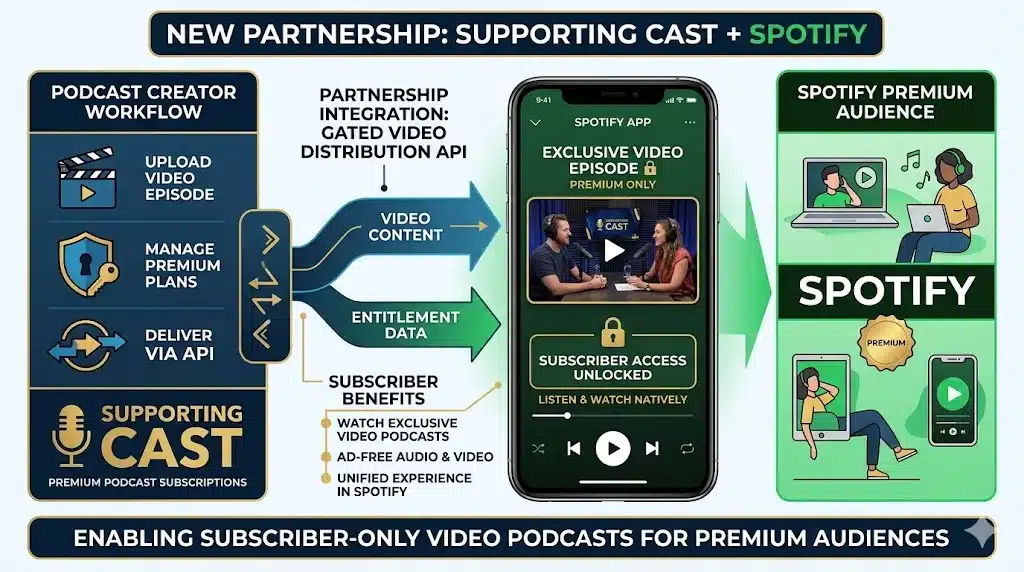
The system is powered through Spotify’s distribution API, which was introduced earlier this year to streamline video podcast publishing and monetization.
Here’s how the process works:
Users subscribe through a publisher’s Supporting Cast-powered membership system
Subscribers link their Spotify account to their premium membership
Exclusive video episodes automatically appear inside Spotify
Viewers can seamlessly switch between video and audio playback
Creators manage everything through a single publishing workflow
This means podcast publishers no longer need separate infrastructure for premium audio and premium video distribution.
Instead, they can manage all subscriber content from one central dashboard.
The integration is especially important because Spotify has become one of the largest podcast listening platforms globally. By allowing premium video to exist directly within the app, Supporting Cast is helping creators meet audiences where they already consume content daily.
The Podcast Industry’s Rapid Shift Toward Video
The expansion highlights one of the biggest ongoing debates in podcasting: the future role of video.
For years, podcasting was defined by audio-only experiences. But audience behavior has evolved significantly, especially among younger demographics.
Creators increasingly film podcast recordings, distribute clips across TikTok, Instagram Reels, YouTube Shorts, and publish full-length video episodes across streaming platforms.
Video podcasting offers several strategic advantages:
Stronger Audience Connection
Visual content creates deeper emotional engagement between creators and audiences. Viewers feel more connected when they can see facial expressions, studio dynamics, guest reactions, and behind-the-scenes moments.
Better Discoverability
Video clips perform exceptionally well on social media platforms, helping podcasts reach new audiences organically.
Higher Monetization Potential
Video opens doors to additional advertising formats, sponsorship opportunities, branded integrations, and premium subscription packages.
Increased Watch Time
Platforms such as Spotify and YouTube prioritize content that keeps users engaged for longer sessions. Video podcasts often generate stronger retention metrics.
Supporting Cast’s move suggests the subscription side of podcasting is now fully embracing this transition.
Supporting Cast CEO Signals Growing Demand for Premium Video
Supporting Cast CEO David Stern acknowledged that podcast publishers are rapidly increasing investment in video production.
According to Stern, creators initially focused heavily on gated audio experiences. But the market has changed.
As podcast publishers expand into video content, subscription platforms must evolve alongside them.
The company believes premium video content will likely follow the same growth trajectory that premium audio subscriptions experienced in recent years.
That prediction could prove accurate given the rising demand for creator-led memberships and exclusive digital communities.
Podcast audiences today are more willing than ever to pay for bonus content, ad-free experiences, and deeper access to creators they trust.
Adding premium video only strengthens that value proposition.
First Podcasts to Launch Subscriber-Only Video on Spotify
Several major podcasts and publishers are already participating in the rollout.
Among the first adopters are journalist-driven and creator-led media brands aiming to strengthen subscriber relationships through exclusive visual content.
Libero
One of the first participating publishers is “Libero,” an online soccer magazine launched in 2025 by a collective of respected football writers and journalists.
The publication has built a strong reputation among soccer fans for long-form analysis, cultural storytelling, and premium reporting.
Adding subscriber-only video could help deepen audience loyalty while creating new recurring revenue opportunities.
Legacy
Another early participant is “Legacy,” a history-focused podcast hosted by historian Peter Frankopan and journalist Afua Hirsch.
The show combines historical analysis with modern cultural commentary, making it particularly suited for visual storytelling and audience engagement.
Goalhanger
The popular podcast network Goalhanger is also preparing to roll out subscriber-only video content through Supporting Cast’s integration.
Goalhanger has emerged as one of the fastest-growing podcast publishers in recent years, known for combining personality-driven programming with broad audience appeal.
Betches Media
Digital media company Betches Media will also utilize the feature as part of its ongoing expansion into subscription content and creator-led monetization.
Jim Harold’s Campfire
Paranormal storytelling podcast “Jim Harold’s Campfire” is another notable addition.
Host Jim Harold emphasized the emotional impact of video in podcasting, explaining that visual content strengthens the connection between hosts and listeners in ways audio alone cannot.
According to Harold, video helps audiences feel more immersed and connected to the experience.
Spotify’s Bigger Podcast Strategy Is Becoming Clear
The integration also sheds light on Spotify’s long-term ambitions in podcasting.
Spotify has aggressively invested billions into podcast infrastructure, creator partnerships, advertising technology, and exclusive content over the past several years.
While earlier strategies focused heavily on exclusivity deals and celebrity podcasts, Spotify’s newer direction appears centered around creator enablement and monetization tools.
The company introduced its new distribution API in January to simplify how creators publish and monetize video podcasts on the platform.
The API allows creators to:
Upload full-length video episodes directly
Monetize content without changing podcast hosts
Avoid duplicate uploads across multiple systems
Maintain publishing flexibility
Expand audience reach through Spotify’s ecosystem
Several major hosting companies have already integrated with Spotify’s API, including:
Acast
Audioboom
Libsyn
Omny Studio
Podigee
However, those partnerships mainly focused on open and ad-supported video distribution.
Supporting Cast’s integration is the first to introduce entitlement-based premium video access.
That distinction is critical because it unlocks subscription monetization at scale.
What “Entitlement-Gated Video” Actually Means
The term “entitlement-gated” refers to content access based on subscription status.
In simple terms:
Paying subscribers receive access
Non-paying users do not
Authentication happens automatically through account linking
This model allows creators to build sustainable recurring revenue streams while offering premium experiences to their most loyal audiences.
It also reduces piracy and account-sharing concerns because access is tied directly to verified memberships.
For publishers, this creates a more scalable and controlled business model.
Why Publishers Are Betting Big on Subscription Revenue
The digital publishing landscape has changed dramatically over the past decade.
Advertising revenue has become increasingly volatile due to:
Algorithm changes
Declining organic reach
Rising acquisition costs
Ad-blocking technology
Platform dependency
As a result, many creators and publishers are prioritizing direct audience monetization strategies.
Subscription podcasting has become one of the most attractive models because it offers:
Predictable Monthly Revenue
Recurring subscriptions create financial stability compared to fluctuating advertising income.
Stronger Community Building
Subscribers often become highly engaged superfans who support creators long-term.
Better Audience Data
Membership systems provide deeper insights into listener behavior and preferences.
Greater Editorial Independence
Publishers relying less on advertisers can maintain more control over their content strategy.
Supporting Cast’s video integration strengthens all of these advantages.
Video Podcasting Could Change Listener Behavior
One major question remains: how much will audiences actually consume podcasts through video?
The answer may depend on context.
Audio podcasts remain incredibly popular during commuting, exercising, multitasking, and passive listening situations.
But video podcasts excel in other environments, including:
Home viewing
Smart TVs
Desktop consumption
Live events
Fan-focused content
Interview formats
Many podcast creators now produce hybrid experiences where audiences can either watch or listen depending on preference.
Spotify’s interface supports this flexibility by allowing users to switch seamlessly between video and audio.
That functionality could significantly improve user experience compared to fragmented viewing systems elsewhere.
The Battle Between Spotify and YouTube Is Intensifying
Supporting Cast’s expansion also reflects the growing competition between Spotify and YouTube in podcasting.
YouTube has quietly become one of the largest podcast consumption platforms globally, especially among younger users.
Many creators now prioritize video clips and YouTube uploads alongside traditional audio feeds.
Spotify’s challenge has been convincing creators that premium podcast video can thrive inside its ecosystem as effectively as it does on YouTube.
By enabling subscriber-only video, Spotify gains a strategic advantage in monetization.
Unlike YouTube’s advertising-centric model, Spotify can position itself as a destination for premium membership experiences.
That distinction may become increasingly important as creators seek diversified revenue streams beyond ad-supported content.
Creators Want Ownership and Flexibility
Another important aspect of Supporting Cast’s integration is workflow simplicity.
Creators often struggle with fragmented publishing systems that require:
Separate uploads
Different hosting platforms
Multiple subscription tools
Complicated analytics
Platform-specific formatting
Supporting Cast’s system centralizes much of this process.
Publishers only need to attach video files to episodes within the platform’s admin system.
Once connected to Spotify, episodes automatically publish in the appropriate format.
This dramatically reduces operational complexity.
For independent creators and small media teams, streamlined workflows can save significant time and production costs.
Independent Media Companies Could Benefit Most
While large podcast studios have the resources to build custom infrastructure, smaller independent publishers often face technical and financial barriers.
Supporting Cast’s integration lowers those barriers considerably.
Independent journalism brands, niche creators, educational podcasts, and creator-led communities may now have access to premium video monetization tools previously available only to larger networks.
This democratization could accelerate innovation across podcasting.
Smaller publishers can now experiment with:
Subscriber-only interviews
Bonus visual explainers
Behind-the-scenes footage
Interactive fan content
Live video episodes
Premium educational content
As a result, podcast subscriptions could evolve into broader multimedia memberships rather than simple audio products.
Industry Experts Expect Video Podcast Growth to Continue
The broader market trend strongly favors video expansion.
Over the past two years:
YouTube podcast consumption surged
TikTok drove podcast discovery
Spotify expanded video features
Creators increased visual production investments
Audiences embraced hybrid listening habits
Industry analysts increasingly believe future podcast success will depend heavily on multi-format distribution.
Audio alone may no longer be enough for maximum audience growth.
Supporting Cast’s launch positions the company at the center of that transformation.
The Future of Podcast Subscriptions May Look Very Different
The rise of premium video suggests podcast subscriptions are evolving into something closer to creator membership ecosystems.
Future offerings may include:
Exclusive livestreams
Community chats
Video Q&A sessions
Interactive fan events
Bonus documentaries
Extended interviews
Educational courses
Subscriber-only networks
In this environment, the traditional definition of a “podcast” continues expanding.
Creators are becoming multimedia brands.
Platforms are becoming monetization ecosystems.
And audiences increasingly expect flexible, immersive experiences across formats.
Supporting Cast’s Move Could Pressure Competitors
The launch may also increase pressure on rival subscription and hosting platforms.
Companies operating in the podcast monetization space will likely need to accelerate video support to remain competitive.