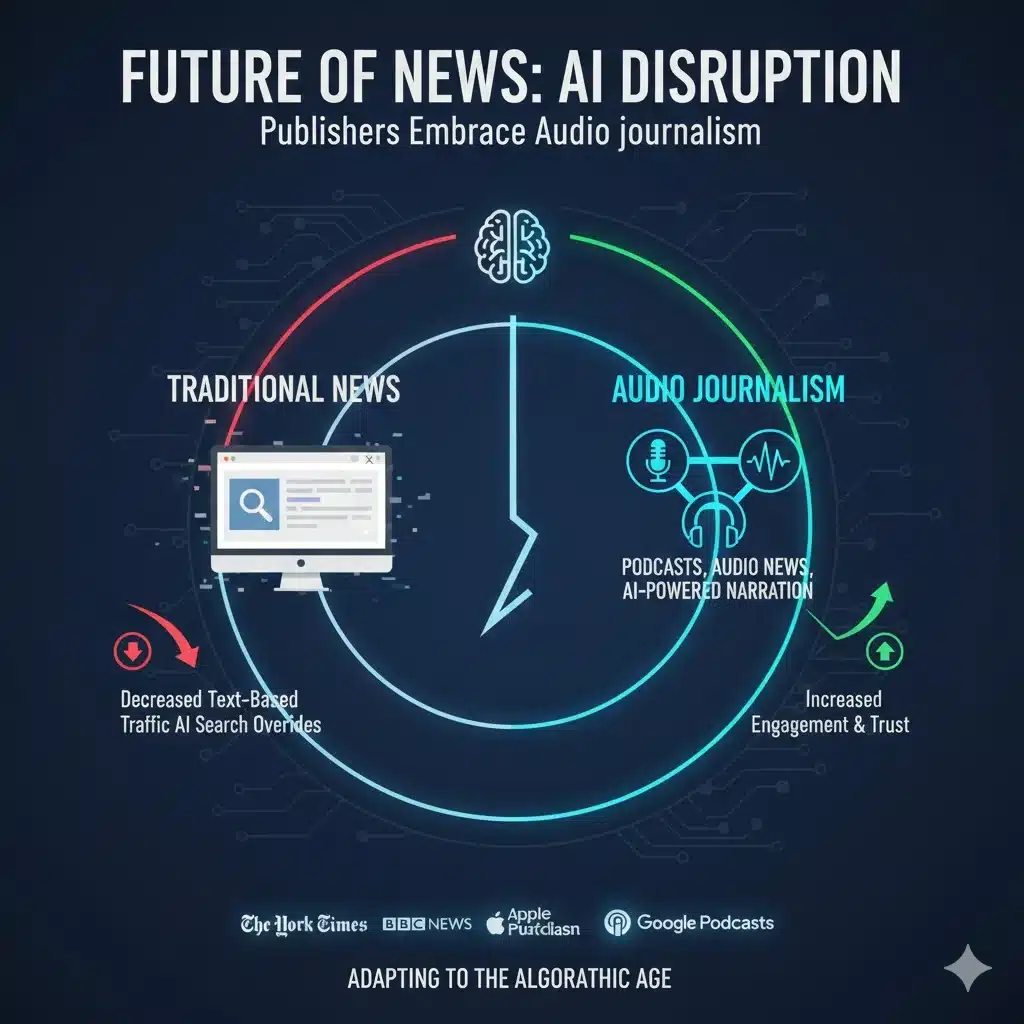
News Publishers Turn to Audio as AI Disrupts Text, Search, and Journalism
As artificial intelligence rapidly reshapes how news is created, distributed, and consumed, publishers across the globe are rethinking their core strategies. Text-based journalism—once the backbone of digital media—is facing unprecedented pressure from AI-powered search engines, automated summaries, and declining referral traffic. In response, news organizations are increasingly betting on audio journalism, including podcasts and voice-based formats, as a more resilient and human-centric future for news.
A new industry outlook from the Reuters Institute for the Study of Journalism signals a major strategic shift underway: audio is no longer a side experiment. It is becoming a central pillar of newsroom survival in an AI-dominated media ecosystem.
For more than a decade, search engines have been the lifeline of digital journalism. That relationship is now under strain.
According to the Reuters Institute’s annual Journalism, Media, and Technology Trends Outlook, news publishers expect search engine traffic to fall by nearly 43% within the next three years. The reason is not declining interest in news—but the rise of AI-powered “answer engines.”
From Search Engines to Answer Engines
AI-driven platforms increasingly deliver:
Instant summaries
Direct answers
Contextual explanations
All without requiring users to click through to original news websites.
This fundamental shift has serious implications:
Reduced visibility for original reporting
Loss of advertising impressions
Weakening brand recognition
Publishers warn that AI is effectively extracting value from journalism without returning traffic, accelerating an already fragile business model.
Why Audio Is Emerging as a Strategic Safe Haven
As text becomes easier for AI to scrape, summarize, and repackage, audio stands apart.
The Reuters Institute report highlights a critical distinction:
Linear audio formats are harder to fragment, automate, or replace.
Unlike text:
Podcasts are consumed start-to-finish
They rely on voice, tone, and personality
They foster loyalty rather than casual clicks
This makes audio far more resistant to AI commoditization.
Audio by the Numbers
Key findings from surveyed news executives:
71% say expanding podcasts and audio formats will be a top priority by 2026
Fewer publishers plan to increase text output
Audio is increasingly tied to subscriptions, memberships, and brand trust
In an age of endless AI-generated articles, human voices are becoming a differentiator.
Podcasts Thrive Where Text Struggles
While AI can summarize an article in seconds, it struggles to replicate:
Authentic conversation
Editorial judgment
Emotional nuance
Trust built over time
Podcasts deliver something AI still cannot convincingly fake at scale: human connection.
Listeners often form parasocial relationships with hosts, tuning in not just for information, but for perspective. This loyalty makes audio a powerful counterweight to the fleeting nature of algorithm-driven news feeds.
Political Communication Is Accelerating the Audio Shift
Audio’s rise is also being fueled by a transformation in political media strategy—particularly in the United States.
The Decline of Traditional Gatekeepers
With public trust in legacy journalism under pressure, many political figures are bypassing traditional newsrooms altogether. Instead, they are turning to:
Podcasts
YouTube interviews
Creator-led platforms
These spaces offer:
Long-form discussions
Minimal editorial challenge
Highly engaged audiences
The Reuters Institute describes this trend as an evolution of the “Trump 2.0 playbook”—once controversial, now widely adopted across the political spectrum.
Podcasts as Political Power Platforms
For politicians, podcasts provide:
Direct access to loyal listeners
Control over narrative framing
Fewer interruptions or adversarial questions
For publishers, this presents a dilemma:
Podcasts drive attention
But often operate outside traditional journalistic norms
Still, the success of political podcasts underscores a broader reality: audiences increasingly prefer depth over headlines.
Creator Economy Reshapes the Media Landscape
The rise of audio cannot be separated from the explosive growth of the creator economy.
Publishers Feel the Pressure
According to the report:
Over two-thirds of publishers fear creators are pulling audiences away
39% worry about losing journalists to creator-led ventures
This competition is most intense in markets like:
The United States
The United Kingdom
Parts of Europe
Where podcasting and video-first creators already dominate attention.
Newsrooms Encourage Journalists to “Act Like Creators”
Facing this reality, publishers are adapting—not resisting.
Planned strategies include:
Encouraging journalists to build personal brands
Allowing more opinion-led and personality-driven formats
Investing in creator partnerships
Key Strategic Shifts
75% of publishers want journalists to behave more like creators
50% plan to collaborate with creators for distribution
Some are launching in-house creator studios modeled on podcast networks
The line between “journalist” and “creator” is rapidly blurring.
Advertising Dollars Follow Audio and Creators
The advertising market is reinforcing this pivot.
Data cited in the report from the Interactive Advertising Bureau (IAB) shows:
U.S. creator advertising spend reached $37 billion in 2025
Growth is projected to be four times faster than the broader ad industry
Brands are increasingly drawn to:
Host-read podcast ads
Authentic endorsements
Long-form engagement
This shift places additional financial pressure on text-heavy legacy outlets.
AI, “Slop,” and the Value of Human Voices
As generative AI floods the internet with low-cost, low-quality content—often described as “AI slop”—trust is becoming a scarce commodity.
The Reuters Institute argues that audio’s strength lies in its humanity.
Trust as a Competitive Advantage
Initiatives like iHeartMedia’s “Guaranteed Human” branding reflect a growing emphasis on authenticity.
In a world saturated with synthetic voices and automated articles:
Recognizable hosts
Transparent editorial standards
Consistent voices
Are emerging as signals of credibility.
Audio Is Not Immune to Disruption
Despite its advantages, audio is not a silver bullet.
Publishers still face:
Platform dependency (Spotify, Apple, YouTube)
Algorithmic discovery challenges
Intense creator competition
Audience habits continue to evolve, and discoverability remains a key obstacle.
Still, among all content formats, audio retains one critical edge: it is still strongly associated with trust, attention, and human presence.
The Future of Journalism Sounds Different
The rise of audio does not signal the end of text—but it does mark a rebalancing.
As AI continues to erode traditional distribution channels:
Text becomes easier to automate
Search becomes less reliable
Trust becomes more valuable
Audio journalism offers publishers a way to reconnect directly with audiences—one voice at a time.
Key Takeaways
AI is accelerating the decline of search-driven news traffic
Audio formats are harder for AI to replicate or replace
Podcasts foster loyalty, trust, and direct relationships
Political communication is increasingly podcast-driven
Publishers are adapting by embracing creator-style journalism
Advertising dollars are flowing toward audio and creators
Human voices stand out amid AI-generated content overload