New York FAIR News Act: Lawmakers Push AI Disclosure Rules for Journalism
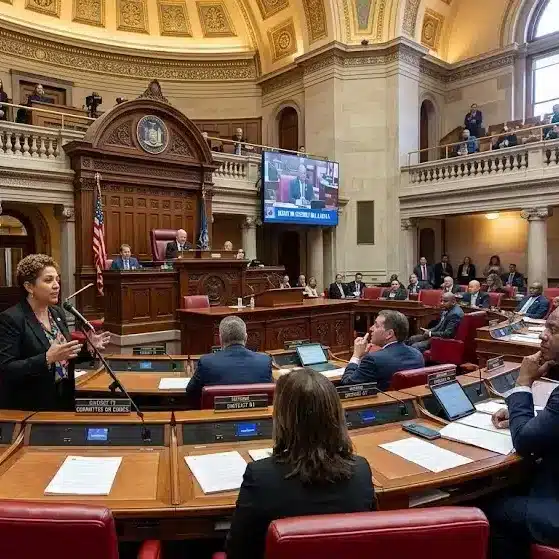
Artificial intelligence is rapidly transforming the global media landscape, but lawmakers in New York now want to ensure that human accountability remains at the center of journalism. A newly proposed bill in the state legislature aims to establish strict disclosure requirements for the use of AI in newsrooms, marking one of the most significant legislative pushes in the United States to regulate artificial intelligence in journalism.
The proposal, known as the New York Fundamental Artificial Intelligence Requirements in News Act (FAIR News Act), seeks to create clear guidelines for how AI can be used in news production while protecting journalists, audiences, and the integrity of factual reporting.
Introduced as S.8451/A.8962-A, the legislation would require media organizations operating in New York to openly disclose when artificial intelligence tools are used in the creation of content. The bill would also mandate that all AI-generated articles, images, audio clips, and visual material be reviewed by a human editor before publication.
Supporters describe the measure as a “common-sense framework” designed to maintain public trust at a time when AI-generated misinformation, deepfakes, and automated journalism are becoming increasingly common across digital platforms.
Artificial intelligence tools have become deeply embedded in modern media operations. From automated article summaries and headline generation to AI-created visuals and synthetic voiceovers, publishers across the world are experimenting with machine-driven workflows to cut costs and increase production speed.
However, the rapid adoption of AI has also sparked growing fears inside newsrooms.
Journalists, editors, media unions, and press freedom advocates argue that unchecked AI use could damage the credibility of journalism, eliminate jobs, and flood the internet with misleading or manipulated content.
New York lawmakers say the FAIR News Act is intended to address those concerns before the situation escalates further.
State Senator Patricia Fahy, one of the leading sponsors of the bill, believes journalism is among the industries most vulnerable to AI disruption.
According to Fahy, the issue extends far beyond newsroom efficiency. She argues that the larger concern is the erosion of public confidence in reliable news reporting.
“Perhaps one of the industries at most risk from the use of artificial intelligence is journalism and as a result, the public’s trust and confidence in accurate news reporting,” Fahy stated while discussing the proposal.
Her concerns reflect a broader national debate about whether AI can responsibly handle the ethical and factual responsibilities traditionally managed by trained journalists.
What the FAIR News Act Would Require
If passed, the FAIR News Act would introduce several major requirements for media organizations operating in New York State.
Key provisions include:
Mandatory disclosure of AI usage in news production
Human editorial review before publication of AI-generated content
Transparency for employees regarding workplace AI implementation
Protections against AI-driven worker displacement
Safeguards to maintain journalistic integrity and accuracy
Under the proposed rules, any content substantially generated or altered by AI tools would need to be clearly identified before reaching the public.
This would apply to:
News articles
Online stories
Audio reports
Broadcast segments
AI-generated photographs
Synthetic video or visual material
The legislation would also require companies to explain to newsroom staff how AI technologies are being used internally.
Supporters argue that transparency is essential not only for consumers but also for employees who may be affected by automation-driven restructuring inside media companies.
Public Trust in AI-Generated News Remains Low
One of the driving forces behind the legislation is growing public skepticism toward AI-created information.
Lawmakers cited findings from a survey conducted by the National Association of Broadcasters that revealed widespread distrust of AI-generated content among consumers.
The survey found:
More than 75% of respondents worry about AI reproducing or stealing journalism
Only 26% trust information produced by AI systems
Around 68% consider AI-generated information untrustworthy
These numbers underscore the challenge facing publishers as they increasingly integrate AI into editorial operations.
While technology companies promote artificial intelligence as a productivity revolution, many consumers still believe human oversight is essential for credible journalism.
Media analysts say trust has become one of the most valuable assets for news organizations in the digital age. Any perception that newsrooms are relying excessively on AI without transparency could further weaken audience confidence.
Newsroom Unions Back the Proposed Legislation
The FAIR News Act has already gained strong backing from labor unions and media advocacy groups across New York.
Several organizations representing journalists, broadcasters, actors, editors, and media workers have publicly endorsed the proposal, calling it a necessary response to the unchecked rise of AI technologies.
Among the supporters are:
Writers Guild of America East (WGAE)
SAG-AFTRA
New York State AFL-CIO
Directors Guild of America
NewsGuild of New York
Vox Media Editorial Union
The support from organized labor highlights growing concerns among workers that AI could eventually replace creative and editorial roles across the media industry.
Vox Media Editorial Union Calls for “Urgent Guardrails”
The Vox Media Editorial Union has emerged as one of the most vocal supporters of the FAIR News Act.
Union representatives acknowledged that some media organizations have already negotiated AI-related protections through collective bargaining agreements. However, they argue that isolated contracts are not enough to protect the industry as a whole.
The union said there is an “urgent need” for statewide guardrails that ensure responsible AI implementation across all media companies.
Many journalists fear that without legal standards, publishers may increasingly rely on automated content generation to reduce staffing costs.
Critics warn this could lead to:
Lower editorial standards
Increased misinformation
Reduced investigative journalism
Declining newsroom employment
Greater dependence on algorithm-driven content
Supporters of the bill say these risks make legislative oversight essential.
Radio Journalists Warn of Misinformation Risks
Employees represented by the Writers Guild of America East chapter at all-news station WINS-AM/FM New York (1010/92.3) have also voiced support for the legislation.
In a public memo supporting the bill, journalists from the station argued that AI systems could threaten both jobs and journalistic integrity if left unregulated.
The employees stated:
“We firmly believe there is an urgent need to establish guardrails for media companies operating in New York State to prevent them from using AI at the expense of the integrity of our work or from the dangerous consequences of misinforming the public.”
The group also emphasized the importance of clear labeling standards for AI-generated news content in search engines and digital platforms.
This reflects broader concerns that audiences may struggle to distinguish between human-produced journalism and AI-generated material online.
Why AI Disclosure Is Becoming a Global Debate
New York’s proposal arrives amid growing international discussions about artificial intelligence regulation.
Governments around the world are struggling to balance innovation with accountability as AI systems become more sophisticated.
Several major concerns are driving these conversations:
Deepfake Misinformation
AI-generated videos and audio recordings can convincingly imitate real people, raising fears about political manipulation and fake news.
Copyright and Intellectual Property
Media companies and creators argue that AI systems are often trained on copyrighted journalism without permission or compensation.
Job Displacement
Automation threatens to reshape employment across journalism, publishing, entertainment, and broadcasting.
Transparency Concerns
Consumers increasingly want to know whether the content they consume was created by humans or machines.
The FAIR News Act directly addresses this transparency issue by requiring disclosure and human oversight.
Assemblywoman Nily Rozic, another key sponsor of the legislation, said the proposal is designed not only to protect audiences but also to safeguard newsroom employees.
Rozic emphasized that the bill would help reinforce local journalism while preventing AI-driven labor abuses.
Local news organizations across the United States are already facing financial pressure from declining advertising revenue and shrinking audiences.
Many journalists fear publishers may use AI to replace entry-level reporting, editing, transcription, and production roles.
Rozic argues that responsible regulation can help media companies innovate without sacrificing workers or editorial standards.
Media Industry Faces Rapid Technological Transformation
The rise of generative AI has fundamentally altered how digital content is created and distributed.
In just a few years, artificial intelligence systems have become capable of:
Writing articles
Generating realistic images
Cloning human voices
Producing video content
Translating languages instantly
Summarizing news events
Automating social media posts
Many publishers now use AI tools to streamline newsroom operations.
Some organizations employ AI for:
SEO headline generation
Automated sports recaps
Earnings report summaries
Content recommendations
Article translations
Audience analytics
While these technologies can improve efficiency, critics argue that overreliance on automation risks undermining journalism’s core values.
Experts Say Human Oversight Is Critical
Media ethics experts say AI can assist journalism but should never fully replace editorial judgment.
Human editors remain essential for:
Fact-checking
Source verification
Ethical decision-making
Contextual analysis
Investigative reporting
Legal review
Sensitivity assessment
AI systems are still prone to inaccuracies, hallucinations, and contextual misunderstandings.
Because of this, supporters of the FAIR News Act insist that human editorial review must remain mandatory before publication.
The proposed law would effectively codify that principle into state regulation.
Could Other States Follow New York’s Lead?
Industry observers believe New York’s proposal could influence similar legislation nationwide.
As one of the country’s largest media hubs, New York plays a major role in shaping journalism standards.
Major organizations with operations in the state include:
National television networks
Digital media companies
Newspaper publishers
Streaming platforms
Radio broadcasters
Magazine publishers
If enacted, the FAIR News Act could become a model for AI regulation in other states.
Lawmakers elsewhere are already considering policies related to AI-generated political advertising, synthetic media disclosure, and algorithmic accountability.
The journalism sector may now become the next major battleground in AI regulation debates.
Support From Major Media Organizations
The proposal has received backing from unions representing workers at several influential media outlets.
Organizations connected to supporting unions include:
ABC News
CBS News
CBS News Digital
CBS News 24/7
The New York Times
The New Yorker
Condé Nast
Hearst Magazines Media
Business Insider
WPIX-TV
The breadth of support demonstrates how widespread concerns about AI have become within the media industry.
Even companies experimenting with AI technologies appear to recognize the need for clearer standards and transparency measures.
SAG-AFTRA Warns Against Unchecked AI Expansion
SAG-AFTRA, which has become increasingly active in AI-related labor disputes, also strongly supports the FAIR News Act.
Rebecca Damon, Executive Director of SAG-AFTRA New York, said the legislation is not intended to stop technological progress.
Instead, she argued that media companies must remain transparent with audiences and workers.
“We are not here to stop technological advancement,” Damon said. “But news media companies must be honest with the public and cooperate with news workers to uphold journalistic standards and workplace protections.”
Her comments echo broader concerns throughout the entertainment and media industries, where AI has become a central issue in labor negotiations.
Actors, writers, journalists, and creative professionals increasingly fear that synthetic content tools could weaken bargaining power and reduce employment opportunities.
The Bigger Question: Can AI and Journalism Coexist?
The debate surrounding the FAIR News Act ultimately reflects a larger philosophical question facing modern media:
Can artificial intelligence coexist with ethical journalism?
Supporters of AI argue that automation can help publishers survive in an increasingly competitive digital environment.
They believe AI can:
Reduce production costs
Increase publishing speed
Improve personalization
Expand multilingual coverage
Enhance audience engagement
Critics, however, warn that journalism is not simply about producing content quickly.
They argue that trust, accountability, and human judgment cannot be automated.
Without proper safeguards, opponents fear the internet could become saturated with misleading AI-generated material that blurs the line between truth and fabrication.
AI Regulation May Become a Defining Issue for Media
The FAIR News Act could mark the beginning of a broader shift toward AI governance in journalism.
As artificial intelligence becomes more integrated into content creation, lawmakers may increasingly pressure media companies to adopt transparency standards.
Potential future regulations could include:
Mandatory AI labeling requirements
Consumer disclosure rules
Copyright licensing standards
AI auditing requirements
Restrictions on synthetic media
Protections for creative workers
For now, New York lawmakers say their goal is straightforward: preserve trust in journalism while ensuring technology develops responsibly.
Industry Reaction Remains Mixed
Although many unions support the legislation, some technology advocates argue that overly restrictive regulations could slow innovation.
Critics of AI regulation often warn that excessive government oversight may place domestic media companies at a competitive disadvantage compared to international firms operating under looser rules.
Others believe voluntary guidelines may be more effective than legislation.
Still, supporters of the FAIR News Act argue that waiting too long could create irreversible damage to journalism and public trust.
They believe clear rules are necessary before AI adoption becomes impossible to regulate.
Why This Story Matters
The fight over AI in journalism is no longer theoretical.
Newsrooms across the globe are already experimenting with generative AI tools, and consumers are increasingly exposed to machine-generated content every day.
The FAIR News Act represents one of the strongest attempts yet to establish transparency and accountability standards within the media industry.
Whether the legislation ultimately passes or not, it signals a major shift in how governments, journalists, and audiences are beginning to approach artificial intelligence.
The outcome could shape the future of digital journalism not only in New York but across the United States.
As AI technology evolves at a rapid pace, the central challenge remains balancing innovation with credibility.
For many lawmakers, journalists, and consumers, preserving trust in news may now depend on how successfully that balance is achieved.
Key Highlights of the FAIR News Act
Proposed Requirements
AI-generated content must be reviewed by a human editor
News organizations must disclose AI usage
Transparency rules would apply to text, audio, images, and video
Employees must be informed about workplace AI implementation