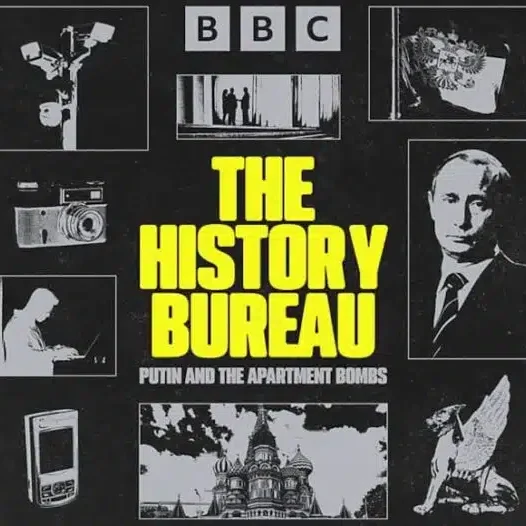
BBC Studios Launches The History Bureau Podcast | Revisiting Modern History
BBC Studios has officially launched The History Bureau, a new long-form narrative podcast that revisits pivotal moments in recent global history through the eyes of the journalists who originally reported them. The series combines investigative storytelling, archival journalism, and retrospective analysis to question what was known at the time—and what may have been missed.
Designed for today’s podcast-savvy audience, The History Bureau draws deeply from the BBC’s unparalleled global reporting network and its extensive archives, offering listeners a rare opportunity to revisit history with the benefit of hindsight.
The History Bureau is a documentary-style podcast series that reunites frontline journalists with the stories they once covered under intense pressure. Each season revisits a major historical event, asking difficult questions:
What did journalists get right at the time?
What information was unavailable or overlooked?
How did political pressure, limited access, and unfolding chaos shape early reporting?
How did those moments influence the world that followed?
Rather than simply retelling historical events, the podcast critically examines how narratives were formed—and how they hardened into “official versions” of history.
A Podcast Built on the BBC’s Greatest Strengths
BBC Studios is uniquely positioned to produce a series like The History Bureau thanks to two defining assets:
A century-old broadcast archive documenting global events as they happened
A worldwide network of correspondents with first-hand experience in conflict zones, political upheaval, and breaking news
According to BBC Studios Audio leadership, these resources allow stories to be revisited with a level of clarity and context that simply wasn’t possible at the time of original reporting.
Season One: Putin and the Apartment Bombs
The debut season, titled Putin and the Apartment Bombs, explores one of the most controversial and consequential episodes in modern Russian history.
The Events That Shook Russia
In September 1999, a series of coordinated explosions ripped through four apartment buildings across Russia during the night. The attacks:
Killed hundreds of civilians
Spread widespread fear and panic
Occurred just weeks after Vladimir Putin became Prime Minister
At the time, Russian authorities blamed Chechen militants for the bombings—a conclusion that was rapidly adopted and widely reported by domestic and international media.
A Story That Never Fully Settled
More than two decades later, the apartment bombings remain shrouded in unanswered questions.
Alternative theories, inconsistencies, and allegations of a darker conspiracy have persisted for years, with critics arguing that the attacks played a crucial role in consolidating Vladimir Putin’s rise to power.
The bombings are often cited as a turning point that:
Justified renewed military action in Chechnya
Boosted Putin’s popularity ahead of national elections
Reshaped Russia’s political trajectory
Revisiting the Reporting: What Did Journalists Really Know?
The History Bureau does not attempt to deliver definitive conclusions. Instead, it brings together journalists who were on the ground in 1999 to reassess:
What evidence was available at the time
How official narratives formed so quickly
Where doubts existed but were difficult to pursue
How political pressure and access limitations influenced coverage
The podcast highlights how fast-moving crises can narrow journalistic focus and how uncertainty often gets flattened into simplified narratives for audiences seeking clarity.
Seven Episodes, One Continuous Narrative
The first season unfolds across seven tightly produced episodes, each running approximately 30 minutes. Designed as a continuous narrative, the series encourages listeners to engage deeply rather than dip in and out.
Key Features of the Podcast Format
Investigative storytelling
First-person reflections from veteran reporters
Archival audio from BBC news coverage
Contextual analysis with historical hindsight
Clear, accessible narration
Hosted by Helena Merriman
The series is hosted by award-winning audio journalist Helena Merriman, who guides listeners through the story with a calm, analytical approach.
Speaking about the project, Merriman explained that the podcast is about far more than revisiting a single historical event.
“Revisiting the 1999 apartment bombings isn’t just about relitigating the past—it’s about understanding the forces that shaped modern Russia and the world we live in today,” she said.
She added that the enduring controversy surrounding the events makes them especially relevant in today’s geopolitical climate.
Exploring Journalism Under Pressure
One of the podcast’s central themes is the reality of reporting during moments of national trauma and political tension.
The series explores how journalists often face:
Limited access to reliable sources
Government-controlled information
Time pressure to publish quickly
Editorial demands for certainty
By examining these constraints, The History Bureau offers rare insight into how news is made—and how historical understanding evolves over time.
BBC Studios on Why This Podcast Matters Now
Annie Brown, Executive Editor of BBC Studios Audio, said the podcast leverages the BBC’s unique position in global journalism.
According to Brown, the ability to re-examine events with decades of perspective allows journalists to ask questions that were impossible to pursue in the heat of breaking news.
She emphasized that the podcast is not about rewriting history, but about understanding how history is constructed.
Release Schedule and Where to Listen
Streaming Availability
Episodes 1–3 of The History Bureau: Putin and the Apartment Bombs are available now
Accessible on BBC Sounds and all major podcast platforms
Episode Release Timeline
New episodes released daily until Friday, 16 January 2026
Radio Broadcast
The series will air weekly on BBC Radio 4
Broadcast begins 21 January 2026 at 09:30
International Access
Global listeners can stream episodes via BBC.com
Why The History Bureau Stands Out in the Podcast Space
In an increasingly crowded podcast landscape, The History Bureau distinguishes itself through:
Deep journalistic credibility
Archival richness
Narrative cohesion
Willingness to embrace uncertainty
A focus on how history is reported, not just what happened
It appeals to listeners interested in politics, global affairs, investigative journalism, and the mechanics of newsmaking itself.
The Growing Demand for Narrative History Podcasts
The launch of The History Bureau reflects a broader trend in audio storytelling, where audiences are gravitating toward:
Long-form journalism
Serialized documentary podcasts
Nuanced political and historical analysis
Trustworthy, well-sourced reporting
BBC Studios’ entry into this space reinforces its commitment to public-interest journalism adapted for modern listening habits.
Final Thoughts
With The History Bureau, BBC Studios has created a podcast that goes beyond conventional history telling. By centering the voices of journalists and confronting the limitations of real-time reporting, the series invites listeners to think critically about how narratives are formed—and how power, pressure, and uncertainty shape what the world comes to accept as truth.
As the first season unfolds, it sets a strong precedent for future investigations into defining moments that continue to influence global politics today.