Azerion Integrates Spotify Ad Exchange Into Hawk DSP Globally
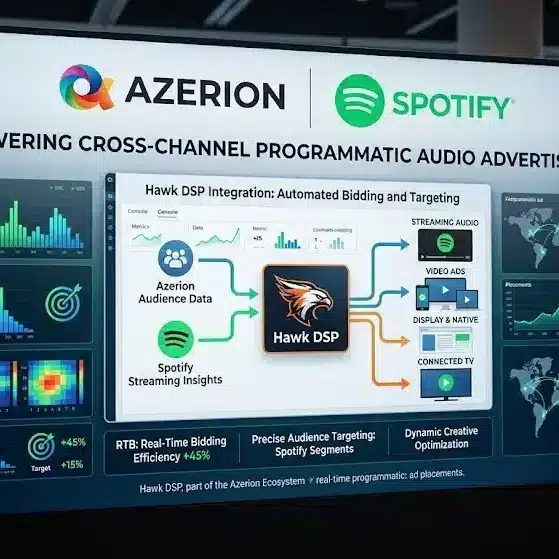
Digital advertising company Azerion has announced a major expansion of its programmatic advertising capabilities after integrating the Spotify Ad Exchange directly into its Hawk DSP platform worldwide.
The move is expected to strengthen Azerion’s position in the rapidly evolving ad-tech ecosystem by giving advertisers broader access to Spotify’s premium inventory across multiple ad formats, including audio, video, display, and podcast advertising. Industry observers say the partnership could reshape how brands approach omnichannel audio and streaming campaigns in 2026 and beyond.
The announcement comes at a time when advertisers are increasingly shifting budgets toward digital audio, connected media, and automated programmatic buying systems that deliver both efficiency and scale.
Direct Integration Opens Global Inventory Access for Advertisers
Under the new agreement, Hawk DSP users can now directly access Spotify Ad Exchange inventory across international markets. The integration supports all major programmatic deal structures, including:
Private Marketplace (PMP)
Programmatic Guaranteed
Open Auction
Preferred Deals
The partnership effectively creates a streamlined buying path between advertisers using Hawk DSP and Spotify’s advertising ecosystem, eliminating multiple technical layers that often slow campaign execution and reduce transparency.
According to Azerion, the direct integration is designed to simplify campaign activation while also improving operational efficiency for agencies and brands running global advertising campaigns.
Advertisers using Hawk DSP will now be able to launch campaigns faster while gaining access to Spotify’s highly engaged user base through a single demand-side platform.
Why This Partnership Matters in the Ad-Tech Industry
The integration highlights a larger trend unfolding across the digital advertising landscape: brands are demanding more direct, transparent, and efficient access to premium media inventory.
For years, advertisers have criticized fragmented supply chains, hidden fees, and latency issues in programmatic advertising. Direct integrations between DSPs and premium publishers are increasingly becoming the preferred solution.
By connecting directly with Spotify Ad Exchange, Azerion aims to address several pain points simultaneously:
Key Benefits of the Integration
Reduced supply-chain complexity
Faster campaign deployment
Lower latency
Improved campaign performance
Greater transparency in media buying
Access to premium global streaming audiences
Omnichannel advertising capabilities
Industry experts say these improvements could be particularly valuable for brands targeting younger, mobile-first audiences who consume large amounts of audio and podcast content daily.
Spotify’s Growing Influence in Digital Advertising
Over the past few years, Spotify has evolved far beyond a music-streaming platform. Today, the company has become one of the world’s largest digital audio advertising ecosystems, especially after its aggressive expansion into podcasting and video content.
Spotify’s advertising business now includes:
Music streaming ads
Podcast advertising
Video advertising
Display advertising
AI-powered audience targeting
Automated ad buying solutions
The company’s ad-supported user base continues to grow globally, making it an increasingly attractive destination for advertisers looking to engage consumers in immersive listening environments.
The integration with Hawk DSP gives advertisers broader programmatic access to these audiences without relying on multiple intermediary platforms.
Azerion Strengthens Its Omnichannel Advertising Strategy
For Azerion, the Spotify partnership aligns closely with its long-term global expansion strategy centered around omnichannel advertising solutions.
The company has been steadily investing in Hawk DSP as a central pillar of its advertising technology business. The platform enables brands and agencies to manage campaigns across multiple channels, including:
Audio
Video
Mobile
Display
Connected TV (CTV)
Digital Out-of-Home (DOOH)
Gaming environments
By adding Spotify Ad Exchange inventory directly into Hawk DSP, Azerion significantly expands its premium media offering while reinforcing its competitive position in the global DSP market.
The company says the move is part of a broader initiative to provide direct access to premium inventory sources while reducing dependence on fragmented ad-tech pathways.
Mehdi Aroussi Highlights Convergence of Culture, Media, and Commerce
Commenting on the partnership, Mehdi Aroussi, Senior Director of Global Partnerships & MENA Region at Azerion, emphasized Spotify’s cultural influence and the strategic importance of the integration.
According to Aroussi, Spotify represents a space where culture, media, and commerce intersect — making it a highly valuable environment for modern advertisers.
He noted that the integration allows clients to reach audiences globally across multiple advertising formats while improving precision and operational efficiency.
Aroussi also described the partnership as another step toward Azerion’s broader mission of creating a more transparent and powerful programmatic advertising ecosystem.
His remarks reflect a growing industry-wide focus on transparency and performance optimization as advertisers demand more accountability from ad-tech platforms.
Spotify Focuses on Highly Engaged Audiences
Spotify executives also framed the integration as a strategic win for advertisers looking to connect with deeply engaged audiences.
Anne Bouttier, Global Head of Automation Sales at Spotify, said Spotify users demonstrate exceptionally high engagement levels compared to many traditional digital advertising environments.
She explained that integrating Spotify inventory into Hawk DSP allows advertisers to more easily plan campaigns around key listening moments while maintaining greater control over audience targeting and inventory selection.
Bouttier added that the partnership brings Spotify’s full suite of advertising formats — including audio, video, display, and podcasts — directly into the Hawk DSP ecosystem.
This could become especially important as advertisers increasingly seek unified buying platforms capable of managing campaigns across multiple media channels simultaneously.
Audio Advertising Continues to Surge Worldwide
The Azerion-Spotify partnership arrives during a period of rapid growth for digital audio advertising worldwide.
Market analysts have noted several key trends driving audio ad spending higher:
Major Drivers Behind Audio Advertising Growth
Increased podcast consumption
Growth in music streaming subscriptions
Rising mobile usage
Demand for screen-free media experiences
Improved audience targeting technologies
Expansion of connected devices
Growth of AI-powered personalization
Digital audio advertising has become particularly attractive because listeners often consume content in highly personal environments such as during commuting, workouts, studying, or work sessions.
This creates opportunities for brands to deliver more intimate and memorable advertising experiences compared to traditional display advertising.
Podcasts Become a Strategic Battleground for Advertisers
Podcast advertising has emerged as one of the most competitive areas within digital media, and Spotify has invested heavily in dominating the sector.
The company has secured exclusive podcast partnerships, expanded creator monetization tools, and introduced advanced ad-targeting systems aimed at advertisers.
With Hawk DSP now directly connected to Spotify Ad Exchange, advertisers gain easier access to premium podcast inventory alongside traditional streaming formats.
This matters because podcast listeners are often viewed as highly attentive audiences with strong engagement metrics and higher trust levels toward hosts and sponsored content.
For brands, podcast advertising offers opportunities to:
Build stronger audience trust
Improve brand recall
Reach niche audience segments
Deliver longer-form storytelling campaigns
Increase conversion potential
The integration could therefore become especially valuable for performance marketers and brand advertisers alike.
One of the most important aspects of the announcement is its emphasis on transparency and supply-path optimization.
In recent years, advertisers have become increasingly concerned about inefficiencies within the programmatic advertising supply chain.
Common industry complaints include:
Hidden transaction fees
Poor inventory visibility
Ad fraud risks
Slow campaign deployment
Excessive intermediaries
Reduced media quality control
Direct integrations such as the one between Azerion and Spotify are viewed as a solution to many of these issues.
By creating a more direct buying relationship, advertisers may benefit from:
Expected Operational Improvements
Better pricing transparency
Cleaner inventory paths
Reduced technical delays
Improved campaign measurement
More accurate audience targeting
Enhanced reporting capabilities
This trend is becoming increasingly important as global advertising budgets continue shifting toward automated buying technologies.
Hawk DSP Continues Global Expansion
Hawk DSP has steadily expanded its international footprint over recent years, particularly in Europe, the Middle East, and emerging markets.
The platform has focused heavily on omnichannel functionality, enabling advertisers to manage campaigns across diverse media environments through a centralized interface.
The Spotify integration strengthens Hawk DSP’s competitive offering against larger global DSP providers by adding premium streaming inventory directly into its ecosystem.
Industry analysts believe partnerships like this could help mid-sized ad-tech firms compete more aggressively against dominant global advertising platforms.
Competition Intensifies in the DSP Market
The global demand-side platform market has become increasingly competitive as advertisers prioritize efficiency, automation, and cross-channel targeting.
Major DSP providers are racing to secure direct partnerships with premium publishers and streaming platforms in order to differentiate their offerings.
The Azerion-Spotify partnership signals that audio and podcast advertising inventory are becoming essential assets in modern media buying strategies.
Several factors are fueling DSP competition:
Key Industry Trends
Growth of streaming media
Expansion of connected TV advertising
AI-driven campaign optimization
Cookie-less targeting solutions
Demand for first-party data
Omnichannel media planning
Real-time bidding innovation
As consumer media habits continue evolving, platforms that can combine scale, premium inventory, and operational simplicity are expected to gain a competitive advantage.
Streaming Platforms Become Central to Modern Advertising
Streaming services are no longer viewed solely as entertainment platforms. Increasingly, they are becoming critical components of global advertising strategies.
Spotify, in particular, occupies a unique position because of the emotional connection users often develop with music, podcasts, and curated listening experiences.
Advertisers are increasingly seeking environments where audiences are:
Highly attentive
Emotionally engaged
Logged-in and authenticated
Accessible across devices
Receptive to personalized advertising
The Hawk DSP integration gives brands greater access to these opportunities at scale.
Global Brands Likely to Benefit Most
Large international advertisers could be among the biggest beneficiaries of the integration.
Because the partnership spans global markets and multiple ad formats, multinational brands can potentially centralize campaign planning and execution more efficiently.
Industries expected to benefit include:
Automotive
Entertainment
Consumer technology
Retail
Financial services
Travel
Gaming
Luxury brands
For global agencies managing campaigns across regions, direct Spotify access within Hawk DSP may simplify media planning and improve operational consistency.
The Future of Programmatic Audio Advertising
The Azerion-Spotify partnership also underscores the broader evolution of programmatic audio advertising.
As automation technologies improve, advertisers are increasingly seeking:
Real-time audience insights
Dynamic creative optimization
Contextual targeting
AI-powered bidding systems
Unified reporting dashboards
Cross-device attribution
Programmatic audio is expected to become one of the fastest-growing segments within digital advertising over the next several years.
The combination of premium streaming environments and automated buying systems is likely to play a major role in that expansion.
Industry Experts See Long-Term Strategic Value
While the immediate benefits focus on campaign efficiency and inventory access, analysts believe the integration could have longer-term strategic implications for both companies.
For Spotify, expanding DSP integrations helps attract more advertising demand globally while improving monetization opportunities across its growing content ecosystem.
For Azerion, the partnership enhances Hawk DSP’s value proposition in an increasingly crowded ad-tech market.
Experts say future growth in digital advertising will likely depend on three major pillars:
Future-Focused Advertising Priorities
Premium inventory access
Transparent supply chains
Omnichannel audience engagement
The Azerion-Spotify collaboration appears designed to address all three simultaneously.
Digital Audio Advertising Enters a New Phase
The partnership reflects how rapidly digital audio advertising has matured from a niche segment into a mainstream media channel.
As consumers spend more time with streaming platforms and podcasts, advertisers are responding by reallocating budgets toward immersive audio environments.
Spotify’s scale combined with Hawk DSP’s omnichannel infrastructure could create new opportunities for brands seeking measurable engagement across devices and formats.
The collaboration also reinforces a larger industry shift toward direct, transparent, and performance-driven advertising ecosystems.
With competition intensifying across the global ad-tech market, integrations like this may become increasingly common as platforms race to secure premium inventory partnerships and streamline advertiser access.
What the Integration Means for Advertisers
For advertisers evaluating the practical impact of the partnership, the key advantages are likely to include:
Core Advantages
Faster campaign activation
Global access to Spotify inventory
Simplified media buying workflows
Reduced technical complexity
Omnichannel campaign execution
Enhanced targeting opportunities
Better audience engagement potential
Improved transparency and efficiency
As programmatic advertising continues evolving, partnerships focused on direct connectivity and premium inventory access are expected to shape the future of digital media buying.
The Azerion and Spotify collaboration may therefore represent more than just another ad-tech integration — it could signal where the broader advertising industry is heading next.