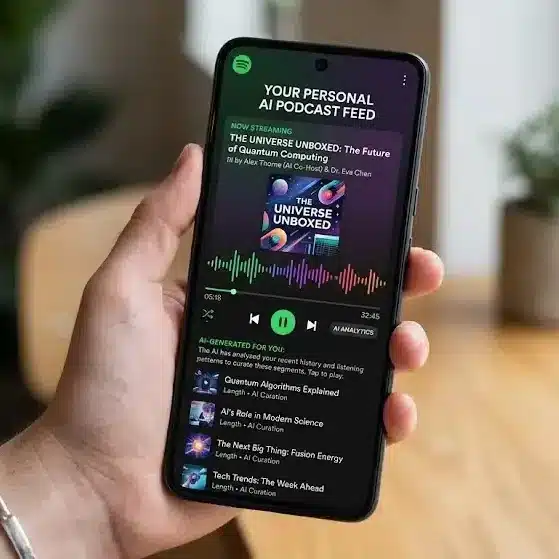
Spotify Introduces AI Personal Podcasts Feature | Save AI Audio on Spotify
Spotify has announced a new beta feature called “Save to Spotify”, enabling users to store and play AI-generated personal podcasts directly within the platform. The feature arrives at a time when generative AI tools are rapidly changing how people consume information, communicate, and create content.
The announcement reflects Spotify’s broader strategy to position itself not merely as a music streaming service, but as a complete audio ecosystem capable of adapting to emerging technologies and evolving listener behavior.
From AI-generated study notes transformed into spoken audio to personalized daily briefings created by coding agents and automation tools, Spotify appears ready to embrace a future where “podcasts” are no longer limited to professionally produced shows.
For years, podcasts followed a familiar format: professionally recorded conversations, interviews, storytelling, educational programs, or serialized content distributed through streaming platforms.
That definition is now rapidly evolving.
The rise of advanced AI tools such as OpenAI Codex, Anthropic Claude Code, and emerging automation platforms like OpenClaw has introduced a new category of content — highly personalized, AI-generated audio files designed specifically for individual users.
These tools can transform:
Personal notes
Calendar updates
Study materials
Coding summaries
Productivity briefings
Daily schedules
Research documents
News recaps
Journals and reflections
into spoken audio experiences that resemble traditional podcasts.
The shift has sparked a growing debate across the tech and media industries:
What exactly counts as a podcast in the AI era?
Spotify’s answer appears straightforward: if people are listening to audio content regularly, it belongs on Spotify.
Spotify’s Strategic Bet on Personalized Audio
Spotify says users increasingly want a single destination for all their audio experiences. Instead of switching between AI apps, productivity tools, voice assistants, and podcast platforms, listeners prefer centralized access.
The company explained that users are already relying on AI agents to create personalized audio experiences throughout their day.
According to Spotify, people are using AI-generated audio for:
Exam preparation summaries
Daily work briefings
Calendar overviews
Personal productivity recaps
Coding explanations
Learning modules
AI-curated updates
Personalized news reports
Spotify believes these listening habits naturally align with its long-term business vision.
The company stated that users want these AI-generated audio experiences available “where they already listen to everything else.”
That single sentence reveals a deeper strategic ambition: Spotify wants to become the default operating system for audio consumption in the AI age.
What Is the ‘Save to Spotify’ Feature?
The newly introduced Save to Spotify beta tool allows users to save personal AI-generated audio content into their Spotify libraries.
The uploaded content remains private and accessible only to the individual user.
The feature works across multiple devices, ensuring synchronization between smartphones, tablets, desktops, and smart speakers.
Key Features of Spotify’s AI Personal Podcast Tool
Private listening experience
Cross-device synchronization
Available to free and Premium users
Integration into personal libraries
AI-generated audio support
Personalized content storage
Seamless playback inside Spotify
Unlike public podcasts distributed to global audiences, these “personal podcasts” function more like private audio assistants tailored to the user’s daily needs.
Spotify has confirmed that the feature is still in beta testing, meaning additional capabilities and restrictions may evolve over time.
Why Spotify’s Move Matters
Spotify’s decision is more important than it may initially appear.
This isn’t merely about letting users upload audio files. It signals a fundamental transformation in how audio platforms view content creation and personalization.
Historically, streaming platforms depended heavily on creators, publishers, and media companies to supply content. AI changes that equation entirely.
Now, every user can become:
A creator
A listener
A curator
A personalized media ecosystem
AI-generated content blurs the line between consumer and creator, and Spotify appears eager to capitalize on that transition early.
Industry analysts believe this move could reshape:
Podcasting
Audio publishing
Personalized education
Productivity tools
Digital assistants
AI media consumption
The Rise of AI Audio Consumption
The emergence of AI-generated “personal podcasts” is tied directly to the explosive growth of AI agents and automation tools.
Over the past year, AI systems capable of generating highly natural voice outputs have become significantly more advanced.
Users can now generate realistic spoken audio from text in minutes.
This has created entirely new listening behaviors.
Instead of reading long documents or scanning notes, users increasingly prefer listening while:
Driving
Working out
Walking
Traveling
Cooking
Studying
Working remotely
The convenience of passive audio consumption aligns perfectly with Spotify’s business model.
OpenAI Codex and the AI Agent Boom
Spotify’s announcement also highlights the rapid growth of AI agent platforms.
OpenAI reportedly revealed that its Codex coding agent surpassed 3 million weekly active users in early April before quickly climbing beyond 4 million users within weeks.
That level of adoption made Codex one of OpenAI’s fastest-growing products.
Meanwhile:
Claude Code from Anthropic continues gaining traction among developers
OpenClaw and similar AI automation tools are expanding rapidly
AI-generated productivity systems are entering mainstream workflows
Although many companies still avoid disclosing detailed user metrics, analysts estimate that millions of users now interact with AI agents daily.
These systems are increasingly used for:
Coding
Automation
Summarization
Research
Learning
Scheduling
Content generation
Personalized media
Spotify’s move appears designed to integrate itself directly into that growing ecosystem.
Audio Is Becoming the Preferred AI Interface
One of the biggest technology trends emerging in 2026 is the rise of audio-first AI interaction.
Text-based AI remains dominant, but voice and audio consumption are rapidly becoming more attractive due to convenience and multitasking.
Consumers increasingly prefer:
Listening over reading
Conversational interfaces
Voice summaries
Audio explainers
Spoken productivity updates
This behavioral shift could dramatically expand Spotify’s role in users’ everyday lives.
Instead of opening Spotify solely for entertainment, users may soon rely on the platform for:
Morning briefings
AI-generated learning
Daily planning
Personalized productivity
Educational summaries
Smart audio workflows
That transition could redefine Spotify’s competitive position against tech giants developing AI ecosystems.
Spotify Wants to Own More Than Music
Spotify has spent years diversifying beyond music streaming.
The company previously invested heavily in:
Podcast acquisitions
Audiobooks
Creator tools
Voice technology
AI recommendation systems
Now, AI-generated personal podcasts may become another major category inside the app.
The strategy aligns with Spotify’s long-term effort to increase user engagement and listening hours.
The more audio experiences users consume inside Spotify, the stronger the company’s ecosystem becomes.
This also helps Spotify compete against:
YouTube
Apple Podcasts
Audible
AI voice assistants
Smart productivity apps
Personalized learning platforms
Could AI Podcasts Disrupt Traditional Podcasting?
The rise of AI-generated personal audio could significantly disrupt the traditional podcast industry.
For years, podcasting depended on mass audiences and public distribution.
AI personalization changes the economics entirely.
Future listeners may increasingly prefer:
Customized briefings
Personalized educational audio
AI-generated niche content
On-demand summaries
Hyper-specific learning modules
rather than general-interest podcasts designed for broad audiences.
This creates both opportunities and challenges for creators.
Potential Benefits
More personalized user experiences
Easier content accessibility
Faster information consumption
Improved learning efficiency
Greater productivity integration
Potential Risks
Reduced demand for traditional podcasts
Content overload
AI misinformation concerns
Lower visibility for independent creators
Ethical questions around AI-generated media
Privacy Questions May Follow Spotify’s AI Expansion
Although Spotify says personal podcasts remain private, privacy experts may still raise concerns over how AI-generated content is stored, processed, and integrated.
Questions likely to emerge include:
How is user-generated audio data stored?
Will Spotify analyze private uploads?
Could recommendation algorithms use personal AI content?
What safeguards exist for sensitive information?
How secure are AI-generated voice files?
As AI ecosystems grow more interconnected, privacy and data governance will likely become increasingly important.
Spotify has not yet disclosed extensive technical details regarding data handling policies tied to the beta feature.
The Future of Personalized Media Consumption
Spotify’s move reflects a larger industry transformation already underway.
Media consumption is becoming deeply personalized.
Instead of consuming identical content streams, users increasingly expect:
AI-curated experiences
Personalized recommendations
Custom learning formats
Adaptive content delivery
Voice-first interaction
The rise of generative AI accelerates this trend dramatically.
Industry observers believe the future of media may revolve around:
Hyper-Personalized Content
AI systems generating content uniquely tailored to each individual.
Real-Time Audio Generation
Instant spoken summaries generated dynamically from live information.
AI Productivity Integration
Audio becoming central to workflows, learning, and organization.
Context-Aware Listening
AI-generated content adapting based on location, schedule, mood, or behavior.
Spotify appears determined to establish itself at the center of that transformation.
Why This Could Be a Turning Point for Spotify
Spotify’s embrace of AI-generated personal podcasts may ultimately prove to be one of the company’s most strategic decisions in years.
Rather than resisting AI disruption, Spotify is integrating itself into emerging listening habits early.
That approach could help the company:
Increase platform engagement
Expand listening hours
Strengthen user retention
Build AI-driven ecosystems
Capture next-generation audio behavior
The company’s willingness to experiment also highlights a broader shift among technology firms embracing AI-native experiences instead of treating AI merely as a support tool.
AI and the New Audio Economy
The emergence of AI-generated audio may eventually create an entirely new digital economy.
Possible future developments include:
AI-generated educational subscriptions
Personalized news channels
Custom AI radio stations
Voice-first productivity ecosystems
Dynamic AI storytelling
Personalized coaching audio
AI-generated language learning
Spotify’s infrastructure already positions it well for many of these opportunities.
The platform has:
Massive global reach
Existing audio infrastructure
Recommendation algorithms
Creator ecosystems
Established user behavior
This gives Spotify a strong foundation for scaling AI-powered audio experiences rapidly.
Industry Reaction Remains Mixed
While many technology enthusiasts praise Spotify’s innovation, some media professionals remain cautious.
Critics argue that AI-generated content could dilute podcast quality and overwhelm users with algorithmically generated material.
Others worry about:
Authenticity
Human creativity
AI-generated misinformation
Oversaturation of content
Listener fatigue
However, supporters argue personalized AI audio represents the natural evolution of digital media.
The debate is likely to intensify as AI-generated content becomes more mainstream.
Spotify Signals Confidence in the AI Future
Despite ongoing debates around generative AI, Spotify’s decision sends a strong message to the broader technology industry.
The company clearly believes:
AI-generated audio consumption will continue growing
Personalized listening experiences are becoming mainstream
Audio remains central to future digital interaction
AI agents will shape everyday media habits
By integrating AI-generated personal podcasts early, Spotify may gain an advantage in defining how users interact with AI-powered audio ecosystems moving forward.
What Happens Next?
Spotify says the feature remains in beta and will continue evolving.
The company hinted that:
Usage limits may apply
Features could change over time
User feedback will shape development
Additional integrations may arrive later
Industry observers expect Spotify to eventually expand compatibility with more AI tools and automation systems.
Future updates could potentially include:
Direct AI integrations
Voice cloning support
Dynamic audio generation
Smart summaries
Personalized recommendation engines
AI workflow automation
If adoption accelerates, AI-generated personal podcasts may soon become a standard feature across streaming platforms.
The Bigger Picture
Spotify’s latest move demonstrates how quickly AI is transforming the media landscape.
What once sounded futuristic — AI-generated personalized podcasts tailored for individual listeners — is rapidly becoming reality.
As AI tools continue advancing, the line between creator, consumer, assistant, and platform will likely become increasingly blurred.
For Spotify, the goal appears clear:
Become the primary destination for every kind of audio experience in the AI era.
And if consumer behavior continues shifting toward personalized, voice-first interaction, the company’s gamble on AI-generated personal podcasts may eventually reshape the future of listening itself.
Key Takeaways
Spotify launched a beta feature allowing users to save AI-generated personal podcasts.
The feature supports private listening across devices.
AI tools like Codex and Claude Code are accelerating personalized audio creation.
Spotify sees AI-generated audio as part of its broader ecosystem strategy.
Personalized media consumption is rapidly becoming mainstream.
The move could reshape podcasting, productivity, and audio streaming industries.