Magellan AI Integrates Nielsen DMA Data to Transform Local Podcast Attribution
Magellan AI has officially integrated Nielsen’s Designated Market Area (DMA) data into its advertising attribution platform. The strategic licensing agreement allows Magellan AI clients to measure podcast advertising effectiveness using the same geographic standards long trusted across broadcast television and radio.
The announcement marks a pivotal development for brands investing in digital audio — especially those seeking precise metro-level performance insights rather than relying solely on national metrics.
Why This Move Matters for Podcast Advertising in 2026
Podcast advertising has evolved far beyond its early, experimental phase. What was once a predominantly national branding channel is now a sophisticated, performance-driven medium. However, one limitation persisted: localized attribution.
With the integration of Nielsen’s DMA framework, Magellan AI is closing that gap.
Key Highlights of the Announcement:
Magellan AI has licensed Nielsen’s DMA geographic data.
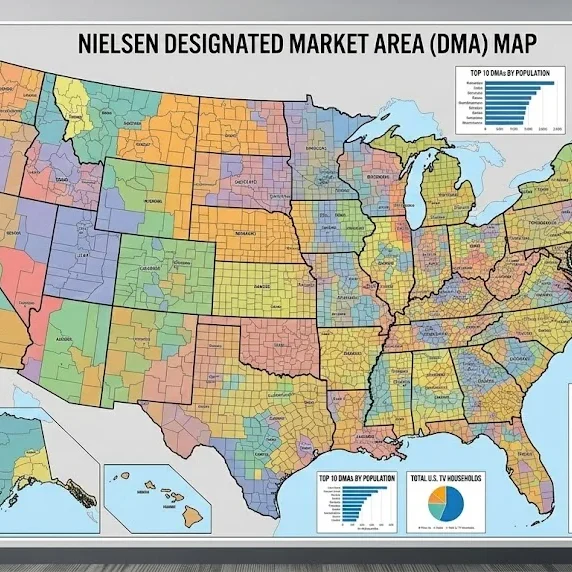
Advertisers can now measure podcast performance across 210 U.S. media markets.
Attribution aligns with the same market definitions used in radio and TV.
The feature is live within Magellan AI’s reporting dashboard.
Brands can compare digital audio results alongside traditional media campaigns.
This alignment offers advertisers standardized local measurement, a capability increasingly demanded in today’s fragmented media landscape.
What Are Nielsen DMAs — And Why Do They Matter?
Nielsen’s Designated Market Areas (DMAs) represent 210 standardized geographic media regions across the United States. These boundaries are the backbone of how television and radio advertising has been bought, sold, and measured for decades.
Why DMAs Are Critical in Advertising:
They create uniform geographic standards.
Media planners use them to allocate budgets by metro region.
They allow side-by-side comparisons between channels.
Major brands rely on them for regional campaign reporting.
Agencies structure local media buying strategies around them.
Until now, podcast measurement lacked direct DMA alignment, creating reporting inconsistencies when comparing digital audio performance with broadcast campaigns.
That discrepancy is now being addressed.
Magellan AI’s Strategic Expansion into Market-Level Measurement
Cameron Hendrix, CEO of Magellan AI, emphasized that the integration reflects the company’s broader ambition to deliver the most comprehensive attribution suite in the industry.
“Our goal is to provide the most accurate and comprehensive measurement toolkit in the industry,” Hendrix stated. “Integrating Nielsen’s DMA data into our attribution reporting gives our clients the flexibility to move beyond national metrics and prove the value of podcasting at the local level, where so many business decisions are made.”
This statement underscores a key industry reality: Many business decisions — especially retail, automotive, healthcare, and political campaigns — are made locally.
National metrics often fail to reflect the nuances of regional consumer behavior.
Now, podcast advertisers can see whether campaigns are driving measurable impact in specific metropolitan areas like:
New York
Los Angeles
Chicago
Dallas–Fort Worth
Atlanta
Miami
And hundreds more across the country.
A “Significant Upgrade” to Podcast Attribution
Magellan AI described the licensing agreement as a major upgrade to its measurement suite. From an operational standpoint, here’s what changes:
Before DMA Integration:
Podcast attribution primarily reported at national scale.
Limited comparability with TV and radio market data.
Brands relied on internal modeling for local insights.
Media mix optimization required assumptions.
After DMA Integration:
Reporting aligned with 210 standardized markets.
Cross-channel comparisons become seamless.
Local impact measurement becomes transparent.
Budget allocation decisions become data-driven.
Attribution reports align with global brand planning frameworks.
For large advertisers, this compatibility reduces friction between digital and traditional planning teams.
Nielsen’s Perspective: Standardization Across Platforms
From Nielsen’s standpoint, the partnership reinforces its commitment to measurement consistency in an evolving media ecosystem.
Rich Tunkel, Managing Director at Nielsen Audio, highlighted the growing demand for cross-platform comparability.
“Advertisers need a consistent way to evaluate the effectiveness of their media across every platform. By leveraging Nielsen’s DMA data, Magellan AI will bring a new level of comparability and transparency to podcast attribution and ensure consistent measurement against the same rigorous geographic standards as other major media.”
This speaks directly to a core industry challenge: Media fragmentation has complicated campaign evaluation.
Streaming, podcasts, CTV, broadcast radio, and linear TV often operate on separate measurement systems.
DMA alignment reduces that fragmentation.
The Bigger Trend: Localized Audio Advertising Gains Momentum
The podcast advertising market has matured rapidly. But local targeting has become one of the fastest-growing segments within digital audio.
Previously, verifying impact at the metro level required advanced modeling or patchwork reporting.
Now, DMA integration offers standardized clarity.
How This Affects Advertisers and Agencies
The practical implications extend beyond analytics dashboards.
For Advertisers:
Validate ROI by metro.
Adjust creative based on local response.
Shift spend toward high-performing markets.
Justify podcast budgets internally.
For Agencies:
Integrate podcast data into media mix models.
Present unified reporting decks.
Optimize local flighting strategies.
Improve forecasting accuracy.
For Publishers:
Demonstrate local advertiser value.
Expand regional ad sales.
Position podcasts as full-funnel media.
This integration strengthens podcasting’s role as a performance channel — not just a branding vehicle.
Competitive Landscape: Why Measurement Is the New Battleground
As podcast ad revenue continues to grow, competition among measurement providers intensifies.
Magellan AI’s DMA integration positions it strategically among analytics platforms seeking differentiation.
Key competitive advantages now include:
Geographic standardization
Cross-media comparability
Attribution transparency
Enterprise-grade reporting compatibility
Measurement has become the critical differentiator in digital advertising ecosystems.
Industry Reaction: A Step Toward Mature Podcast Economics
Industry insiders see this development as part of a broader shift: podcasting is entering a mature economic phase.
The early days of download counts and promo codes are evolving into advanced attribution modeling, geo-targeting precision, and unified reporting frameworks.
Experts suggest this move could trigger:
Increased local podcast ad spend.
Greater CMO confidence in digital audio.
Expanded cross-channel experimentation.
Higher demand for transparent measurement tools.
What This Means for the Future of Podcast Advertising
The DMA-enabled attribution is now live within Magellan AI’s standard reporting dashboard, meaning current customers can immediately begin leveraging the feature.
Looking ahead, this move signals several likely industry developments:
More standardized cross-platform metrics.
Enhanced local podcast ad buying tools.
Greater accountability in digital audio spending.
Integration of audio into holistic media mix modeling.
As traditional and digital media continue converging, unified geographic standards may become non-negotiable.
The Bottom Line
Magellan AI’s licensing of Nielsen DMA data represents more than a technical update. It reflects a fundamental shift in how podcast advertising is measured and valued.
By aligning digital audio performance with the same geographic standards used in television and radio, advertisers gain:
Transparency
Comparability
Local accountability
Strategic flexibility
For an industry striving for credibility within enterprise media planning, that alignment could prove transformative.