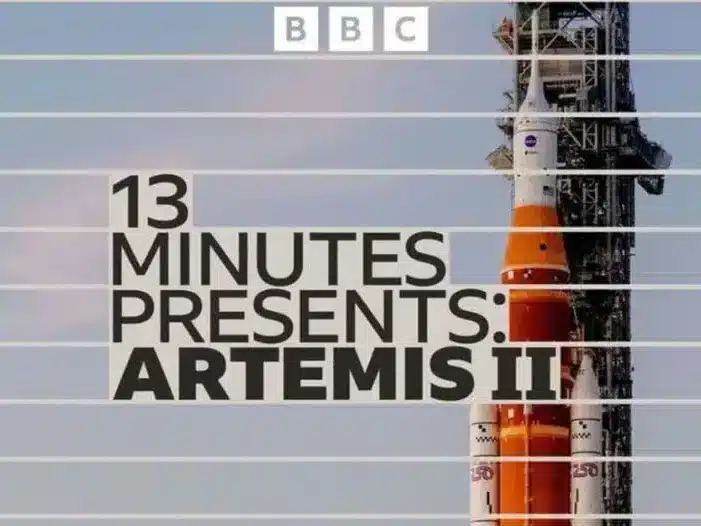
BBC Launches Daily Artemis II Podcast Coverage as NASA Returns Astronauts to the Moon
The BBC World Service is preparing to take global audiences closer than ever to the next major chapter in human space exploration, announcing that its popular space podcast 13 Minutes will return with a special daily series tracking NASA’s Artemis II mission in real time.
Titled “13 Minutes Presents: Artemis II”, the new season will deliver daily podcast episodes throughout the 10-day mission, offering listeners an immersive, up-to-the-minute account of the spacecraft’s journey as astronauts travel around the Moon for the first time in more than half a century.
The BBC confirmed that the podcast series will begin around two days before launch and continue every day until the mission concludes.
NASA’s Artemis II is being widely seen as one of the most significant space missions since the Apollo era. It will mark the first crewed mission to orbit the Moon since Apollo 17 in 1972, the last time humans set foot on the lunar surface.
While Artemis II is not designed to land on the Moon, it will still represent a critical step forward in NASA’s long-term lunar strategy.
What Artemis II Will Do
The Artemis II mission will:
Carry astronauts aboard NASA’s Orion spacecraft
Travel toward the Moon
Loop around the far side of the Moon
Return safely to Earth after roughly 10 days
This mission will serve as a full-scale rehearsal for Artemis III, which is expected to attempt a lunar landing in 2027.
BBC’s “13 Minutes Presents” to Deliver Daily Updates
The BBC World Service described the new season as a way to bring listeners directly into the mission, covering key moments including launch, deep-space travel, lunar flyby, and return.
The daily podcast format is expected to include:
Mission milestones explained in simple terms
Expert analysis of technical challenges
Human stories behind the astronauts and engineers
Real-time updates as the mission unfolds
BBC insiders suggest this format is designed to meet the growing appetite for space news, particularly among younger global audiences consuming science content through podcasts and social media.
Hosted by Top Space Communicators and Astronaut Experts
One of the biggest highlights of the new series is its high-profile hosting lineup, featuring some of the most recognizable voices in space communication.
Podcast Hosts Include:
Dame Dr Maggie Aderin-Pocock (space scientist and broadcaster)
Tim Peake (former ESA astronaut and ISS veteran)
Kristin Fisher (journalist and space correspondent)
They will also be joined by:
Rebecca Morelle, BBC News Science Editor
Pallab Ghosh, BBC Science Correspondent
Together, the team will provide expert insight while keeping the storytelling accessible for general audiences.
“A Defining Moment in Space Exploration,” Says Maggie Aderin-Pocock
Speaking about the upcoming series, Dame Dr Maggie Aderin-Pocock called Artemis II a pivotal moment in modern space history.
“The Artemis II mission is a defining moment in space exploration, and 13 Minutes Presents: Artemis II is about bringing people with us on that journey. To be able to tell that story as it unfolds, in real time, is incredibly exciting.”
Her remarks underline the BBC’s goal of making the mission feel personal, immediate, and relatable to listeners worldwide.
Tim Peake: “We’ll Discuss the Risks, Rewards, and Teamwork”
Former astronaut Tim Peake emphasized that Artemis II is not just about the spacecraft, but about the immense human effort behind the mission.
“Artemis II marks the first time in over fifty years that humans will travel around the Moon, and through this podcast we’ll be discussing the risks, the rewards and the remarkable teamwork behind the mission as it happens.”
With his direct experience in spaceflight, Peake is expected to provide a rare behind-the-scenes perspective on what astronauts experience physically and psychologically during such missions.
Artemis II Could Break the Apollo 13 Distance Record
If Artemis II performs as planned, the mission could send astronauts further away from Earth than any human has ever traveled.
That would potentially surpass the current record set during the Apollo 13 mission, which famously became an emergency rescue mission in 1970 but still holds the record for the farthest distance traveled by humans.
This detail adds a major historical weight to Artemis II, positioning it as not just a return to lunar exploration—but potentially a new milestone in human spaceflight.
Meet the Artemis II Astronaut Crew
NASA has confirmed that four astronauts are scheduled to participate in the mission, representing both the United States and Canada.
Artemis II Crew Members
Reid Wiseman
Victor Glover
Christina Koch
Jeremy Hansen
The inclusion of Canadian astronaut Jeremy Hansen reflects Artemis II’s international collaboration element, highlighting NASA’s partnerships as it prepares for long-term lunar exploration.
Launch Window Expected in Early March
According to the BBC announcement, Artemis II’s next potential launch opportunity is expected in early March, though NASA has not confirmed a final launch date publicly in the BBC report.
Given the complexity of human-rated space missions, launch schedules may shift depending on:
weather conditions
technical readiness
safety evaluations
spacecraft testing outcomes
The podcast’s planned “two days before launch” start suggests the BBC expects high public attention as launch day approaches.
BBC World Service to Air Episodes on “Outside Source” Programme
In addition to podcast platforms, the BBC confirmed the Artemis II coverage will also be integrated into its broadcast programming.
Where It Will Air
The series will also air on the BBC World Service as part of:
Outside Source (Weekdays) at 5:30pm GMT
The Newsroom (Weekends)
This dual distribution strategy allows the BBC to reach both traditional radio audiences and podcast-first listeners.
BBC Two and iPlayer to Feature Artemis: Horizon Special
Beyond the podcast, BBC audiences will also see Artemis II coverage on television.
Tim Peake and Dame Dr Maggie Aderin-Pocock are set to appear in a special programme titled:
Artemis: Horizon Special
The programme will be broadcast on:
BBC Two
BBC iPlayer
The BBC confirmed that the documentary-style special was filmed with access inside NASA, giving viewers a rare look into preparations behind the Artemis programme.
Why Artemis II Matters for the Future of Lunar Exploration
NASA’s Artemis programme is not simply about returning to the Moon—it is designed as a stepping stone for even more ambitious missions.
Artemis II is considered crucial because it will test:
Orion spacecraft systems under real mission stress
astronaut safety procedures in deep space
navigation around the Moon’s far side
communications performance and mission control response
This mission will help NASA validate its readiness for Artemis III, which aims to return astronauts to the lunar surface in 2027.
A Growing Global Fascination With Space Storytelling
The BBC’s decision to deliver daily episodes highlights how space exploration has regained mainstream momentum.
In recent years, interest in missions from NASA, SpaceX, ESA, and China’s space programme has exploded, driven by:
social media coverage
livestreamed launches
rising commercial spaceflight ambitions
renewed geopolitical interest in lunar exploration
With Artemis II positioned as a “once-in-a-generation” mission, the BBC is clearly aiming to become a key destination for audiences looking for clear, reliable coverage.
What Listeners Can Expect From “13 Minutes Presents: Artemis II”
The BBC has not released full episode details yet, but based on past seasons, listeners can likely expect:
Daily Podcast Features
Launch-day special reporting
Astronaut profiles and mission history
Technical breakdowns of Orion spacecraft systems
Expert interviews with NASA insiders
“What could go wrong” segments exploring risk management
Highlights of key mission moments in under 15 minutes
The storytelling approach is expected to blend science journalism with real-time news updates—perfectly designed for listeners who want fast, engaging, and trustworthy space coverage.
Final Thoughts: BBC’s Real-Time Coverage Brings Artemis II to the World
As Artemis II prepares to send astronauts around the Moon once again, the BBC World Service is positioning itself at the center of global space storytelling with a podcast series that aims to inform, inspire, and connect audiences to history as it happens.
With a strong team of science communicators, a daily format, and integration across radio, podcast, and television platforms, 13 Minutes Presents: Artemis II could become one of the BBC’s biggest science media events of the year.
For space fans, casual listeners, and anyone fascinated by humanity’s next giant leap, the countdown has officially begun.