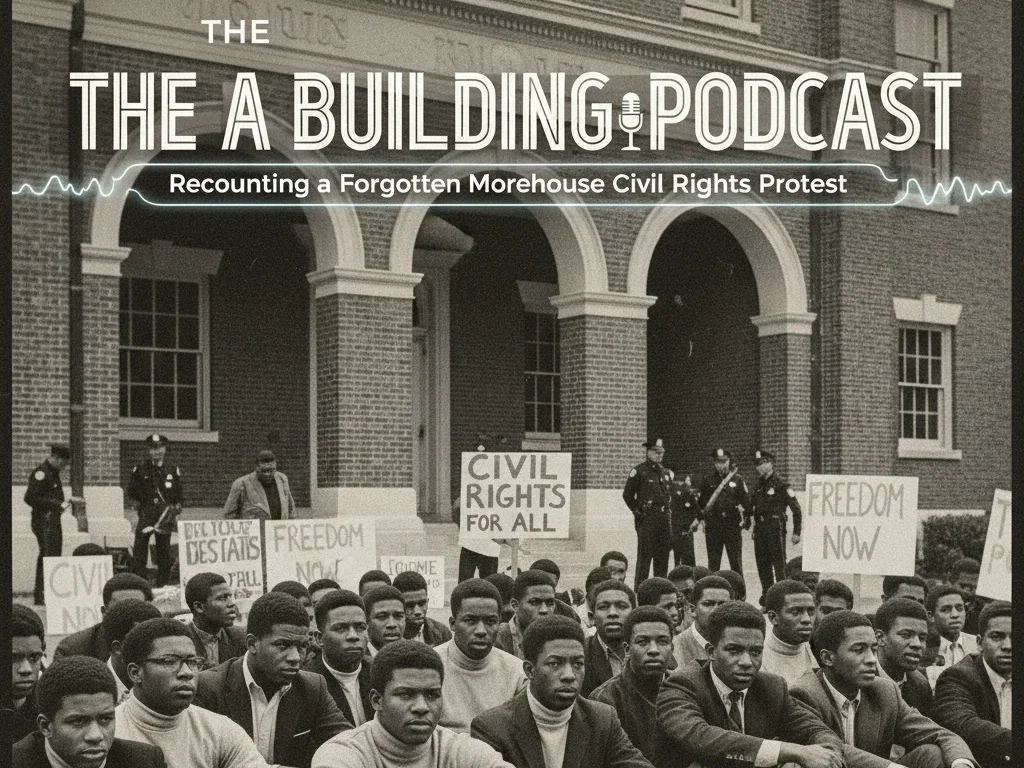
The A Building Podcast Recounts Forgotten Morehouse Civil Rights Protest
Titled “The A Building,” the documentary podcast revisits the extraordinary 1969 student uprising at the historically Black college in Atlanta, where a group of students barricaded themselves inside the administration building and held several members of the Board of Trustees hostage for nearly two days.
Among those students was a young Samuel L. Jackson, long before his rise as one of Hollywood’s most recognizable actors. Among the hostages was Martin Luther King Sr., father of the slain civil rights leader and then president of Morehouse’s Board of Trustees.
Produced by Imagine Entertainment — the company founded by Brian Grazer and Ron Howard — in collaboration with iHeartPodcasts, the series reframes the protest as both a political reckoning and a deeply human story of risk, consequence, and transformation.
At a time when student protests, curriculum debates, and institutional accountability are once again at the center of national discourse, “The A Building” arrives with renewed urgency.
Rather than offering a conventional historical recap, the podcast uses immersive audio storytelling to explore:
The emotional tension of student-led resistance
The generational divide within Black leadership
The moral complexity of protest tactics
The long-term impact of radical student action
Executive Producer Nathan Kloke describes the series as unfolding “like a heist film,” but with far deeper stakes.
“What makes this story so powerful is not just the drama,” Kloke explains, “but how clearly it shows the purpose and power of protest — and the cost of demanding change.”
The A Building: What Happened at Morehouse College in 1969
A Campus on Edge
The late 1960s were a volatile period in American history. Across the country, college campuses had become centers of political activism, fueled by the Vietnam War, racial injustice, and generational unrest.
At Morehouse College, the assassination of Dr. Martin Luther King Jr. in 1968 intensified tensions between students and administrators. Many students felt the institution — despite its civil rights legacy — was failing to reflect Black history, culture, and lived experience in its curriculum and policies.
The Spark That Ignited a Standoff
In April 1969, frustration boiled over.
A group of students organized a coordinated protest, occupying the administration building — commonly referred to on HBCU campuses as “The A Building.” What began as a protest escalated into a dramatic standoff when students refused to leave and took members of the Board of Trustees hostage.
The occupation lasted approximately 48 hours.
The students’ demands included:
Expanded Black Studies programs
Greater student representation in governance
Improved living conditions on campus
Institutional acknowledgment of Black identity and history
Samuel L. Jackson Before Stardom: A Life-Altering Moment
One of the most striking revelations in “The A Building” is the role played by Samuel L. Jackson, then a Morehouse student deeply involved in campus activism.
The podcast traces how Jackson’s participation in the protest led to severe consequences, including expulsion from Morehouse College. The event derailed his academic path — but ultimately redirected his life.
Years later, after being readmitted, Jackson shifted his academic focus, discovered acting, and embarked on a career that would eventually make him a global cultural icon.
The series presents this turning point not as destiny, but as the unintended outcome of a risky act of resistance.
Holding History Accountable: Martin Luther King Sr. as a Hostage
Perhaps the most emotionally complex aspect of the story is the presence of Martin Luther King Sr. among the hostages.
As president of the Board of Trustees, King Sr. represented institutional authority. As the father of Dr. King, he symbolized moral leadership and legacy.
“The A Building” does not simplify this contradiction. Instead, it explores the painful reality of generational divides within Black leadership — and how even shared goals can produce conflict when methods differ.
A Podcast Years in the Making
The series was co-created and produced by Menelek Lumumba and Hans Charles, both of whom spent years researching archival material, conducting interviews, and reconstructing events that had largely faded from public memory.
“This project has been years in the making,” Lumumba says. “And yet it feels more relevant now than ever.”
According to the creators, the goal was not to glorify the protest or condemn it — but to present its full complexity.
Charles adds:
“When you first hear this story, it almost sounds unbelievable. That it happened at Morehouse, in Atlanta, during that moment in history — it’s quintessential American history.”
Consequences, Fallout, and Institutional Change
Immediate Aftermath
The immediate consequences for the students were severe:
Expulsions and academic penalties
Heightened political scrutiny
Public controversy within Atlanta’s Black community
Yet the podcast makes clear that the protest also triggered lasting institutional changes.
Long-Term Impact on HBCUs
Over time, the uprising contributed to:
Expanded Black Studies programs
Increased student voice in governance
A broader national conversation about curriculum equity
The reverberations extended beyond Morehouse, influencing student activism at HBCUs and predominantly white institutions alike.
“The A Building” joins a growing list of high-profile documentary podcasts produced by Imagine Entertainment in partnership with iHeartPodcasts.
Recent releases include:
Hello Isaac
Big Sugar
The Tao of Muhammad Ali
Obscurum
The Secret World of Roald Dahl
According to Will Pearson, President of iHeartPodcasts, the aim is to connect historical narratives to present-day realities.
“This is premium documentary storytelling,” Pearson says. “It revisits a moment that feels both historic and urgently relevant.”
Why Audio Is the Perfect Medium for This Story
The podcast format allows “The A Building” to unfold with:
Archival audio
First-person recollections
Dramatic pacing
Emotional nuance
Rather than compressing events into headlines, the series gives space to contradiction, silence, and reflection — elements often lost in traditional historical accounts.
A Story of Protest, Power, and Legacy
At its core, “The A Building” is not just about a building, a protest, or even a famous actor’s past.
It is about:
The power of youth-led resistance
The risks of challenging authority
The long shadows cast by acts of courage
As debates over education, activism, and institutional responsibility continue to shape American life, this once-overlooked moment from 1969 feels newly alive.
Where to Listen to ‘The A Building’
“The A Building” is available on major podcast platforms through iHeartPodcasts, with new episodes rolling out as part of Imagine Entertainment’s documentary slate.