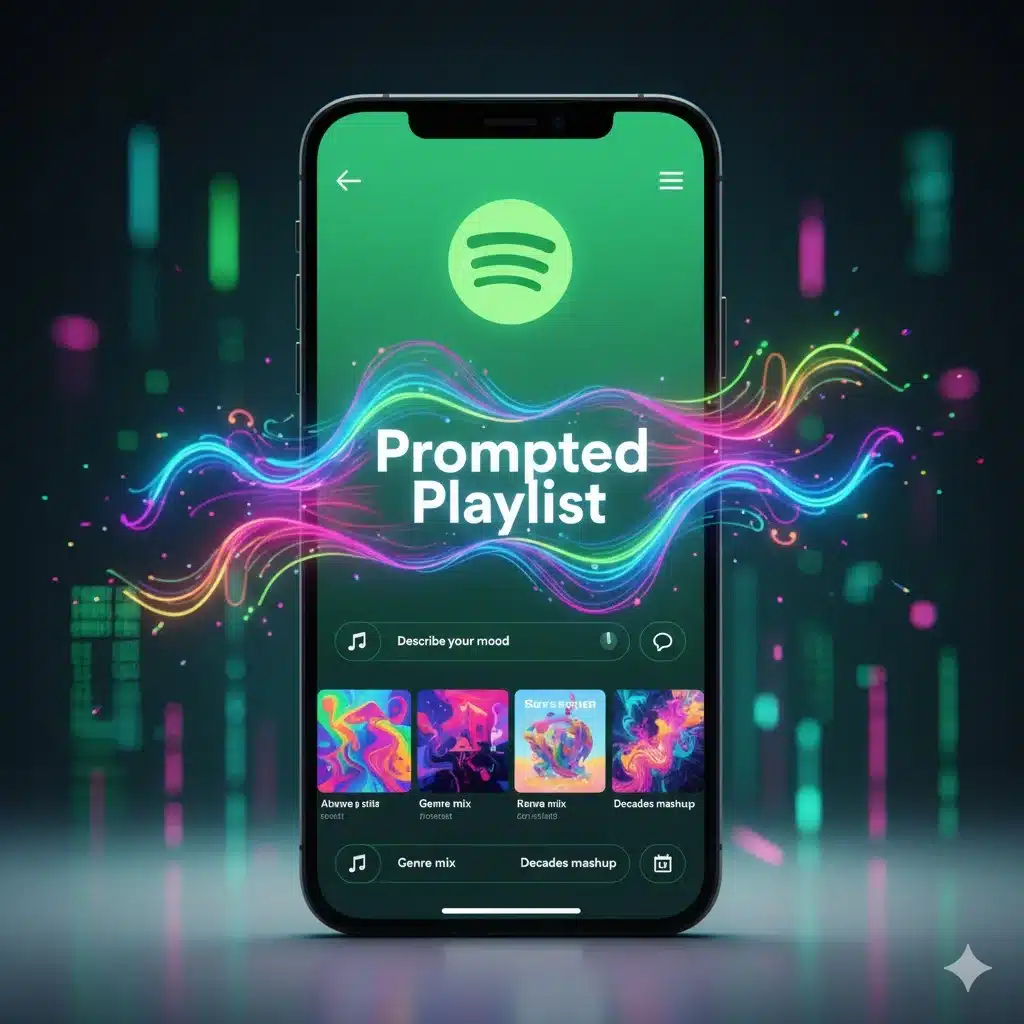
Spotify Tests User-Controlled Algorithm Feature: Inside Prompted Playlists and the Future of Music Discovery
For years, Spotify’s algorithm has quietly shaped global music consumption. It is the invisible force behind the playlists we love, the artists who go viral, and the tracks that appear just when listeners need them most. But now, Spotify is testing something that could fundamentally alter this dynamic — a shift that puts power into users’ hands rather than leaving all decisions to machine learning.
In New Zealand, Spotify has launched Prompted Playlists, a beta feature that allows listeners to directly influence how Spotify’s algorithm curates music. If the experiment succeeds, it may represent the first time one of the world’s largest streaming platforms allows users to co-create how personalization works. This isn’t simply another app update. It’s a peek into the future of algorithmic control, where personalization is no longer passive — it becomes a collaboration between human intention and machine intelligence.
And it could have massive ripple effects across the music industry, creator economy, and tech ecosystem. This in-depth feature explores what Spotify is changing, why it matters, the economic and cultural implications, and how this test could reshape digital media personalization for years to come.
More than 600 million Spotify users rely on the platform’s algorithm to navigate an overwhelming ocean of audio content. The algorithm’s influence is powerful:
It determines which artists get surfaced to new listeners
It fuels fandom growth
It drives streaming numbers that influence charts, royalties, and careers
It creates personalized playlists like Discover Weekly, Release Radar, and Daily Mixes
It subtly shapes trends, genres, and listening behavior
Spotify’s personalization engine is, arguably, the most consequential cultural algorithm operating today.
Yet despite its importance, it has always been a black box. Users receive recommendations, but they can’t explicitly tell the system what they want — only react to what’s offered.
That changes now.
From Passive Consumption to Active Co-Creation
Spotify’s beta experiment signals a philosophical shift.
Instead of simply tracking listening habits and adjusting in the background, the new feature invites users to:
Set specific rules for playlists
Describe exactly what they want
Use natural language instead of complicated filters
Influence how the algorithm interprets personal taste
It’s a move from algorithm decides to algorithm collaborates.
And it raises an important question: Is this the future of all personalization engines?
What Exactly Is Spotify’s “Prompted Playlist” Feature?
A New Kind of Playlist Powered by Natural Language
Prompted Playlists allow users to type instructions in everyday language — not search queries, but commands.
For example, a listener might type:
“Create a playlist with songs released in the last five years that I haven’t heard.”
“Add tracks from this year’s biggest films.”
“Give me indie pop with upbeat energy for a morning commute.”
“Mix my favorite artists with rising underground musicians.”
“Keep it fresh — no repeats from last month.”
Spotify takes those instructions and cross-references them with a user’s entire listening history — even from day one of their membership.
Then the system creates a playlist that is:
Personalized
Dynamic
Continuously updated
Connected to global trends and “world knowledge,” according to Spotify
It’s the closest thing to having a personal DJ who understands your taste evolution across years.
Why New Zealand?
Spotify often uses New Zealand as a test market for early-stage experimental features. The region offers:
High smartphone penetration
English-speaking audience
Manageable user base
Cultural overlap with global music trends
Faster, cleaner beta feedback loops
In short, it’s an ideal laboratory for controlled algorithm experimentation.
What Spotify’s Leadership Says
Gustav Söderström — Co-President, CPO, and CTO of Spotify — described it as a turning point:
“Prompted Playlists let you describe exactly what you want to hear and set the rules for your personalized playlist. Unlike anything before it, this feature taps into your entire Spotify listening history.”
He emphasizes that the system now listens to the user’s logic, creativity, and intent — not just their past behavior.
This is a monumental shift for personalization technology.
Section 3: Why Spotify Is Making This Move Now
User Empowerment Is Becoming a Competitive Edge
Across digital ecosystems, users want:
More transparency
More control
More ability to correct or guide algorithms
Less mystery behind personalization
Platforms like TikTok, Instagram, and YouTube have faced backlash for opaque recommendation systems. Spotify appears to be pre-empting similar concerns by giving users a say.
AI Expectations Are Changing
Generative AI has shifted user expectations:
People now expect to “talk” to software
Natural language interfaces feel intuitive
AI systems are expected to adapt to human creativity
Spotify’s Prompted Playlists align with these expectations, transforming listening from passive consumption into interactive creation.
Discovery Is Becoming a Revenue Engine
The more effectively Spotify can introduce listeners to new artists, the more:
Streams increase
Catalog depth matters
Long-tail music gains value
Market share improves
Creators stay loyal to the platform
If Spotify makes discovery more meaningful and personalized, it strengthens its position against competitors like YouTube Music, Apple Music, and TikTok Music.
Personalization Must Evolve to Stay Relevant
Listeners today don’t just want recommendations — they want recommendations that feel intentional.
A playlist created from a user’s prompt feels purposeful and personal. That emotional connection can deepen loyalty and usage time.
The Technology Behind Prompted Playlists
Spotify hasn’t published full technical details, but the company has hinted at what powers the experience:
1. AI-powered natural language processing
The system understands conversational instructions and translates them into algorithmic rules.
2. Deep integration with listening history
Spotify claims the feature uses a listener’s entire history — potentially tens of thousands of data points.
3. Cultural knowledge graph
The system appears to identify trends, film soundtracks, genre classifications, energy profiles, and contextual metadata.
4. Dynamic playlist regeneration
Playlists aren’t static; they evolve as user behavior or world events change.
5. Hybrid AI + human editorial input
Spotify editors supply starting prompts for inspiration.
Taken together, this is a blend of AI, machine learning, personalization engines, and human curation — a massive technical undertaking.
How This Changes Music Discovery
A New Relationship Between Listener and Algorithm
For the first time, listeners can communicate their taste — not just reveal it indirectly.
This has several implications:
1. Users can break out of algorithmic bubbles
Previously, listeners often felt trapped in loops of similar music. Now, they can explicitly ask for:
Unheard songs
Different genres
New regions
Fresh discoveries
More obscure tracks
2. Personalized playlists become more personal
The system now understands not just habits but intent.
3. Listener creativity becomes part of the curation
People can conceptualize playlists as creative expressions, not just algorithmic outputs.
4. AI becomes a collaborative tool
Spotify is pioneering a new AI-human workflow where personalization becomes co-authored.
How This Impacts Artists and the Music Industry
Gustav Söderström said the goal is to create “more inspired discovery.” If that’s true, artists may experience tangible benefits.
1. More opportunities for new artists to be surfaced
If listeners can ask for “artists I haven’t heard before,” it opens the door for emerging musicians.
2. Stronger fan engagement
Spotify reports:
34% more likelihood of repeat streams when a track is discovered via video
24% more likelihood of saving or sharing
85% more long-term engagement from super listeners
Better discovery = stronger fandom = more streams.
3. Genre fluidity and cross-category exposure
Prompted playlists could introduce fans of one genre to adjacent worlds. This may help break the “genre siloing” effect seen in traditional algorithms.
4. More democratic playlisting
User-defined playlists reduce reliance on Spotify’s editorial teams, giving artists more pathways to visibility.
5. New data for artists
The prompts users choose could give Spotify — and eventually artists — new insights into why and how fans discover music.
The Beta Video Launch in the U.S. & Canada
While New Zealand gets algorithm control, Spotify has launched another test in the U.S. and Canada: official music videos.
Why music videos matter:
They deepen engagement
They increase repeat listens
They create a stronger emotional bond between listener and artist
They compete directly with YouTube
Spotify says early results show measurable performance boosts when music videos are available.
This hints at a future where Spotify becomes not just a listening platform — but a full audio-visual discovery hub.
Competitive Landscape — Why Spotify Is Moving Aggressively Now
Spotify’s rivals are evolving:
YouTube Music has the advantage of integrated music videos
Apple Music emphasizes high-quality audio and live radio
TikTok Music has algorithmic virality
Amazon Music is growing rapidly with Prime integration
Spotify must continue innovating to maintain:
Leadership in personalization
Dominance in music discovery
Influence over global music culture
Prompted Playlists and expanded video experiences are strategic moves designed to reinforce Spotify’s identity as the world’s most personalized audio platform.
Consumer Expectations and the Future of Personalization
Modern users expect platforms to:
Understand context
Interpret emotion
Recognize intent
Allow customization
Provide transparency
Offer control
Spotify’s test brings personalization closer to these expectations.
In the future, users might instruct Spotify:
“I need relaxing music for stress.”
“I’m going through a breakup; play something healing.”
“Give me songs like X but not Y.”
“Add new releases every Friday.”
“Play 70% familiar, 30% new.”
This evolution could fundamentally change the relationship between humans and recommendation systems.
Challenges, Risks, and Concerns
No groundbreaking feature comes without potential downsides.
1. Data privacy concerns
Deep personalization requires deeper data analysis. Users may question how their listening history is processed.
2. Algorithm over-dependence
Even with control, users may rely too heavily on AI-curated playlists over organic exploration.
3. Undocumented biases
Natural language systems can misinterpret certain prompts or tastes.
4. Creator visibility
Some artists may still struggle if user behavior leans heavily toward established genres.
5. Global rollout complexities
Expanding beyond English prompts requires robust multilingual NLP capabilities.
Spotify appears aware of these challenges — hence the limited beta.
What Comes Next — Predictions for Spotify’s Roadmap
If this beta succeeds, here’s what Spotify may do next:
“Shows about mental health, but only with female hosts.”
3. Add contextual awareness
Location, weather, mood, time of day.
4. Integrate voice prompts
Hands-free playlist creation.
5. Bring generative AI into playlist design
AI may write playlist descriptions, cover art, even create mood-based transitions.
6. Blend music + video + social
Spotify could eventually compete with TikTok-style discovery.
Conclusion: Spotify’s Algorithm Revolution Has Begun
Spotify’s Prompted Playlist beta is more than a feature test. It’s a foundational shift in how personalization works across all digital platforms. For the first time, listeners have a say in how the algorithm thinks. It is a move toward transparency, creativity, and co-authorship in a world dominated by machine learning.
If Spotify expands this globally — and adds voice, video, social layers — it could redefine the future of music discovery, reshape the creator economy, and influence how people interact with AI-powered platforms everywhere.
The question now is not whether the algorithm will change. It has. The question is how deeply users will choose to shape it.