Programmatic Radio Advertising Gains Transparency and Brand Safety, ANA Report Shows
As programmatic buying reshapes the future of digital media, audio advertising—particularly radio and streaming audio—has entered a new era of automation, accountability, and brand trust. With platforms such as Amazon Ads, AudioGo, Triton Digital, StreamGuys, and StackAdapt simplifying audio ad buying in much the same way display and video were transformed years ago, the latest findings from the Association of National Advertisers (ANA) offer timely and encouraging insights.
According to ANA’s newest quarterly Programmatic Media Transparency Benchmark Report, advertisers are reclaiming more of their media dollars, reducing waste, and achieving unprecedented levels of brand safety—signaling a structural shift in how programmatic advertising operates across channels, including audio.
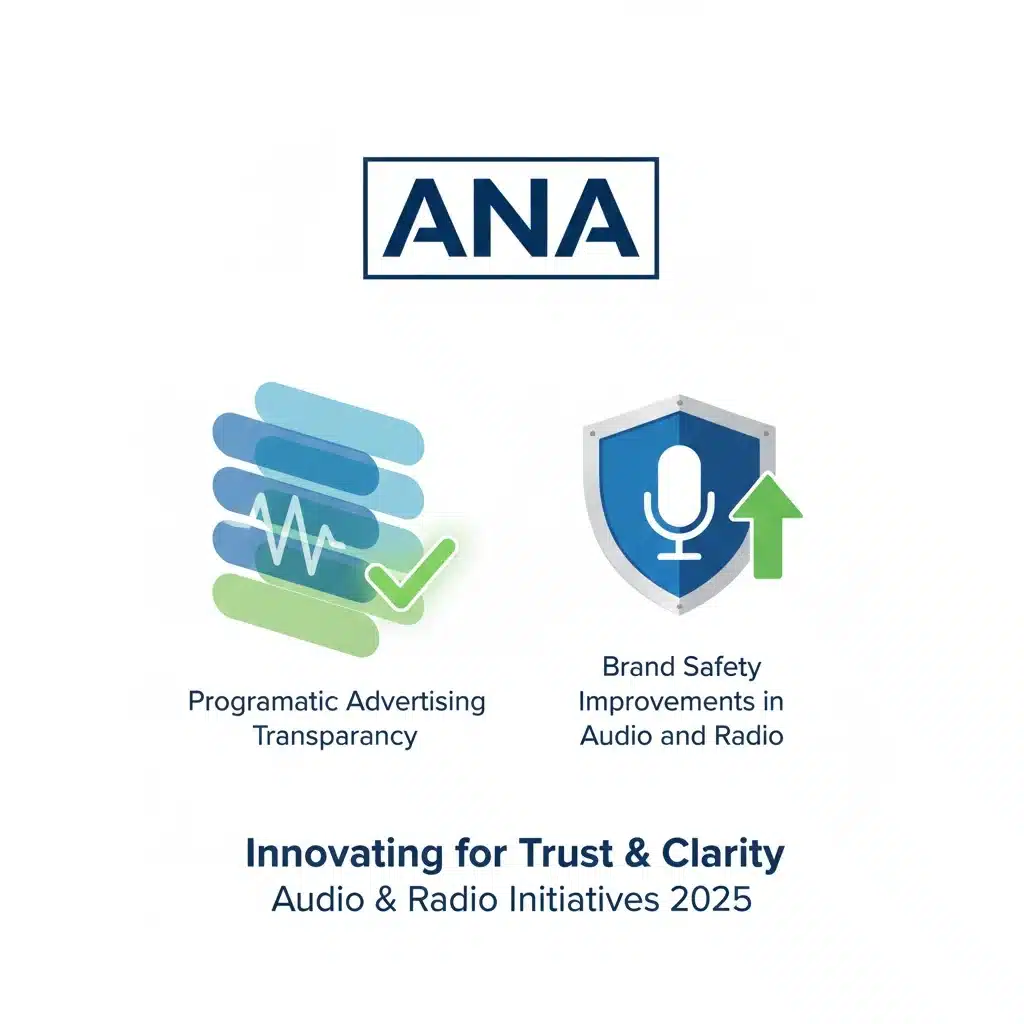
Once considered complex and opaque, programmatic buying is rapidly maturing—particularly in audio. As radio inventory becomes easier to transact programmatically, advertisers are gaining:
Faster media buying and optimization
Greater audience precision
Improved supply chain visibility
Reduced dependence on manual insertion orders
The ANA’s report confirms what many marketers have suspected: programmatic audio is no longer experimental—it’s operationally efficient and increasingly accountable.
TrueAdSpend Index Shows Marketers Are Reclaiming Lost Value
One of the most closely watched metrics in the ANA report is the TrueAdSpend Index, which measures how much of an advertiser’s spend actually reaches publishers as working media.
When Connected TV (CTV) is excluded, the index climbed to 47.1% in Q3 2025, up from 46.6% in Q2. This means nearly half of every programmatic dollar now goes directly to media owners, rather than being consumed by intermediaries, fees, or inefficiencies.
Key Financial Highlights from the Report
Seller revenue: Increased to 73.2% of total spend
Supply-side platform (SSP) costs: Dropped by 1.6 percentage points to 13.2%
Invalid traffic: Held steady at 0.4%
Made-for-advertising (MFA) exposure: Declined to 0.7% of spend
These metrics point to a healthier, more efficient programmatic ecosystem—especially relevant for audio, where trust and contextual alignment are essential.
$13.6 Billion Redirected Back to Working Media
Perhaps the most striking takeaway is the scale of financial recovery.
The ANA estimates that compared to 2023, advertisers have successfully redirected approximately $13.6 billion that would previously have been lost to:
Excessive platform fees
Fraudulent traffic
Low-quality or non-viewable inventory
Opaque supply chain layers
Today, those dollars are increasingly funding measurable, high-quality media placements that reach real audiences—benefiting both brands and publishers.
“Marketers leveraging log-level data, curated supply, and quality-led optimization are reclaiming wasted spend and unlocking billions in incremental ROI,” the ANA report notes.
Why This Matters for Programmatic Radio and Audio
As audio inventory becomes easier to access programmatically, advertisers are applying the same discipline they’ve developed in display and video:
Curated marketplaces
Publisher-direct relationships
Brand-safe inventory standards
Data-driven optimization
For radio broadcasters and streaming audio platforms, this evolution represents an opportunity to capture larger brand budgets—provided transparency and quality standards remain high.
Private Marketplaces Continue to Dominate Programmatic Spend
Despite the growth of open exchanges, private marketplaces (PMPs) remain the preferred route for advertisers seeking quality and control.
According to the ANA:
81.6% of all programmatic spend now flows through PMPs
Advertisers are consolidating budgets with trusted publishers and vetted SSPs
Quality, not sheer scale, is driving media investment decisions
This trend strongly favors premium audio publishers and established radio networks that can demonstrate brand-safe environments and consistent performance.
A New Era of Brand Safety Measurement
For the first time, the ANA report introduces formal brand safety and suitability benchmarks across programmatic channels—a long-standing concern for advertisers, especially in news, audio, and open-web environments.
The results were overwhelmingly positive.
Brand Safety Benchmarks at a Glance
99.1% of ad spend occurred in low-risk environments
Median brand risk: Just 0.13%
Low-risk classified spend:99.05%
Negative-content adjacency: Only 1.56% of spend
These figures represent a major milestone for programmatic media, long criticized for safety and suitability concerns.
The report also highlights advancements in AI-driven sentiment analysis, which now allows platforms to distinguish between:
Harmful or inflammatory content
Legitimate journalism
Neutral or positive editorial environments
Nearly half of all programmatic ad spend appeared next to positive or neutral content, demonstrating that advertisers can now achieve scale without over-blocking trusted news or editorial programming—a particularly important development for radio and spoken-word audio formats.
ANA: From Transparency to Full Accountability
ANA CEO Bob Liodice described the findings as a turning point for the industry.
“Marketers can now verify that their ads appear in trusted, responsible environments. These results show concrete signs that programmatic is evolving from an opaque system into one defined by accountability and control.”
The ANA characterizes the current moment as a “defining inflection point” for the $123 billion digital advertising market, where transparency is no longer the goal—but the baseline.
What This Means for Advertisers in 2026
As programmatic audio and radio buying accelerates, advertisers should take note of several strategic implications:
Actionable Takeaways
Invest in curated programmatic supply paths
Prioritize log-level data access
Focus on quality-led optimization, not just CPM efficiency
Leverage AI-based brand safety and sentiment tools
Partner with trusted SSPs and premium publishers
Those who adapt quickly stand to gain higher ROI, stronger brand protection, and better long-term media performance.
The Bigger Picture: Programmatic Advertising Grows Up
What was once a fragmented and fee-heavy ecosystem is rapidly becoming leaner, cleaner, and more accountable. As radio and audio inventory joins this evolution, the implications stretch far beyond one channel.
For marketers, publishers, and technology platforms alike, the message is clear: Programmatic advertising is no longer about automation alone—it’s about precision, integrity, and sustainable value creation.