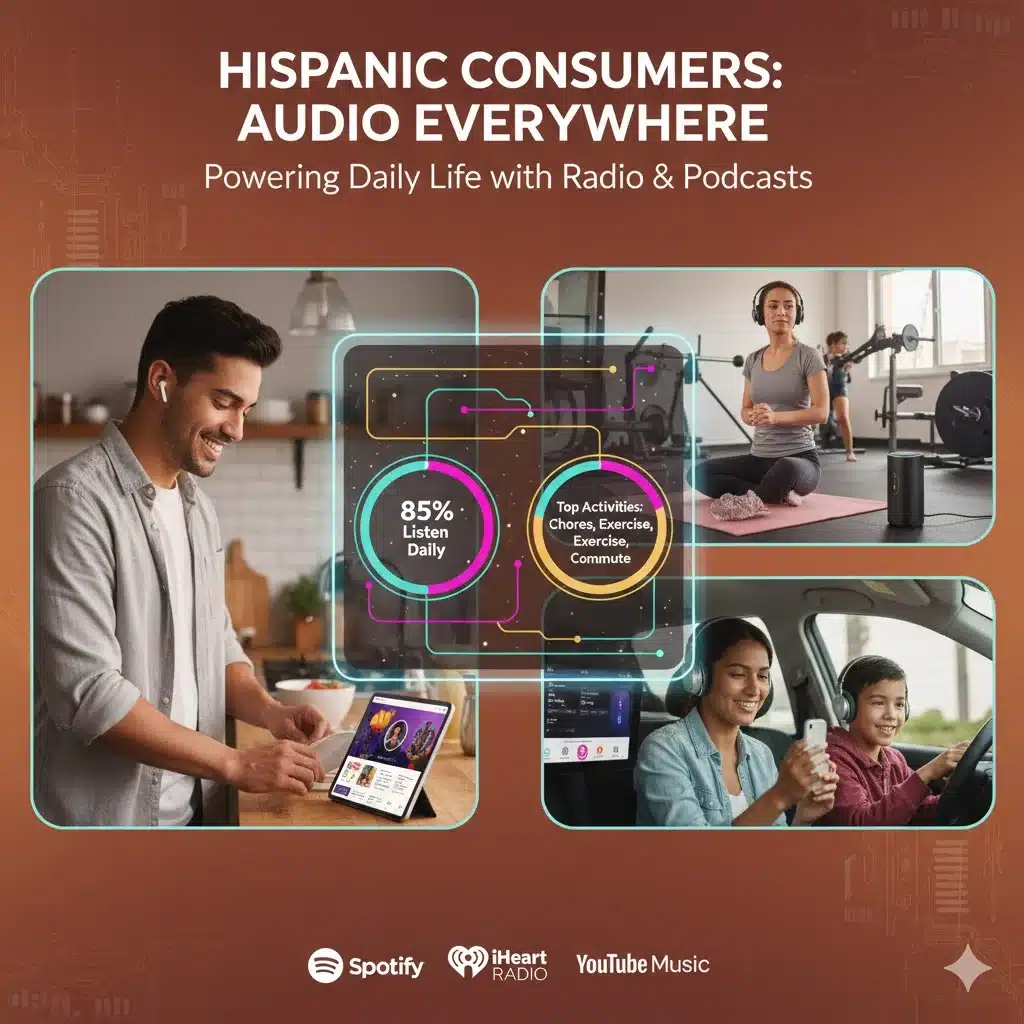
Podcasts and Radio Drive Powerful Reach Among Hispanic Audiences: Nielsen Report
Audio continues to stand out as one of the most effective channels for reaching U.S. Hispanic consumers. According to Nielsen’s latest Audio Today report, broadcast radio and podcasts are no longer competing formats—but complementary forces that together deliver reach, relevance, and results.
The report underscores a critical shift in audio planning: podcasts now sit alongside traditional radio as a core component of the Hispanic daily media mix. Rather than replacing radio, podcasting enhances and extends audio’s impact across daily routines—particularly during moments tied closely to decision-making and purchasing behavior.
For advertisers seeking efficiency and cultural resonance, Nielsen’s message is clear: audio works best when radio and podcasts are planned together.
Why Audio Matters More Than Ever in a Fragmented Media World
The modern media environment is defined by choice overload. Consumers split their attention across streaming platforms, social feeds, connected TV, and mobile apps—making consistent reach increasingly difficult.
Yet amid this fragmentation, audio has retained a uniquely strong foothold, especially among Hispanic audiences.
Key reasons audio remains resilient:
It fits naturally into daily life
It does not require visual attention
It accompanies work, commuting, errands, and family time
It builds trust through familiar voices and personalities
Nielsen’s findings highlight that Hispanic listeners engage with audio continuously throughout the day, often switching seamlessly between radio and podcasts depending on context.
Radio Still Leads Reach—But Podcasts Extend the Impact
Broadcast radio remains the undisputed leader in reach among Hispanic audiences, particularly within younger demographics.
Radio’s unmatched scale:
Over 93% reach among Hispanic adults aged 18–49
Dominant presence during in-car and away-from-home listening
Strong local relevance and cultural connection
However, podcasts provide meaningful incremental reach that radio alone cannot fully deliver.
Nielsen reports that more than 40% of podcast listeners overlap with radio audiences, making podcasting an ideal layer for advertisers looking to expand frequency and engagement without duplicating spend.
When podcasts are added to radio campaigns, advertisers gain additional reach and move closer to full-market coverage.
By combining the two formats, campaigns can achieve near-universal exposure among Hispanic consumers, a rare advantage in today’s media economy.
Ad-Supported Audio Dominates Hispanic Listening Time
One of the most compelling insights from the Audio Today report is the continued dominance of ad-supported audio.
Citing Edison Research’s Share of Ear data for Q3 2025, Nielsen notes:
64% of all audio listening is ad-supported
Among Hispanic adults:
Radio + podcasts account for 76% of daily ad-supported listening
Ad-supported streaming music services capture just 21%
What this means for advertisers:
Hispanic audiences are highly accessible through advertising-supported channels
Audio advertising remains a cost-efficient way to reach scale
Marketers can avoid the premium costs associated with subscription-only environments
In short, audio delivers both attention and acceptance, a rare combination in modern advertising.
Podcasts Drive Strong Consumer Action Among Hispanic Audiences
While radio excels at reach, podcasts shine when it comes to engagement and response.
Nielsen’s data reveals that Hispanic consumers demonstrate exceptionally high responsiveness to podcast advertising, outperforming many other media formats.
Podcast ad impact highlights:
41% more likely to make a purchase after hearing a podcast ad
95% more likely to visit a retail location
116% more likely to follow or engage with a brand on social media
These behaviors point to podcasting’s unique strength: deep listener trust.
Unlike many digital ads that are skipped, blocked, or ignored, podcast ads are often host-read, conversational, and integrated into content, making them feel more like recommendations than interruptions.
Trust, Culture, and Community: Audio’s Emotional Advantage
Nielsen’s report goes beyond metrics to address something harder to quantify—but equally powerful: emotional connection.
For many Hispanic listeners, audio personalities—whether radio hosts or podcast creators—serve as trusted voices within the community.
Why trust matters:
Trust increases ad recall
Trust improves brand perception
Trust shortens the path to purchase
The report describes audio as a “trusted extension of community”, noting that Hispanic audiences often form long-term relationships with familiar hosts who reflect their language, values, and cultural identity.
This emotional bond gives audio advertising a credibility advantage that is difficult to replicate in visual or algorithm-driven media.
In-Car Listening: Where Audio Influences Decisions
Context plays a major role in advertising effectiveness, and Nielsen emphasizes that away-from-home listening—particularly in cars—remains central to Hispanic audio consumption.
In-car audio insights:
Radio dominates dashboard listening
Podcasts increasingly accompany commuting and errands
Listeners are often close to retail locations
Ads are heard near real-world points of purchase
This proximity to action helps explain why audio advertising—especially during commutes—has such a strong influence on store visits and immediate decision-making.
Podcasts Are Not Replacing Radio—They Are Strengthening It
One of the most important takeaways from Nielsen’s analysis is strategic, not tactical:
Podcasts should not be viewed as a challenger to radio, but as a complementary extension of audio’s overall power.
Rather than forcing advertisers to choose between formats, Nielsen encourages integrated audio planning that reflects real consumer behavior.
Benefits of a combined radio + podcast strategy:
Maximized reach across age groups
Increased frequency without saturation
Stronger emotional engagement
Better alignment with daily routines
Improved campaign performance and ROI
This approach mirrors how Hispanic consumers actually use audio—fluidly, flexibly, and throughout the day.
Smarter Planning Through Cross-Platform Measurement
To support this integrated strategy, Nielsen highlights the role of advanced planning and measurement tools.
Using Nielsen Media Impact, advertisers can now:
Plan radio and podcast campaigns together
Leverage Edison Podcast Metrics for accurate podcast data
Model incremental reach and frequency
Optimize spend across audio platforms
This data-driven planning capability helps brands justify audio investments at a time when accountability and performance metrics are under intense scrutiny.
Why This Matters for Brands Targeting Hispanic Consumers
The U.S. Hispanic population continues to grow in size, influence, and purchasing power. As competition for attention intensifies, brands that understand how to connect authentically will have a significant advantage.
Nielsen’s findings suggest that:
Audio remains culturally relevant and commercially effective
Hispanic consumers are highly receptive to audio advertising
Podcasts add measurable value when layered with radio
Trust and familiarity drive stronger outcomes than sheer impressions
For marketers, the implication is clear: ignoring audio—or treating podcasts as an afterthought—means leaving reach, engagement, and revenue on the table.
The Future of Audio Advertising Is Integrated
As the media landscape continues to evolve, audio’s role is not shrinking—it is adapting and expanding.
Radio provides scale. Podcasts provide depth. Together, they deliver results.
Nielsen’s Audio Today report positions this partnership as a blueprint for future audio strategies, particularly for advertisers focused on multicultural audiences.
In an era where attention is scarce and trust is priceless, radio and podcasts remain essential tools for brands looking to connect, convert, and grow within the Hispanic market.
Key Takeaways for Advertisers
Integrated planning leads to near-total market coverage
Audio remains a top-performing channel for Hispanic audiences
Radio delivers unmatched reach; podcasts add incremental impact
Ad-supported audio dominates daily listening time
Podcast ads drive strong purchase and engagement behavior
Emotional connection and trust fuel audio effectiveness