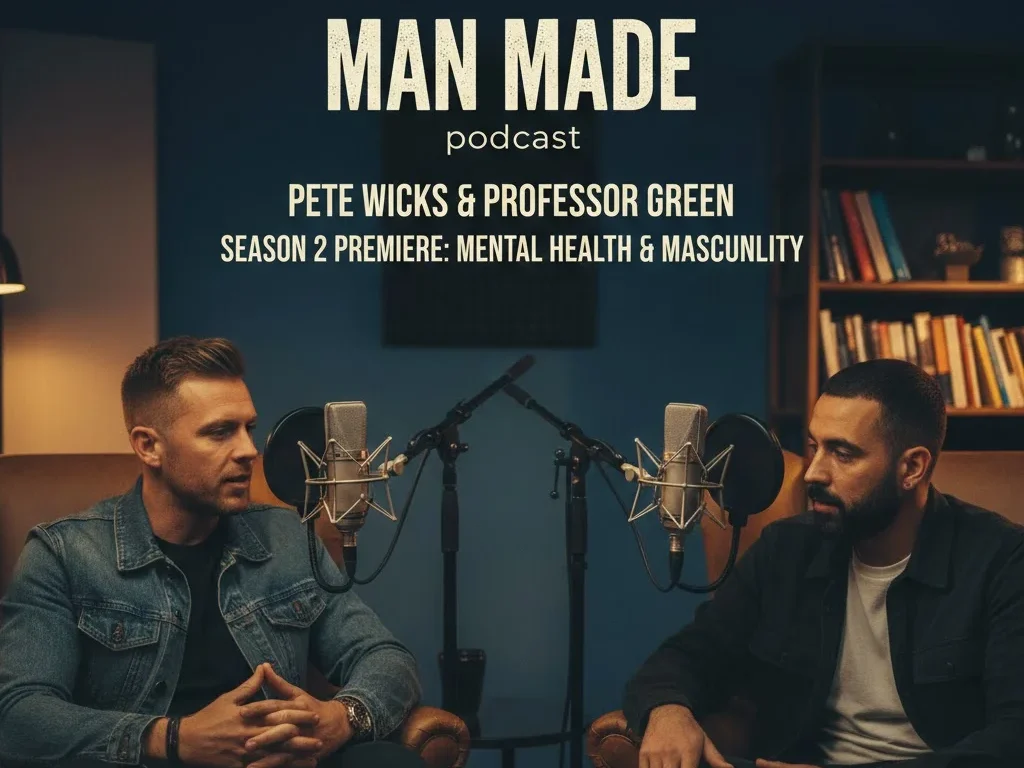
Pete Wicks Returns With Man Made Podcast Season 2 Featuring Professor Green
Pete Wicks is officially back with a brand-new season of his hit podcast Man Made, and the second series is already setting a deeply emotional tone — with musician and mental health advocate Stephen Manderson, widely known as Professor Green, joining as the very first guest.
The new episode dives straight into the heart of what Man Made has become known for: raw honesty, unfiltered emotion, and real conversations around masculinity, identity, trauma, mental health and emotional wellbeing. But this time, the discussion hits even deeper, with both men revealing personal struggles that are rarely spoken about publicly — and even more rarely spoken about by men in the public eye.
With millions of listeners increasingly drawn to podcasts that offer authenticity over performance, Pete Wicks’ return couldn’t be more timely. And with Professor Green speaking candidly about abandonment fears, an autism diagnosis, and the life-changing reality of fatherhood, the episode is already being described by fans as one of the most meaningful conversations the show has featured so far.
A Strong Start: Why Man Made Season 2 Is Already Making Headlines
The launch of Season 2 of Man Made comes at a moment when mental health conversations are dominating digital media and social platforms — but not always in a way that feels real.
Unlike many celebrity-led shows that stay surface-level, Pete Wicks’ podcast has earned its reputation by going where most interviews refuse to go.
This season opener is not about promotions, PR soundbites, or viral controversy.
Instead, it delivers something far more impactful: two men reflecting openly on the parts of life that break you, shape you, and force you to rebuild.
What the new episode covers:
Mental health struggles behind the public image
Childhood trauma and abandonment fears
Autism diagnosis and misunderstood neurodivergence
Education challenges and identity pressure
Fatherhood and emotional transformation
Masculinity, vulnerability and healing
Professor Green Shares His Lifelong Fear of Abandonment
One of the most striking moments of the episode comes when Professor Green speaks about his upbringing and the emotional wounds that have followed him throughout his life.
He describes carrying a deep, persistent fear of abandonment — something that still affects how he thinks, how he reacts, and how safe he feels in the world.
In an emotional statement, he explains:
“I think I still carry those feelings. I just wanna feel safe. I don’t feel safe in my own body. I don’t feel safe in my own head. I don’t feel safe in my own home.”
Those words land hard — not because they’re dramatic, but because they feel painfully relatable for many listeners dealing with anxiety, trauma, or emotional insecurity.
Why this moment matters
In a world where many public figures are encouraged to appear “fine,” Professor Green’s honesty reminds listeners that success doesn’t erase trauma.
Money doesn’t cure mental health.
Fame doesn’t fix childhood wounds.
And sometimes, the loudest voices in music are the ones carrying the quietest pain.
Autism Diagnosis: “People Don’t Believe It”
Another major revelation from the episode is Professor Green speaking openly about being diagnosed with autism — and the exhausting reality of how people respond.
He explains that one of the hardest parts is not the diagnosis itself, but how others perceive him.
In his words:
“I’ve been diagnosed as autistic. That’s difficult. People are gonna go, you are clearly not autistic because of how I can show up. That’s exhausting. But that’s been learned.”
The conversation shines a spotlight on a growing issue in neurodivergence discussions: the public misconception that autism always “looks” a certain way.
Autism stereotypes and public misunderstanding
Professor Green’s comments highlight how damaging stereotypes can be, especially for adults who mask symptoms or have learned to adapt socially.
Many autistic individuals face:
Being dismissed because they appear “high functioning”
Misunderstanding from family and peers
Emotional burnout from constant masking
Judgment for not matching stereotypes
Pressure to constantly explain themselves
His words also point to a bigger truth: autism isn’t always obvious, and the emotional labour of proving your reality can be exhausting.
A Conversation About Education, Intelligence and Neurodivergence
The episode also explores Professor Green’s relationship with education, where he reflects on the struggles of formal qualifications — even while being academically capable.
He speaks about how people often assume academic performance equals intelligence, when in reality many neurodivergent people face barriers that have nothing to do with ability.
Key themes discussed:
Difficulty fitting into rigid education systems
Challenges with structure and expectations
Feeling misunderstood by teachers and peers
Pressure to “perform normally”
Being labelled despite having potential
For many listeners, this part of the episode will resonate deeply — particularly those who grew up being told they were “bright but lazy,” or who struggled with traditional learning environments while having clear talent.
Fatherhood Changed Everything for Professor Green
One of the most uplifting sections of the episode comes when Professor Green talks about becoming a father — and how it reshaped his life in ways he never expected.
He admits that stepping into parenthood felt terrifying, especially without prior experience with children.
He shares:
“I didn’t know I could do it. I had no experience with kids… So, to find my way to it now it’s, yeah, it was scary.”
But what stands out is how he describes fatherhood not as a burden — but as a transformation.
How fatherhood shifted his perspective
According to Professor Green, becoming a parent influenced:
His emotional awareness
His understanding of responsibility
His approach to relationships
His self-reflection and growth
His sense of purpose
He speaks about the reality many men don’t openly admit: fatherhood forces you to confront yourself.
It forces you to grow up, even if you still feel like you’re healing.
Pete Wicks Shares a Personal Childhood Trauma
While Professor Green’s honesty dominates much of the episode, Pete Wicks also shares deeply personal memories — reinforcing why Man Made stands out among celebrity podcasts.
Pete reveals one of the most painful experiences of his life: discovering his mother after she attempted to take her own life when he was only 11 years old.
He recalls:
“One of my biggest fears is that my mum tried to take her own life when I was 11 and I found her… I never want to leave people because I’ve felt it.”
This moment is not just emotional — it’s a rare example of a public figure allowing vulnerability without trying to soften it or package it into something “digestible.”
The emotional impact of childhood trauma
Pete’s confession highlights how trauma doesn’t disappear as you grow older.
Instead, it often shows up later as:
Fear of abandonment
Hyper-responsibility for others
Anxiety around relationships
Struggles with emotional boundaries
Feeling the need to “save” people
And in the context of a podcast focused on masculinity, his honesty becomes even more significant.
What Man Made Is Really About: Masculinity Without the Toxicity
The Man Made podcast has built a loyal audience because it approaches masculinity differently than most mainstream media.
Instead of reinforcing outdated stereotypes about men being “strong and silent,” it invites guests to explore the reality behind those expectations.
The show’s core themes include:
Emotional wellbeing
Mental health awareness
Male identity and pressure
Vulnerability and honesty
Healing from trauma
Breaking generational cycles
With this new season opener, Pete Wicks makes it clear that Man Made is not here to entertain through gossip — it’s here to challenge what masculinity means in the modern world.
Why This Episode Feels So Relevant Right Now
This isn’t just another celebrity interview.
It’s a conversation that arrives at the perfect cultural moment.
With more men speaking up about depression, anxiety, neurodivergence, and trauma, audiences are increasingly hungry for real stories — not filtered, rehearsed narratives.
The episode stands out because it feels:
Human
Unpolished
Brave
Honest
Emotionally intelligent
And perhaps most importantly: it feels needed.
Key Takeaways From Pete Wicks and Professor Green’s Conversation
For listeners who want the main insights, here are the biggest takeaways from the episode:
Highlights from the Season 2 premiere:
Professor Green opens up about his lifelong fear of abandonment
He reveals the emotional difficulty of not feeling safe internally
He discusses his autism diagnosis and how others dismiss it
He explains the exhausting reality of “masking” behaviour
The episode explores neurodivergence and education struggles
Fatherhood is described as life-changing but frightening
Pete Wicks shares childhood trauma involving his mother’s suicide attempt
Both men reflect on how trauma shapes emotional attachment
The Rise of Podcasts Like Man Made in 2026
Podcasts have evolved massively in the last few years, and 2026 has become the era of long-form truth.
Short-form social media may dominate attention spans, but podcasts dominate emotional connection.
And Man Made fits perfectly into that shift.
Why audiences love long-form mental health podcasts:
They allow deeper conversations
Guests feel less pressured to perform
Stories unfold naturally
Emotional topics aren’t rushed
Listeners feel like they’re part of the conversation
This is the exact format that makes moments like Professor Green’s autism discussion and Pete’s trauma confession hit so hard.
Fans React to the New Series Launch
Although early reactions are still building, the launch of Season 2 has already sparked attention among fans who praised the show for its honesty.
Many listeners are sharing clips and quotes, particularly around:
Autism visibility
Men’s mental health
Fatherhood struggles
Emotional vulnerability
The episode is likely to trend further as more people discover it through YouTube, podcast apps, and social media reposts.
Where to Listen and Watch Man Made Season 2
The new season of Man Made is available across major platforms, making it easily accessible for both audio listeners and viewers.
You can listen or watch on:
Spotify
Apple Podcasts
Amazon Music
Google Podcasts (where available)
YouTube (full video version)
The video format is expected to draw strong viewership, as audiences increasingly prefer to see raw emotional reactions rather than only hearing audio.
Why Man Made Could Become One of the Most Important UK Podcasts of the Year
With this season opener, Pete Wicks is positioning Man Made as more than a podcast.
It’s becoming a platform.
A space where men can admit they are struggling without being mocked for it.
And in a culture still healing from decades of emotional repression, that matters.
What makes the show different:
It’s not performative activism
It’s based on real lived experiences
Guests aren’t forced into a “perfect” narrative
Trauma is treated with respect
Mental health is discussed without cliché
The conversation with Professor Green proves that Man Made isn’t trying to go viral — it’s trying to go deeper.
Expert Perspective: Why Men Talking Like This Is So Powerful
Although the episode is personal, it touches on wider social issues.
Mental health experts have long emphasised that men often avoid seeking support due to stigma, fear of appearing weak, or cultural expectations.
Public conversations like this one help reduce that stigma.
Why these conversations matter:
They normalise therapy and emotional openness
They encourage men to speak up earlier
They reduce shame around diagnoses like autism
They show fatherhood is emotionally complex
They remind listeners they aren’t alone
In many ways, this episode is not just entertainment — it’s a public service.
What’s Next for Man Made Podcast Season 2?
While only the first episode has been released, the season is expected to feature more high-profile guests and emotionally intense discussions.
If Season 1 was about introducing the concept, Season 2 looks set to expand the show’s reach — and its depth.
What listeners can likely expect:
Bigger celebrity guests
More personal confessions
Deeper themes around masculinity
Honest discussions on identity and relationships
Conversations about addiction, grief, trauma and self-worth
The choice to open with Professor Green signals that this season is going to be bold and emotionally heavy — in the best way.
Final Thoughts: A Season Opener That Hits Hard and Stays With You
Pete Wicks has returned with Man Made Season 2, and he’s done it with an episode that feels more like a therapy session than a celebrity chat.
Professor Green’s honesty about abandonment, autism, and fatherhood is both heartbreaking and empowering.
Pete’s openness about childhood trauma is equally raw, proving once again that Man Made isn’t afraid to show the uncomfortable side of life — the side people usually hide.
For anyone who has ever struggled with anxiety, identity, emotional safety, or simply feeling understood, this episode offers something rare:
A reminder that even the strongest-looking people can feel broken.
And that healing begins the moment you stop pretending you’re okay.
FAQs
Who is the first guest on Man Made Season 2?
The first guest is Stephen Manderson, better known as Professor Green.
What is Man Made podcast about?
It focuses on conversations around masculinity, mental health, emotional wellbeing, trauma, and identity.
What did Professor Green reveal in the episode?
He spoke about his fear of abandonment, his autism diagnosis, struggles with education, and how fatherhood changed him.
What personal story did Pete Wicks share?
Pete revealed that his mother attempted suicide when he was 11, and he found her — an event that shaped his fears and emotional life.
Where can you watch Man Made podcast?
The podcast is available on all major platforms and can also be watched on YouTube.