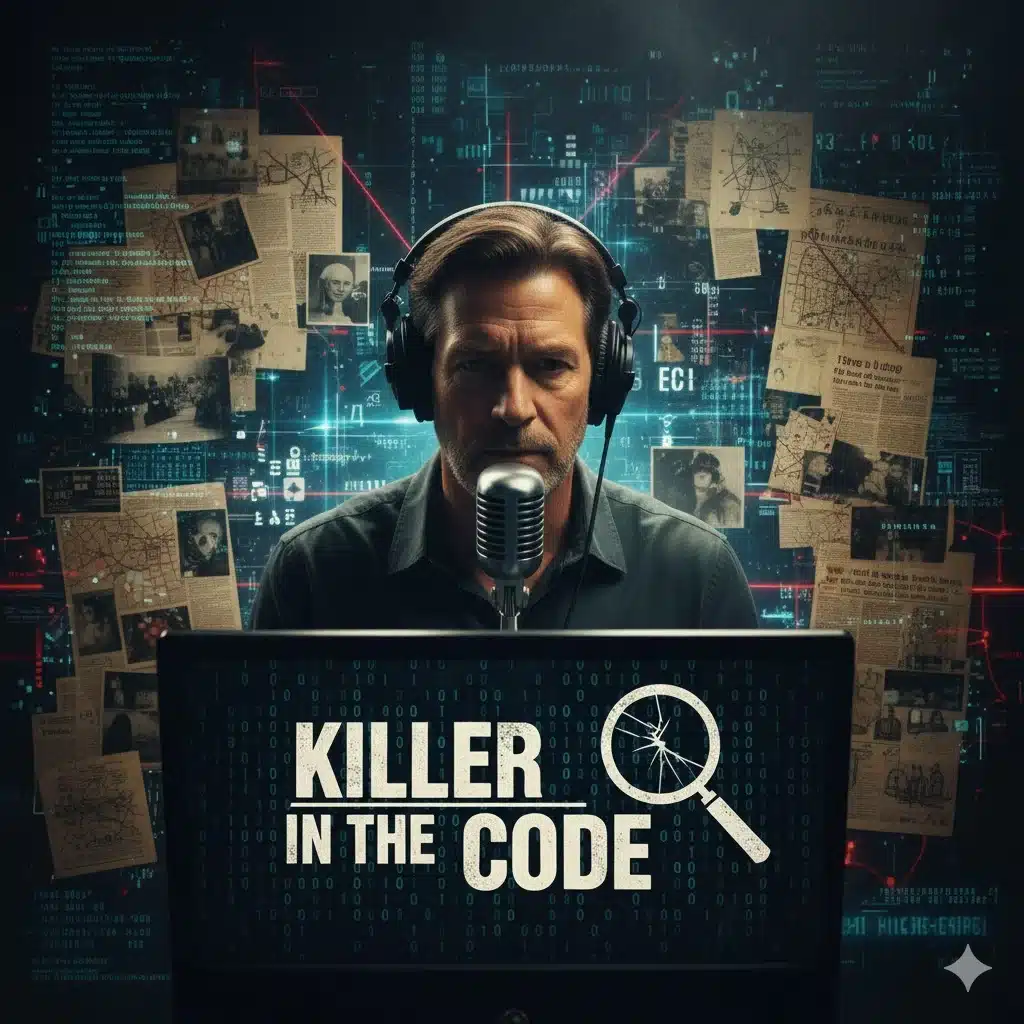
Michael Connelly’s Killer in the Code Podcast Uses AI to Crack Zodiac & Black Dahlia Cases
When storytelling, science, and cold-case justice collide, the results can be extraordinary. That collision is now unfolding in “Killer in the Code,” a gripping new true-crime podcast from global bestselling author Michael Connelly, where genealogy, cryptology, and artificial intelligence converge to reopen some of the most infamous unsolved murder cases in American history.
Blending investigative journalism with cutting-edge forensic technology, the podcast promises not just narrative intrigue—but potentially historic breakthroughs.
Michael Connelly, one of the most influential crime storytellers of the last three decades, is returning behind the microphone with a project unlike anything he has attempted before.
Known worldwide for iconic crime franchises such as:
The Lincoln Lawyer
Bosch
Bosch: Legacy
Ballard
Connelly now turns his attention back to real-life crime, hosting and narrating a podcast that explores how modern technology may finally crack cases that have remained unsolved for over half a century.
What Is “Killer in the Code”?
“Killer in the Code” is a serialized investigative docuseries centered on the real-world work of Alex Baber, a cold-case consultant and founder of Cold Case Consultants of America.
Over a two-year investigation, Baber pursued new leads in two of the most notorious cold cases in American history:
The Zodiac Killer
The 1947 murder of Elizabeth Short, famously known as The Black Dahlia
What sets this investigation apart is its methodology.
A New Model for Cold Case Investigation
Rather than relying solely on traditional detective work, Baber employs a hybrid forensic approach that includes:
Cryptology – decoding historical ciphers
Genetic genealogy – leveraging ancestry databases
AI-assisted forensic analysis – using machine learning to identify patterns humans miss
Michael Connelly joined the investigative team not as a fictional storyteller, but as a documentarian, helping chronicle the process while ensuring narrative clarity and credibility.
Cracking the Zodiac Killer’s Cipher
One of the podcast’s most jaw-dropping revelations involves what investigators describe as one of the Zodiac Killer’s most difficult unsolved ciphers.
Episode One: “The Hidden Beneath the Hidden”
In the opening episode, Baber deciphers a Zodiac cipher that had resisted decades of professional codebreakers. According to the podcast, the solution leads to:
A significant identity breakthrough
A previously overlooked suspect
New interpretive context for Zodiac communications
To ensure legitimacy, Connelly brought in Ed Giorgio, former Chief Codemaker and Codebreaker at the NSA, to independently verify Baber’s findings.
The Black Dahlia Case Revisited
The podcast does not stop with the Zodiac Killer.
It also revisits the murder of Elizabeth Short, whose mutilated body was discovered in Los Angeles in January 1947—a case that has haunted American criminal history for nearly 80 years.
Episode Two: “The Smoking Gun”
This episode focuses on newly examined physical evidence that investigators claim may connect suspects across both cases.
According to the series:
Evidence long thought inconclusive was reprocessed using modern techniques
Genealogical mapping surfaced familial links previously impossible to detect
AI-assisted pattern recognition helped identify overlapping behaviors and timelines
Veteran Detectives Weigh In
To ground the investigation in law enforcement reality, the podcast features interviews with respected homicide detectives, including:
Rick Jackson – former LAPD homicide detective
Mitzi Roberts – former head of the LAPD Cold Case Unit
Roberts oversaw the Black Dahlia investigation for more than 15 years, making her perspective particularly crucial.
Their participation lends weight to the podcast’s claims while offering listeners a rare look inside decades of cold-case frustration and hope.
“Truth Stranger Than Fiction” — Connelly Reflects
In the series, Connelly acknowledges how extraordinary the investigation has become:
“This is a case that certainly proves the adage that the truth is stranger than fiction. To put these cases in the solved column after more than half a century is something I never thought I would live to see.”
For a novelist whose career has been built on imagined crimes, Connelly admits that real life has now surpassed fiction.
Why AI Is Changing True Crime Forever
One of the podcast’s most compelling themes is how artificial intelligence is reshaping forensic investigations.
How AI Is Used in the Podcast’s Investigation
Sorting millions of data points across decades
Identifying linguistic similarities in handwritten and coded messages
Matching genealogical DNA profiles faster than human analysts
Reconstructing timelines using probabilistic modeling
This approach represents a new frontier in criminal justice, particularly for cold cases once considered unsolvable.
Interactive Companion Website Expands the Investigation
To deepen listener engagement, “Killer in the Code” is supported by a companion website where users can access:
Decrypted cipher documents
Source materials used in the investigation
Genealogical charts and timelines
Evidence imagery and archival records
This transparency allows listeners to verify claims, explore evidence, and draw their own conclusions—a rarity in true crime storytelling.
Michael Connelly’s True-Crime Legacy
This podcast builds on Connelly’s extensive experience in true crime audio, including:
Murder Book
Murder Book, Murder Book
The Wonderland Murders
Across fiction and nonfiction, Connelly has sold over 90 million books worldwide and serves as executive producer on multiple television adaptations.
“Killer in the Code” may be his most ambitious nonfiction project yet.
When and Where to Listen
“Killer in the Code” is now available on:
Apple Podcasts
Spotify
YouTube
All major podcast platforms
📅 New episodes begin releasing January 15, 2026
Why “Killer in the Code” Matters Now
In an era where cold cases are being reopened through DNA and data science, this podcast stands at the intersection of:
Criminal justice reform
Technological evolution
Ethical storytelling
It raises urgent questions:
How many cases remain solvable with today’s tools?
Should AI be standard in criminal investigations?
What responsibility comes with reopening decades-old wounds?
Final Takeaway
“Killer in the Code” is not just another true-crime podcast. It is a forensic experiment, historical reexamination, and narrative investigation rolled into one—guided by one of the most respected voices in crime storytelling. If the findings hold, this series may not just tell history—it may rewrite it.