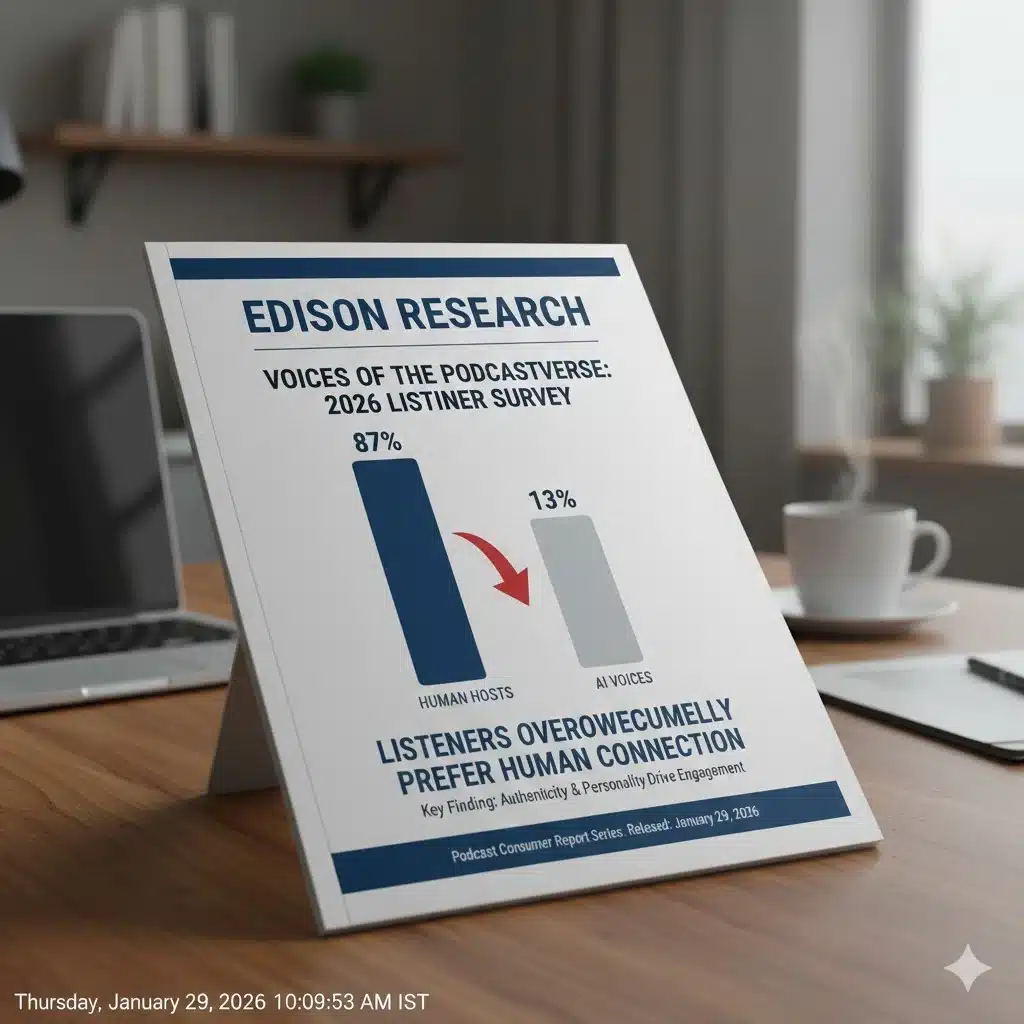
Edison Report: Podcast Listeners Prefer Human Hosts Over AI Voices in 2026
Artificial intelligence is reshaping podcast production, but audiences still want real human voices behind the microphone. A new report from Edison Research highlights a growing divide between technology-driven content creation and listener expectations, revealing that while AI is welcomed as a production assistant, it is not embraced as a replacement for human podcast hosts.
As podcasting continues its rapid evolution — expanding into video, smart TVs, and more diverse audiences — one thing remains clear: authenticity, emotional depth, and real conversation still matter most to listeners.
This article breaks down Edison’s latest findings, analyzes what they mean for creators and media companies, and explores how the future of podcasting is being shaped by both technology and human connection.
AI Is Entering Podcasting — But Listeners Are Drawing the Line
Artificial intelligence tools are increasingly being integrated into podcast workflows, from scriptwriting and topic research to editing and automated narration. However, Edison Research’s data suggests that listeners remain skeptical of AI voices replacing human hosts.
According to the report, a significant number of podcast listeners have already encountered AI-generated podcasts:
Around 25% of first-year podcast listeners say they have listened to a podcast narrated by an AI voice.
Among long-time podcast listeners, the figure stands at roughly 20%.
While experimentation with AI-driven podcasts is becoming more common, acceptance remains low.
Listeners may be curious — but curiosity does not equal preference.
Audiences Want AI Behind the Scenes, Not Behind the Mic
Edison’s qualitative interviews, conducted as part of its “Evolving Ear” study, reveal a clear trend in listener sentiment: AI is welcome as a supporting tool, but not as the star of the show.
Most participants expressed comfort with AI being used for:
Brainstorming podcast ideas
Conducting background research
Editing and post-production
Scheduling and administrative tasks
Enhancing workflow efficiency
However, they strongly opposed AI replacing human hosts, narrators, or storytellers.
One respondent summarized the prevailing opinion simply:
“I don’t want AI doing the creative stuff.”
Listeners repeatedly emphasized that emotional intelligence, authenticity, and chemistry cannot yet be replicated by synthetic voices.
Why Listeners Reject AI Hosts: Emotion, Authenticity, and Connection
A key reason for resistance is the perception that AI voices lack emotional depth and natural conversation.
Listeners reported several shortcomings of AI-narrated podcasts:
Flat or robotic tone
Missing emotional nuance
Lack of genuine humor or empathy
Unnatural pacing and inflection
Absence of real-life personality and spontaneity
Many listeners said they could instantly recognize AI-generated speech, describing it as less engaging, less trustworthy, and less immersive.
Podcasting, at its core, is a medium built on human storytelling, intimacy, and relatability — qualities that remain difficult for machines to replicate convincingly.
Edison Research: Humans Must Stay at the Center of Podcasting
Gabriel Soto, Senior Research Director at Edison Research, reinforced the importance of maintaining human presence in podcasting as companies rush to adopt AI tools.
“Almost everyone had a similar sentiment. They’re willing to accept AI in the development and brainstorming of a podcast, but not in the execution or the entity hosting the podcast itself,” Soto said.
His takeaway was clear:
Podcast audiences want creators to remain human.
Rather than signaling a shift toward fully automated content, Edison’s research suggests a more balanced future — one where AI enhances productivity, while humans remain the heart of storytelling.
The Future of Podcasting: AI as an Assistant, Not a Replacement
Despite rapid technological advancement, Edison’s findings indicate that AI’s most sustainable role in podcasting will be supportive, not performative.
AI can:
Speed up editing workflows
Reduce production costs
Help creators scale content
Improve research accuracy
Automate routine tasks
But human creators remain essential for:
Emotional storytelling
Building audience trust
Hosting meaningful conversations
Creating humor, empathy, and spontaneity
Establishing long-term listener loyalty
For podcast brands, the takeaway is clear: technology should enhance creativity — not replace it.
New Podcast Listeners Are More Diverse Than Ever
Beyond AI, Edison’s report reveals a major demographic shift in podcast audiences, particularly among first-year listeners.
Compared to long-time podcast fans, new listeners are:
Younger
More likely to be women
More racially diverse
More politically varied
Notably:
39% of first-year podcast listeners are non-white, compared to 25% of veteran listeners
New listeners show greater political diversity, including more Republican-identifying audiences, reflecting the rise of conservative podcast content
Soto noted that podcast audiences are increasingly beginning to mirror the broader population, signaling a new era for the medium.
“The data suggests consumers will look more like the face of the country in podcasting’s next chapter,” he said.
Podcasting Is Becoming a Mass-Market Medium
Once considered a niche format, podcasting has now become mainstream, reaching audiences across:
Age groups
Genders
Racial backgrounds
Political affiliations
Lifestyle categories
This transformation is forcing creators, advertisers, and platforms to adapt content strategies to serve broader and more diverse communities.
The opportunity is enormous — but so is the responsibility to reflect real voices, perspectives, and experiences.
Podcast Listening Time Has Quadrupled in a Decade
Edison’s report also highlights explosive growth in podcast consumption.
Key Growth Metrics:
Americans now spend 773 million hours per week listening to podcasts
Ten years ago, weekly listening time was around 170 million hours
This represents a 355% increase over the past decade
This dramatic rise confirms that podcasting is no longer a side medium — it is now a core part of modern media consumption.
Video Podcasts Are Driving the Next Growth Wave
One of the biggest forces behind podcast expansion is the rise of video podcasting.
What was once primarily an audio format is now increasingly visual — blending podcasting with streaming, YouTube culture, and smart TV consumption.
Key Findings:
Smart TV podcast consumption has grown from 1% in 2021 to 9% today
Smart TVs have now surpassed smart speakers as a podcast listening platform
Many creators are now producing studio-style video podcasts that resemble talk shows or digital TV programs
Soto described this as podcasters “disrupting what’s on TV in American households throughout the day.”
First-Year Listeners Prefer Video Podcasts Over Audio
Video is especially popular among new podcast listeners, reshaping how younger audiences discover and engage with content.
Edison’s data shows:
77% of first-year listeners watch video podcasts
75% listen to audio-only podcasts
Video consumption among newcomers now exceeds audio-only usage
This signals a shift in how future audiences may define what a “podcast” actually is — potentially blurring the line between podcasts, talk shows, and streaming content.
Video Discovery Is Expanding — Not Replacing — Audio
Despite the rise of video, Edison’s research suggests that video is not killing audio podcasts.
Instead, video often acts as a gateway to traditional audio listening:
72% of first-year listeners started listening to the audio version after discovering a podcast through video
68% of long-time listeners report the same behavior
This suggests that video can expand audience reach while still reinforcing the value of audio-first podcasting.
“Video has transformed the definition of podcasting, but it doesn’t necessarily eat up audio,” Soto said.
What This Means for Podcast Creators in 2026
Edison’s findings offer several actionable insights for podcasters, networks, and media brands:
1. Keep Humans at the Center
AI can assist production, but human hosts drive connection and loyalty.
2. Use AI Strategically — Not Creatively
AI should enhance workflow, not replace voices or storytelling.
3. Embrace Video Without Abandoning Audio
A hybrid audio-video strategy can maximize reach and discovery.
4. Adapt to a More Diverse Audience
Creators must reflect broader demographics, cultures, and political perspectives.
5. Build Authentic, Emotionally Resonant Content
In an AI-heavy world, authenticity becomes a competitive advantage.
The Bigger Picture: Why Human Voices Still Matter
Podcasting thrives because it feels personal, intimate, and real.
Listeners form emotional bonds with hosts. They trust their opinions, relate to their stories, and feel like part of a community.
AI may be fast, efficient, and scalable — but it cannot yet replace:
Human warmth
Real-life experience
Genuine humor
Emotional storytelling
Personal identity
As media becomes more automated, human creativity and authenticity may become even more valuable.
Conclusion: The Podcast Industry’s Human Future
Edison Research’s latest report sends a powerful message to the podcast industry:
Technology will shape production — but people will shape connection.
While AI continues to revolutionize how podcasts are made, audiences remain firm in their desire for real human voices, real stories, and real emotion.
The future of podcasting will likely be a hybrid model — where AI accelerates efficiency, video expands reach, and humans remain the heart of the medium.
In the race between automation and authenticity, listeners have made their preference clear.