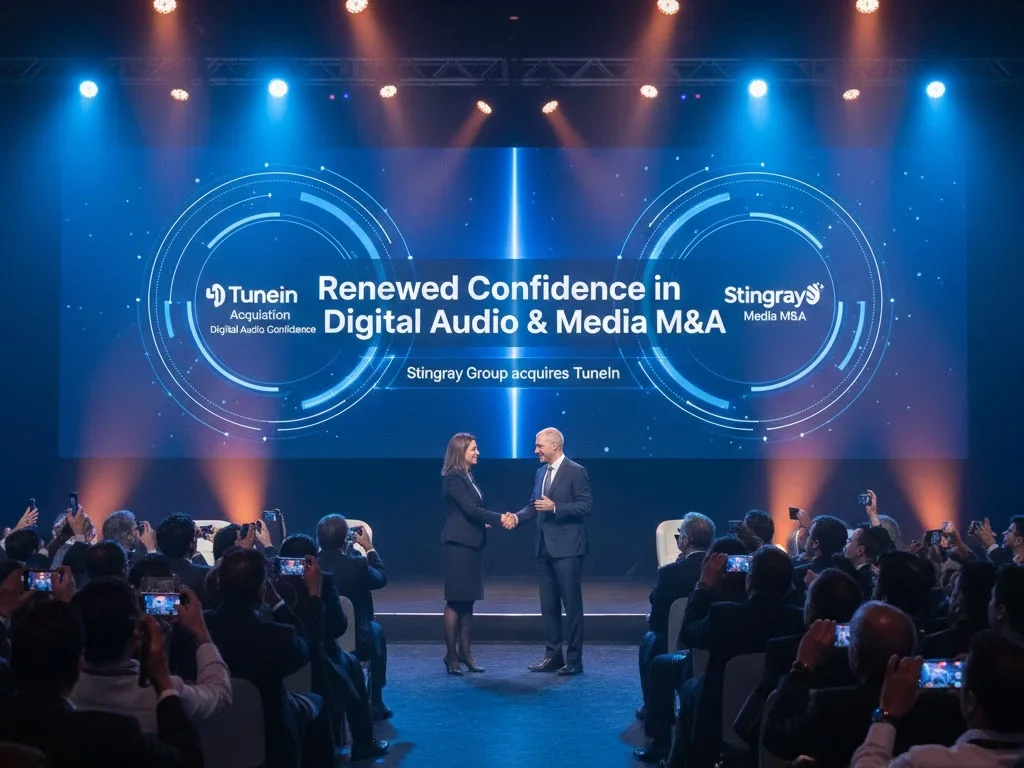
Digital M&A Rebounds in 2025: TuneIn’s $175M Sale Signals New Confidence in Audio
While much of the digital media conversation over the past year has revolved around artificial intelligence, short-form video, and blockbuster marketing technology acquisitions, one of the most telling developments of 2025 emerged from a comparatively understated corner of the market: digital audio.
The sale of TuneIn to Stingray Group for $175 million may not have generated the same headlines as AI unicorn mergers or video ad tech buyouts, but for insiders across radio, podcasting, and streaming audio, the deal carries outsized strategic weight. It arrives at a moment when digital M&A activity is rebounding, advertiser confidence is cautiously improving, and buyers are once again willing to invest in scaled, revenue-generating platforms rather than experimental bets.
According to LUMA Partners’ year-end digital media and marketing technology analysis, dealmaking surged in the second half of the year, closing 2025 with 469 transactions — the highest level in five years. That resurgence alone is notable. But buried within the data is a deeper story: audio has re-entered the strategic acquisition conversation in a serious way.
After a turbulent 2024 marked by valuation resets, tighter capital, and macroeconomic uncertainty, digital mergers and acquisitions staged a strong recovery in 2025. LUMA’s data points to a 13% year-over-year increase in total transactions, with momentum accelerating sharply in the back half of the year.
Key characteristics of this rebound include:
A return of strategic buyers, rather than purely financial sponsors
Increased activity in ad tech and marketing technology
Growing emphasis on distribution, monetization, and omnichannel scale
Fewer speculative deals, more infrastructure-focused acquisitions
While AI-driven platforms captured much of the spotlight, the broader trend was clear: buyers were prioritizing assets that already work.
Strategic Buyers Take the Lead
One of the most striking shifts highlighted by LUMA is the dominance of strategic acquirers in larger transactions. Roughly two-thirds of scaled deals above $100 million were executed by strategic buyers in 2025 — a sharp increase compared to the prior year.
This signals a meaningful change in mindset.
Instead of waiting for public market multiples to rebound or attempting to build new platforms internally, large media and technology companies increasingly opted to buy proven capabilities:
Established audiences
Reliable revenue streams
Existing advertising infrastructure
Global or multi-market distribution
The TuneIn acquisition fits squarely into this pattern.
The TuneIn Acquisition: Deal Structure and Key Details
Breaking Down the Numbers
In November 2025, Stingray Group announced an agreement to acquire TuneIn, one of the world’s most recognized audio aggregation platforms.
Deal terms include:
$175 million total consideration
$150 million paid at closing
Up to $25 million in earn-out payments, tied to future performance
LUMA categorizes the transaction as a scaled ad tech acquisition, underscoring TuneIn’s role not just as a consumer audio product, but as a monetizable distribution platform.
Why the Buyer Matters More Than the Price
While the valuation itself is notable in a market that has been cautious about media assets, the identity of the buyer is what gives this deal broader industry significance.
Stingray Group operates across:
Music channels and curated audio experiences
Radio services and digital broadcasting infrastructure
Ad-supported audio platforms in multiple global markets
Rather than viewing TuneIn as a standalone consumer app, Stingray framed the acquisition as a strategic expansion of its digital audio footprint, designed to accelerate streaming growth and strengthen monetization capabilities.
That framing mirrors a larger trend reshaping digital media M&A.
Why Audio Is Suddenly Attractive Again
From Experimental to Essential
For years, digital audio often sat in an awkward middle ground — less flashy than video, less hyped than AI, and slower to scale than social platforms. But in 2025, perceptions are shifting.
Platforms like TuneIn offer something increasingly rare in digital media:
Habitual, daily usage
Brand-safe listening environments
Lean-back consumption that complements multitasking
Global reach without the volatility of social algorithms
In other words, audio looks less like a gamble and more like infrastructure.
Advertisers Never Left Audio — They Just Waited
Even during downturns, advertisers continued to value audio for:
High attention and completion rates
Contextual relevance
Lower fraud risk compared to some digital formats
Strong performance in brand lift and recall
As marketers push toward unified, cross-channel buying, audio’s ability to integrate with display, video, and connected TV strategies has become a selling point rather than a limitation.
TuneIn’s Strategic Role in a Fragmented Audio Landscape
An Aggregation Platform at the Center
TuneIn occupies a unique position in the audio ecosystem by aggregating:
Live radio from thousands of stations worldwide
Podcasts and spoken-word programming
Music and sports content
News, talk, and niche formats
As media consumption fragments across devices and platforms, aggregation regains strategic importance. For broadcasters expanding into streaming and podcasters experimenting with video, TuneIn functions as connective tissue.
Distribution Is the New Power Lever
One of the clearest lessons from recent M&A activity is that distribution matters more than ever.
…gives companies leverage not just in advertising, but in partnerships, content licensing, and data insights.
The TuneIn deal reflects growing recognition that controlling distribution can be more valuable than owning content alone.
Audio Inside the Omnichannel Media Future
Convergence Is No Longer Theoretical
The boundaries between audio, video, and digital publishing continue to blur:
Podcasts increasingly include video components
Radio brands stream on digital platforms
Advertisers demand unified measurement across formats
In this environment, audio platforms that can plug seamlessly into broader media ecosystems become highly attractive acquisition targets.
TuneIn’s scale and technical infrastructure allow it to sit comfortably at that intersection — a factor likely central to Stingray’s interest.
Monetization at Scale
Another reason audio platforms are gaining favor: they already monetize.
Unlike early-stage social or AI products still searching for sustainable business models, TuneIn offers:
Established ad inventory
Programmatic and direct sales integration
Predictable listening behavior
For strategic buyers under pressure to show returns, that reliability matters.
What the Deal Signals for Radio Broadcasters
Validation of Digital Audio Strategy
For traditional radio groups navigating the transition from terrestrial broadcasting to streaming, the TuneIn acquisition serves as validation.
It suggests that:
Digital extensions of radio brands hold real enterprise value
Aggregation and scale remain defensible advantages
Audio audiences are still worth paying for
This may encourage more broadcasters to invest in digital infrastructure — or explore strategic partnerships rather than building everything in-house.
Potential for Further Consolidation
As M&A confidence grows, industry observers expect:
Smaller audio tech platforms to become acquisition targets
Regional broadcasters to seek digital exits
International players to expand through bolt-on deals
TuneIn could be an early signal of a broader audio consolidation cycle.
Podcasting and Streaming: Reading Between the Lines
Audio Isn’t Competing With Video — It’s Complementing It
Despite the rise of video podcasts and visual storytelling, audio remains uniquely positioned for:
Commuting
Workday listening
Background consumption
The TuneIn deal underscores that audio doesn’t need to replace video to remain valuable — it simply needs to integrate intelligently.
Scale Still Wins
For podcasters and streaming startups, the message is clear: scale, distribution, and monetization readiness matter.
Platforms that can demonstrate:
Loyal, repeat usage
Advertiser-friendly environments
Multi-market reach
…are far more likely to attract strategic interest.
Looking Ahead: What LUMA Expects Next
M&A Momentum Likely to Continue
According to LUMA Partners, digital media M&A activity is expected to accelerate further over the next 12 months, driven by:
Improved macroeconomic visibility
Strategic buyers seeking adjacent capabilities
Pressure to diversify revenue streams
Audio, once considered a secondary channel, appears well positioned to benefit from this renewed confidence.
Beyond AI and Video
While AI and video will continue to dominate headlines, the TuneIn acquisition highlights a quieter truth: durable platforms with real users and real revenue still matter.
For executives in radio, podcasting, and streaming audio, that may be the most encouraging signal of all.
Conclusion: A Defining Moment for Digital Audio
The sale of TuneIn may not have been the loudest deal of the year, but it could prove to be one of the most consequential for the audio industry.
In a market rediscovering its appetite for strategic acquisitions, TuneIn stands as proof that audio is no longer on the sidelines of digital media M&A. Instead, it is emerging as a foundational asset — capable of anchoring broader digital strategies in an increasingly complex media landscape.
As digital dealmaking regains momentum, the message is clear: audio is back on the map.