Deloitte 2026 Outlook: Video Podcasts & Fan-Driven Franchises Will Dominate Media
Podcasts are no longer just audio shows competing for ear time. According to Deloitte’s latest 2026 Technology, Media, and Telecommunications Outlook, the industry is undergoing a fundamental transformation—one that mirrors the evolution of blockbuster entertainment franchises rather than traditional radio or on-demand audio.
The big takeaway? The podcasts that will thrive in 2026 and beyond are those built like fan franchises, not just content feeds.
As video podcasts (vodcasts) surge in popularity and social platforms reshape discovery and monetization, Deloitte’s research suggests that the future of podcasting belongs to brands that cultivate deep fandom, creator-led communities, and cross-platform ecosystems.
This shift has major implications for creators, advertisers, platforms, and media companies fighting for a shrinking slice of consumer attention.
Video Podcasts Are Redefining How Audiences Engage
Why Video Matters More Than Ever
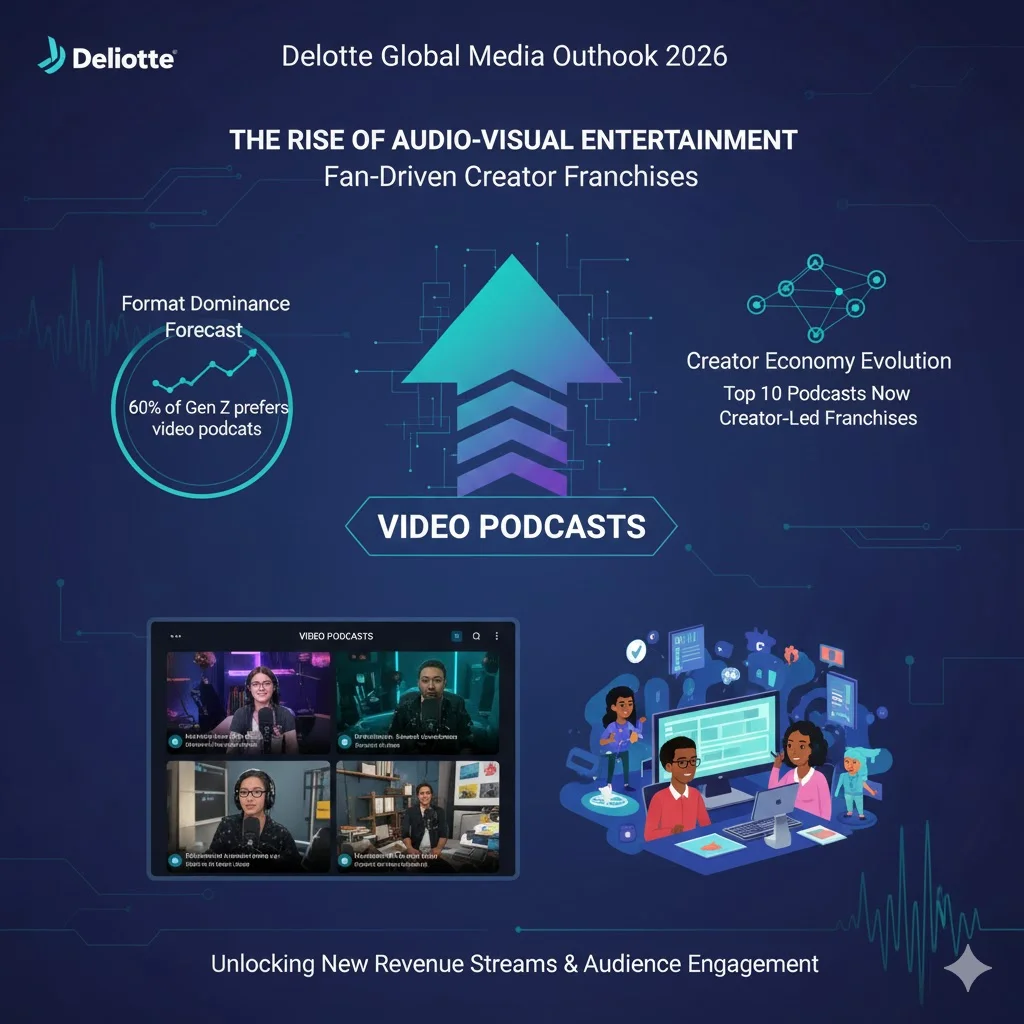
Video podcasts are rapidly claiming screen time once dominated by traditional television and subscription streaming services. Deloitte projects that global podcast and vodcast advertising revenue will reach nearly $5 billion in 2026, marking close to 20% year-over-year growth.
This growth is being fueled by two major forces:
The mainstream adoption of video podcasts
The migration of younger audiences away from linear TV
Unlike traditional audio-only formats, vodcasts offer a visually immersive, highly shareable experience that aligns with modern content consumption habits shaped by YouTube, TikTok, and Instagram Reels.
Podcasting Is Now Competing Directly With Television
The rise of vodcasts signals a deeper industry shift: podcasts are no longer an “adjacent” medium. They are now direct competitors for screen-based attention.
According to Deloitte:
A growing percentage of top-performing podcasts now include video versions
Consumers increasingly prefer platforms that support high-quality, native video playback
Podcasts are replacing TV talk shows, panel discussions, and even reality formats in some demographics
This evolution positions podcast creators as on-camera personalities, not just voices—blurring the line between podcasters, influencers, and television hosts.
What the Data Says: Inside Deloitte’s Digital Media Trends Survey
Deloitte’s predictions are backed by findings from its 2025 Digital Media Trends Survey, which sampled 3,595 U.S. adults across age groups and consumption habits.
Key Findings at a Glance
27% of U.S. consumers watch video podcasts weekly
Gen Z and Millennials lead vodcast adoption
44% of vodcast viewers do not multitask while watching
Only 29% of audio-only listeners say the same
This data points to a critical insight: Video podcasts command more focused attention than audio alone.
For advertisers and creators alike, that attention translates into higher brand recall, stronger emotional connection, and greater conversion potential.
Engagement Levels Are Higher for Video Podcast Audiences
Deloitte’s research reveals that video podcast consumers:
Consume 1.5x more content than audio-only listeners
Are more likely to watch full episodes
Engage more deeply with hosts and on-screen narratives
This heightened engagement creates fertile ground for:
Long-form storytelling
Community-building
Premium advertising formats
In a media landscape flooded with short-form clips, vodcasts offer something rare: sustained attention.
Podcast Advertising Is Quietly Driving Commerce
While podcast advertising has long been considered a brand-awareness play, Deloitte’s findings highlight its growing role in direct consumer purchasing behavior.
Commerce Impact Highlights
25% of U.S. podcast listeners and viewers report purchasing a product or service advertised on a podcast
Video formats increase trust and perceived authenticity
Host-read ads continue to outperform traditional display formats
As video podcasting matures, advertisers are gaining confidence in the medium’s ability to move audiences from attention to action.
Strategic Imperatives for Platforms and Publishers
Deloitte’s outlook outlines several priorities for companies hoping to capitalize on the video podcast boom.
1. Invest in Native Video Infrastructure
Audio-first platforms are being urged to:
Upgrade streaming infrastructure for video
Improve in-app video discovery
Support creator-friendly production tools
Some platforms have already begun this transition, signaling an arms race to become the default home for vodcasts.
2. Expand Into Shoppable and Interactive Advertising
One of the most promising opportunities lies in dynamic video advertising, including:
Clickable overlays
In-video product tagging
Integrated checkout experiences
These formats blur the line between content and commerce—unlocking new revenue streams for creators and sponsors alike.
3. Localize Content for Emerging Markets
Global growth remains a key lever.
Deloitte notes that platforms can accelerate adoption by:
Investing in local creators
Producing regionally relevant content
Leveraging culturally influential personalities
This strategy mirrors the global playbooks of major streaming services, now adapted for the podcast ecosystem.
The Attention Economy Is a Zero-Sum Game
Despite rapid innovation, one constraint remains fixed: time.
Deloitte estimates that U.S. consumers still spend roughly six hours per day on media, forcing all formats—audio, video, social, gaming, and podcasts—into direct competition.
As a result:
Every minute gained by podcasts is a minute lost by TV or streaming
Discovery and retention matter more than raw reach
Formats that feel personal and relevant win
Social Video Platforms Hold the Economic Advantage
While podcasts are growing, Deloitte highlights a stark reality: Social video platforms dominate advertising dollars.
Advertising Power Shift
Social video now commands over 50% of U.S. ad spending
Precision targeting outperforms traditional media buys
This dominance reshapes expectations for podcast monetization and distribution strategies.
Gen Z and Millennials Trust Creators More Than Celebrities
One of the most disruptive insights from Deloitte’s report centers on cultural influence.
Changing Trust Dynamics
63% of Gen Z and 49% of Millennials say social ads influence their purchases most
Streaming TV ads rank significantly lower
Over half of Gen Z say creators feel more relevant than TV actors or mainstream celebrities
This shift has elevated podcasters and digital creators into a new class of parasocial influencers, where audiences form emotional bonds that drive loyalty and spending.
Fandom Is Becoming the Industry’s Growth Engine
From Audience to Identity
Historically, podcast success was measured by downloads and reach. Deloitte argues that the next phase of growth will be driven by fandom intensity, not just scale.
Fans are no longer passive listeners—they are:
Brand advocates
Community members
High-intent consumers
In this model, a smaller but deeply engaged audience can outperform a massive but casual one.
Why Fans Matter More Than Casual Listeners
Deloitte’s research shows that self-identified media fans:
Spend more time with preferred formats
Follow creators across platforms
Are more likely to buy merchandise, tickets, and subscriptions
For podcast publishers, fandom translates into:
Higher retention
Organic distribution
Sustainable monetization
Creators as Multi-Platform Franchises
One-third of U.S. consumers say fandom for a favorite music artist is core to their identity, and many of these fans actively follow artists into:
Podcasts
Live events
Social media content
Brand collaborations
This “creator adjacency” effect creates measurable lifts in discovery and revenue for podcasts anchored by culturally relevant hosts.
Meet the Media “Super Fans”
Perhaps the most valuable audience segment identified by Deloitte is the media super fan.
Who Are They?
Roughly 10% of U.S. consumers
Media is central to personal identity
Subscribe to multiple streaming services
Use more social platforms than average
Spend the most time with digital content
These users are the most cross-platform native, making them early adopters of podcasts, vodcasts, and new media formats.
Why Super Fans Shape the Future of Podcasting
Super fans are predictive indicators of where media consumption is heading. They:
Sample new formats faster
Support creators financially
Influence broader audience behavior
Winning this cohort often signals long-term success for new podcast franchises.
Final Takeaway: Podcasts Must Think Bigger Than Audio
Deloitte’s 2026 outlook makes one thing clear: The podcast industry is evolving into a fandom-driven, video-forward, creator-led ecosystem.
Success will depend on:
Building emotional connection, not just reach
Treating podcasts as franchises, not files
Leveraging video, community, and commerce together
In a crowded attention economy, the podcasts that endure will be those that stop chasing downloads—and start building worlds fans want to belong to.