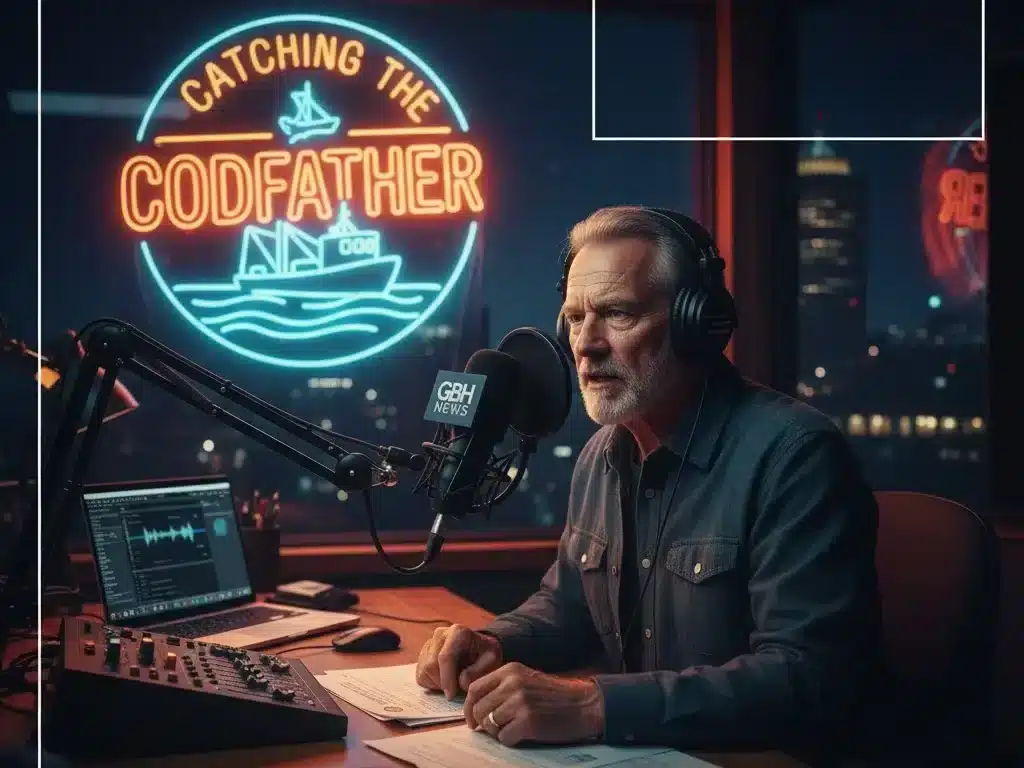
Boston’s GBH Launches ‘Catching The Codfather’ Podcast for Public Radio Nationwide
Boston-based public media giant GBH is making a bold strategic move in the audio storytelling space by offering its latest true-crime podcast, “Catching The Codfather,” to public radio stations across the United States. Through a new distribution partnership with PRX, the series is set to transcend the podcast ecosystem and enter traditional broadcast radio — a hybrid approach that reflects the evolving future of public media.
The six-part investigative series explores the dramatic rise and downfall of Carlos Rafael, a powerful New England fishing magnate whose empire collapsed following one of the most notorious fishing fraud cases in American history. Produced by the award-winning team behind “The Big Dig” and “Scratch & Win,” the project underscores GBH’s growing ambition to deliver local journalism with national resonance.
GBH Takes Podcast Distribution Beyond Digital Platforms
Podcast-to-radio crossovers are not new. However, GBH’s move to actively distribute a full narrative podcast series for on-air broadcast nationwide marks a significant step forward in public media strategy.
By partnering with PRX, a leading distributor of public radio content, GBH ensures that Catching The Codfather can reach:
Listeners who may not actively consume podcasts online
This dual-format availability — podcast platforms and broadcast radio — reflects how public broadcasters are adapting to fragmented listening habits while maximizing the lifespan and reach of original journalism.
Inside ‘Catching The Codfather’: A Story of Power, Fish, and Federal Justice
At its core, Catching The Codfather is not just a crime story. It is a layered investigation into:
The economics of commercial fishing
Environmental collapse and regulation
Immigrant entrepreneurship and political influence
The unintended consequences of federal oversight
The series chronicles the life of Carlos Rafael, once revered as the “Codfather” of New England’s fishing industry. To many, he was a self-made millionaire, a benefactor to his community, and a larger-than-life industry leader. To federal prosecutors, he was orchestrating a massive, long-running fraud scheme that undermined conservation laws and destabilized an already fragile ecosystem.
From International Waters to an American Empire
The narrative traces its origins back to 1976, a pivotal year in U.S. maritime history. A newly defined boundary over international waters reshaped the fishing industry overnight, creating both opportunity and crisis.
As foreign fleets were pushed out, domestic fishermen rushed to fill the vacuum. It was during this period of upheaval that Rafael began building his empire in New Bedford, Massachusetts, transforming a struggling port city into the hub of his operations.
But with opportunity came oversight.
Regulation, Resistance, and a Grim Prediction
As federal authorities introduced stricter regulations to prevent overfishing and environmental collapse, tensions grew between regulators and fishermen.
According to series host and lead producer Ian Coss, Rafael foresaw a stark choice for the industry:
Fishermen would either go bankrupt — or break the law.
That prediction, the series argues, became a self-fulfilling prophecy.
Rather than scale back operations, Rafael allegedly engineered an elaborate system of mislabeling catches, falsifying records, and evading quotas — actions that prosecutors later described as among the most brazen fishing frauds ever uncovered in the United States.
Journalism That Challenges Assumptions
Coss says the podcast is designed not to deliver easy answers, but to force listeners to confront uncomfortable questions.
Key Questions Explored in the Series:
Were Rafael’s actions criminal necessity or calculated greed?
Have fishing regulations protected ecosystems — or destroyed livelihoods?
Who bears responsibility for the collapse of New England’s fishing economy?
Can regulation and tradition coexist in modern industries?
“The Codfather story presents a complicated collision of food systems, labor, culture, and environmental policy,” Coss explained. “In a time when government regulation itself is deeply politicized, we hope listeners examine their own assumptions.”
A Character Whose Reach Extended Far Beyond the Docks
According to Devin Maverick Robins, Managing Director of Podcasts at GBH, Rafael’s influence extended well beyond fishing boats and processing plants.
“This is the story of a singular personality whose decisions rippled across communities, ecosystems, and national policy debates.”
Robins emphasized that the podcast is deeply rooted in New England history, yet resonates nationally due to its broader themes of power, accountability, and environmental stewardship.
Built by an Award-Winning Investigative Team
Catching The Codfather is the latest project from a GBH podcast unit that has quickly become one of the most respected in public media.
Previous Acclaimed Projects Include:
“The Big Dig” – A nine-part deep dive into America’s most expensive highway project
“Scratch & Win” – An investigative series examining state-run lottery systems
Notably, The Big Dig earned a Peabody Award in 2024, cementing GBH’s reputation for combining archival research, narrative craft, and rigorous journalism.
Editorial Leadership Applauds the Series
GBH News Editor-in-Chief Dan Lothian praised the project for its ability to turn a regional story into a compelling national narrative.
“This team once again demonstrates how deep investigative reporting, rich archival material, and strong storytelling can elevate a local issue into something that speaks to audiences everywhere.”
Multi-Platform Release Strategy
The rollout of Catching The Codfather reflects modern audience behavior and content consumption trends.
Where and How to Listen:
All major podcast platforms starting February 11
Full video podcast episodes on the GBH News YouTube channel
Public radio broadcast version available to stations nationwide via PRX
This comprehensive distribution ensures accessibility for:
On-demand listeners
Visual-first audiences
Traditional radio listeners
Why This Matters for Public Media
GBH’s approach highlights several major shifts in public broadcasting:
Podcasts are no longer digital-only experiments
Investigative journalism can thrive across formats
Local stories, when told well, have national relevance
By offering Catching The Codfather to stations nationwide, GBH positions itself not just as a content creator, but as a national supplier of premium journalism.
The Future of Audio Storytelling
As competition for listener attention intensifies, public media organizations are increasingly betting on:
Limited-series storytelling
High-production investigative journalism
Cross-platform adaptability
Catching The Codfather exemplifies this evolution — a story rooted in docks and fisheries that ultimately speaks to democracy, regulation, and the human cost of policy decisions.
Final Thoughts
With Catching The Codfather, GBH proves that true crime doesn’t have to be sensational to be compelling. Instead, it can be thoughtful, deeply reported, and socially relevant — offering listeners not just intrigue, but insight.
As the series rolls out nationally, it is poised to become one of public radio’s most talked-about investigative releases of the year.