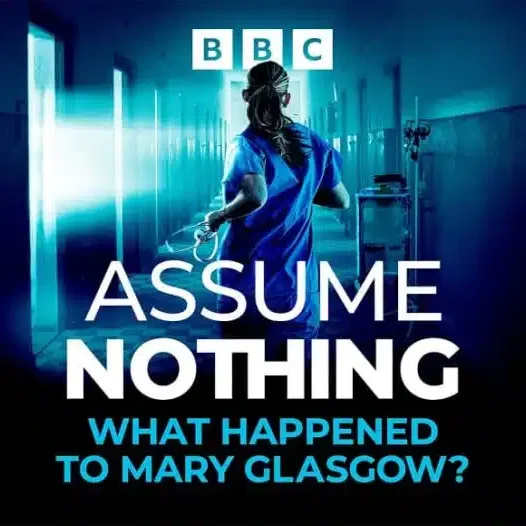
BBC Podcast Reopens 1991 Mystery: What Happened to Mary Glasgow at Stradreagh Hospital?
A fresh series from BBC is revisiting the mysterious circumstances surrounding the death of Mary Glasgow, a nursing assistant who collapsed and died following an incident with a patient in 1991.
The six-episode podcast, titled Assume Nothing: What Happened To Mary Glasgow, explores the unanswered questions surrounding the tragic event. Hosted by journalist Nathan Edgar, the series examines archival evidence, witness testimony, and expert analysis in an attempt to understand what really happened on that March morning.
The podcast is part of the long-running Assume Nothing investigative series produced by BBC Radio Ulster, which is known for examining complex and unresolved stories from Northern Ireland.
The death of Mary Glasgow in 1991 shocked colleagues, family members, and the wider community. At just 35 years old, she was a nursing assistant working the night shift at Stradreagh Hospital in Londonderry, Northern Ireland.
What initially appeared to be a workplace incident soon turned into a deeply puzzling case. Despite investigations and an inquest, the precise cause of her sudden collapse was never conclusively determined.
For decades, the unanswered questions surrounding her death have lingered, leaving family members searching for closure and clarity.
Now, with the launch of this new podcast, journalists and experts are once again examining the evidence to determine whether modern analysis might shed new light on the events of that night.
What Happened on the Night of 23 March 1991?
According to records revisited in the podcast, the tragic incident unfolded during the early hours of 23 March 1991 while Mary Glasgow was finishing her shift.
She had been working at the psychiatric facility when a patient suddenly became aggressive.
Key details from the night include:
Mary Glasgow was nearing the end of her night shift.
A patient reportedly became violent during an interaction.
A disturbance was heard by another staff member.
A colleague rushed to the scene to assist.
Mary collapsed shortly afterward.
Staff attempted emergency resuscitation.
Despite efforts to revive her, she died soon after.
The suddenness of the incident left colleagues shocked and confused. While the confrontation with the patient appeared to be a factor, investigators were unable to determine exactly what triggered Mary’s fatal collapse.
This lack of clarity would soon lead to years of questions and campaigning by her family.
A Husband’s Determined Search for Answers
Mary’s husband, Norman Glasgow, struggled to come to terms with the sudden loss of his wife.
What made the situation even more difficult was the absence of a clear explanation about how or why she died. Determined to uncover the truth, Norman began pressing authorities for a thorough investigation.
For months following the incident, he sought answers from hospital officials and the relevant authorities. Frustrated by delays and uncertainty, he pushed for an official inquest into the circumstances surrounding his wife’s death.
His persistence eventually led to formal proceedings aimed at examining the available evidence.
The Inquest: Evidence But No Final Answer
An inquest was eventually held to determine the cause of Mary Glasgow’s death. The hearing included detailed testimony and medical analysis.
During the proceedings:
Witnesses who were on duty that night provided sworn statements.
Medical experts presented postmortem findings.
Investigators reviewed the circumstances of the altercation.
Hospital procedures and safety conditions were examined.
Despite the evidence presented, the inquest ultimately failed to establish a definitive cause of death.
This outcome left Norman Glasgow and his family without the closure they had hoped for.
For many observers, the unanswered questions raised concerns about workplace safety in psychiatric hospitals and whether staff protections were sufficient at the time.
Concerns Over Safety in Psychiatric Facilities
The circumstances of Mary Glasgow’s death also sparked broader discussions about safety in mental health facilities.
During the early 1990s, psychiatric hospitals across the UK and Northern Ireland were grappling with evolving standards of care and workplace protection.
Healthcare workers frequently faced difficult and sometimes unpredictable situations while caring for vulnerable patients.
Issues raised in relation to the case included:
Staff training for handling violent incidents
Staffing levels during night shifts
Emergency response procedures
Safety protocols in psychiatric wards
Norman Glasgow repeatedly asked whether enough had been done to prevent such tragedies.
While no conclusive findings were made linking policy failures to Mary’s death, the questions raised by the case contributed to ongoing conversations about healthcare worker safety.
A Campaign That Lasted Decades
For Norman Glasgow, the search for answers became a lifelong mission.
Over the years he continued to raise awareness about his wife’s case, speaking publicly and seeking further review of the evidence.
His campaign focused on two main goals:
Understanding exactly what caused Mary’s death
Ensuring greater protection for healthcare workers
Friends and family described his determination as unwavering.
Even as the years passed, Norman remained committed to uncovering the truth behind the tragic incident.
Sadly, he passed away in 2021, still without a definitive explanation for what happened to his wife.
The Impact on Mary Glasgow’s Family
For Mary’s daughters, the case is not just a historical mystery—it is part of their personal history.
Growing up, they were surrounded by memories preserved by their father, including home videos and family recordings that captured moments from before the tragedy.
These materials have become an important archive of family life, offering glimpses of Mary Glasgow as a mother, wife, and colleague.
Yet alongside those memories lies a question that has never been fully answered.
Even after 35 years, the uncertainty surrounding her death remains deeply felt by those closest to her.
A Fresh Investigation Through Podcast Journalism
The new podcast series aims to revisit the case using modern investigative approaches.
Podcast journalism has increasingly become a powerful medium for exploring complex or unresolved stories. By combining narrative storytelling with investigative reporting, such series can bring renewed attention to events that might otherwise fade from public discussion.
In Assume Nothing: What Happened To Mary Glasgow, host Nathan Edgar brings together a team of specialists who examine the case from multiple angles.
Their approach includes:
Reviewing archived documents
Analyzing witness statements
Reconsidering medical findings
Consulting modern experts in forensic and medical fields
By reassessing the available evidence with contemporary knowledge, the podcast hopes to provide a clearer understanding of what may have happened.
The Role of the “Assume Nothing” Podcast Series
The podcast is part of the established Assume Nothing investigative brand produced by BBC Radio Ulster.
The series has previously gained recognition for its in-depth explorations of complex real-life stories.
Key features of the podcast include:
Long-form investigative storytelling
Interviews with experts and witnesses
Reexamination of historical evidence
Balanced and carefully researched reporting
Its award-winning format allows journalists to dive deeply into cases that require extensive context and analysis.
The Mary Glasgow investigation is the latest example of the series tackling a story with lingering unanswered questions.
Why the Case Still Matters Today
Although the events took place in 1991, the case continues to resonate for several reasons.
1. Workplace Safety in Healthcare
Healthcare workers remain among the professionals most exposed to workplace violence. Revisiting historical cases helps highlight the importance of robust safety policies.
2. The Role of Investigative Journalism
Modern investigative journalism often reopens older cases to reassess evidence using new perspectives.
3. Families Seeking Closure
For families affected by unresolved deaths, renewed attention can sometimes lead to fresh insights or new information.
4. Public Accountability
Reexamining past incidents encourages transparency and accountability in public institutions.
These factors help explain why the story of Mary Glasgow still captures public interest decades later.
Modern Analysis: Can New Insights Emerge?
One of the central goals of the podcast is to apply modern knowledge to the case.
Advances in several areas may offer new perspectives, including:
Medical understanding of sudden cardiac events
Improved forensic analysis techniques
Updated workplace safety standards
Psychological insights into violent incidents
While it remains uncertain whether the podcast will uncover definitive answers, its investigation may provide fresh context that was not available during the original inquiry.
Timeline of Key Events in the Mary Glasgow Case
To better understand the story, here is a simplified timeline of major developments:
1991 – March 23
Mary Glasgow collapses and dies after an altercation with a patient during her shift.
1991 – Following months
Her husband Norman Glasgow begins campaigning for an investigation.
Early 1990s
An inquest is held examining witness testimony and medical evidence.
Inquest Outcome
No definitive cause of death is determined.
1990s–2021
Norman Glasgow continues advocating for answers and raising concerns about hospital safety.
2021
Norman Glasgow dies after decades of campaigning.
2026
BBC Radio Ulster launches a podcast revisiting the case.
How and When to Listen to the Podcast
The podcast will be broadcast and released across BBC platforms.
Release schedule:
14 March 2026: First episodes air on BBC Radio Ulster
14 March 2026: Five episodes released simultaneously on BBC Sounds
21 March 2026: Final episode becomes available
Listeners can access the series through the BBC Sounds app or via BBC Radio Ulster broadcasts.
Renewed Attention to a Long-Standing Mystery
True-crime podcasts and investigative audio series have grown significantly in popularity over the past decade.
These productions often play a key role in bringing attention back to unresolved cases.
By presenting detailed narratives, interviews, and expert analysis, they can introduce historical events to a new generation of listeners.
In the case of Mary Glasgow, the podcast serves both as a tribute to her memory and an effort to better understand the circumstances surrounding her death.
Remembering Mary Glasgow
Beyond the investigation and unanswered questions lies the story of a woman remembered by family and colleagues.
Mary Glasgow was described as a dedicated healthcare worker who spent her career helping others.
Those who knew her recall her commitment to patients and her role as a caring mother and partner.
The podcast highlights these personal dimensions, ensuring that the story remains about more than just an unresolved case.
Will the Mystery Ever Be Solved?
It remains uncertain whether the renewed investigation will lead to a definitive explanation for Mary Glasgow’s death.
However, the podcast’s exploration of the case demonstrates the enduring importance of seeking answers—even decades later.
For her family, the series represents another step in keeping her story alive and continuing the search for understanding.
And for listeners, it offers a compelling look at how investigative journalism can revisit history in the pursuit of truth.