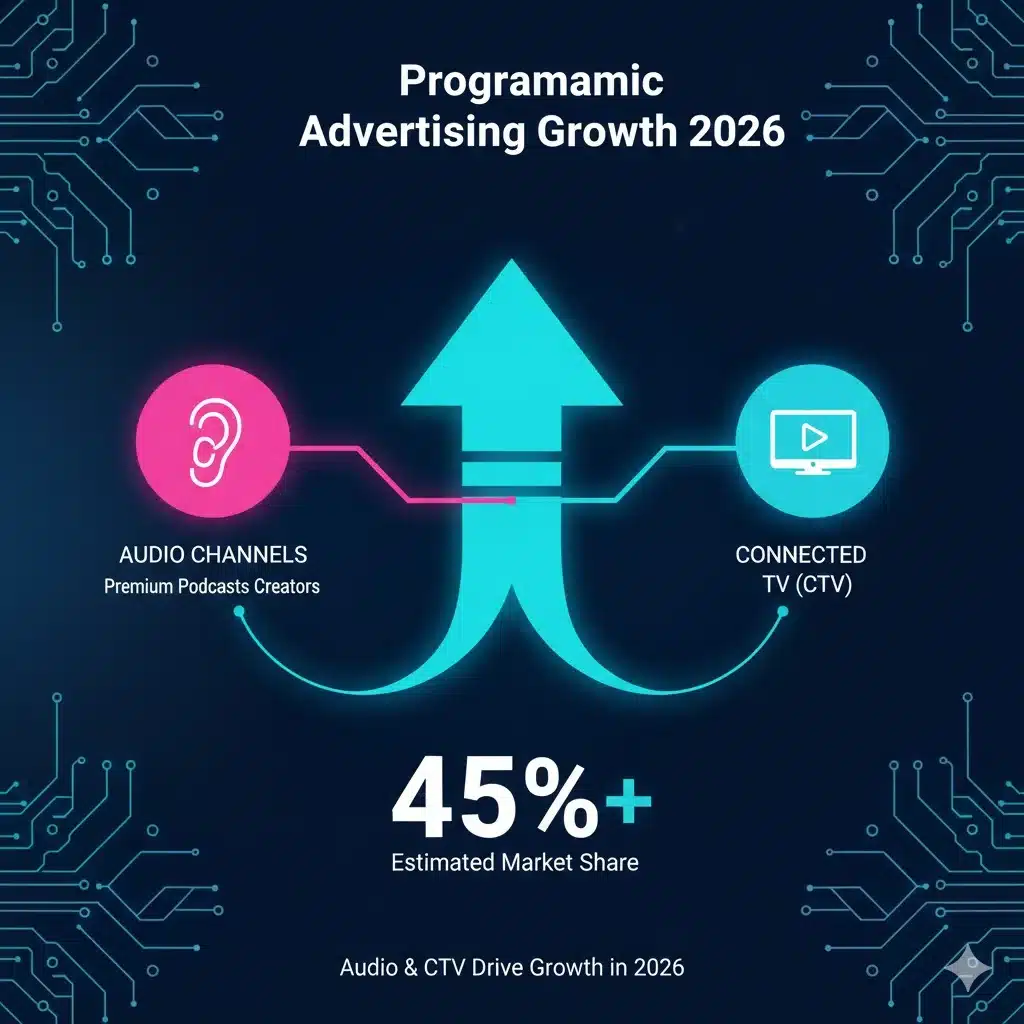
Audio and CTV Drive Programmatic Ad Budget Growth in 2026: Comscore Report
Programmatic advertising is no longer just a buzzword—it is now a central pillar of modern media planning. According to Comscore’s newly released “2026 State of Programmatic Report,” audio and connected television (CTV) are emerging as the only two media channels projected to experience year-over-year growth in programmatic ad spending in 2026.
The findings underscore a significant transformation underway in the global advertising ecosystem. As marketers seek greater efficiency, transparency, and performance accountability, budgets are increasingly shifting away from traditional linear channels and toward automated, data-driven buying models.
This evolution signals not just growth—but maturity—in the programmatic marketplace.
Programmatic Advertising Gains Stronger Acceptance Among Marketers
The Comscore report reveals that programmatic adoption is accelerating, driven by improved measurement tools, cross-channel visibility, and advancements in artificial intelligence.
Key findings at a glance:
58% of media buyers expect their programmatic ad investments to increase in 2026
87% of marketers say cross-channel performance metrics within programmatic platforms are either critical or highly valuable
Audio and CTV are the only channels forecast to see sustained programmatic budget growth
Rather than prioritizing sheer scale, marketers are now focusing on intentional spend, quality placements, and demonstrable outcomes.
Audio Advertising Sees Renewed Momentum Through Programmatic Buying
Once considered difficult to buy at scale, audio advertising is undergoing a renaissance thanks to programmatic infrastructure.
Comscore projects that programmatic audio will capture an average of 10% of total media budgets in 2026. This growth is largely fueled by advertisers reallocating spend from traditional linear radio to programmatic audio environments.
Why audio is gaining traction:
21% of advertisers say they are shifting budgets from linear radio to programmatic audio
Increased access to premium inventory through DSP integrations
Better targeting and attribution capabilities using first-party data
Streaming platforms, podcasts, and digital radio are increasingly viewed as brand-safe, high-attention environments—particularly when activated programmatically.
Connected TV Becomes the Centerpiece of Video Advertising Strategy
If audio is rising steadily, CTV is surging.
The report finds that 45% of marketers are moving budgets from linear television to CTV, positioning connected TV as the dominant growth engine in programmatic video.
Comscore estimates that CTV will account for 26% of total media budgets on average in 2026, a clear indication that advertisers are prioritizing measurable, data-enabled video environments over traditional broadcast TV.
What’s driving CTV growth:
Advanced audience targeting and household-level measurement
Reduced waste compared to linear TV
Integration with omnichannel programmatic strategies
CTV’s ability to combine the storytelling power of television with the precision of digital advertising has made it a top priority for brand and performance marketers alike.
Performance Measurement Remains Central to Programmatic Decision-Making
Despite evolving buying methods, advertisers continue to rely on familiar performance metrics to evaluate campaign success.
Most-used programmatic effectiveness metrics:
Conversion rate – used by 62% of buyers
Return on ad spend (ROAS) – cited by 47%
Reach and frequency – also used by 46%
Click-through rate (CTR) and social engagement play secondary roles
The data suggests that while new technologies shape how ads are bought, outcomes still define value.
AI Emerges as a Critical Force in Programmatic Advertising
Artificial intelligence is rapidly becoming embedded in every layer of the programmatic ecosystem.
According to Comscore:
82% of marketers say AI-powered optimization is essential
69% plan to use AI-generated creative in some capacity in 2026
Only 11% expect AI to produce more than 40% of their creatives, indicating cautious adoption
Rather than replacing human creativity, AI is being deployed strategically to enhance efficiency, accuracy, and safety.
Top AI Use Cases Marketers Expect to Rely On in 2026
The report outlines how marketers plan to integrate AI across the programmatic workflow:
Audience targeting and modeling – 88%
Campaign pacing and bid automation – 77%
Measurement and attribution – 71%
Fraud detection and brand safety – 70%
These applications highlight AI’s role in optimization and governance, not just content generation.
First-Party Data and Contextual Targeting Gain Importance
As privacy regulations tighten and third-party cookies continue to fade, marketers are embracing privacy-forward strategies.
Comscore finds that:
43% of marketers plan to increase their use of contextual targeting in 2026
First-party data is playing a central role in audience activation
Contextual intelligence—paired with trusted publisher environments—is helping advertisers maintain relevance without compromising user privacy.
Industry Perspective: Programmatic’s Shift From Scale to Strategy
Rachel Gantz, Managing Director of Research at Comscore, describes the moment as a turning point for the industry.
“Programmatic is entering its mature growth phase, where buyers are moving budget with purpose and demanding transparency, quality, and outcomes across every screen,” Gantz said.
She added that the next wave of growth will be fueled by smarter budget allocation across CTV, audio, and privacy-forward activation models, powered by AI.
Audio Industry Responds With Expanded Programmatic Access
Audio companies are moving quickly to remove historical buying barriers.
iHeartMedia, one of the world’s largest audio networks, has recently announced several strategic integrations aimed at simplifying programmatic access.
Recent developments include:
Integration with Viant Technology
Inventory availability across StackAdapt, Yahoo DSP, and Google Display & Video 360
A new partnership with Amazon DSP, expanding access to digital audio inventory
Notably, iHeartMedia plans to make broadcast radio inventory programmatically available in the coming months—a major milestone for the industry.
Making Radio Easier to Buy Is the Next Frontier
iHeartMedia CEO Bob Pittman recently addressed the challenge facing traditional radio in a podcast interview.
“The impediment is that buyers say, ‘I know radio works, but it’s hard to buy,’” Pittman said. “What’s important for us as an industry is to get on all the dashboards with all of our products.”
The message is clear: ease of access and integration will determine future growth.
What This Means for Advertisers in 2026
The Comscore report paints a picture of a more disciplined, data-literate, and outcome-driven advertising landscape.
Key takeaways for marketers:
Programmatic is no longer experimental—it’s foundational
Audio and CTV are the fastest-growing programmatic channels
AI is essential, but human oversight remains critical
Privacy-forward targeting is now a competitive advantage
As programmatic continues to evolve, success will depend on intentional investment, smarter technology use, and measurable performance.
Final Thoughts: A Smarter, More Accountable Programmatic Era
The 2026 programmatic market is defined less by hype and more by strategic precision. With audio and CTV leading the charge, and AI enhancing—not replacing—human decision-making, advertisers are entering an era where every dollar is expected to work harder.
For brands, agencies, and publishers alike, the message is unmistakable: The future of advertising is automated, accountable, and audience-first.