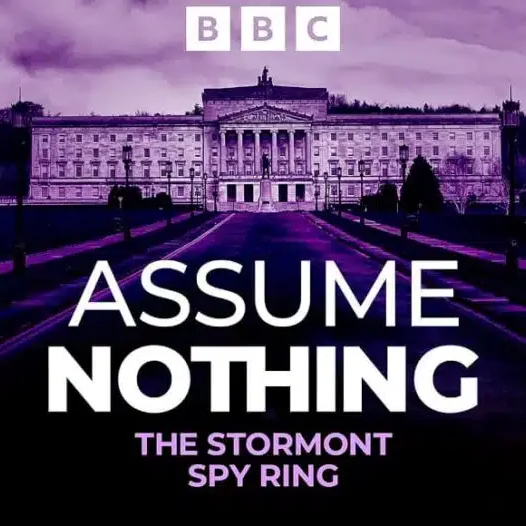
Assume Nothing Podcast Explores Stormont Spy Ring and Denis Donaldson Murder
BBC Radio Ulster has unveiled a powerful new investigative audio series, Assume Nothing: The Stormont Spy Ring, an eight-part podcast that revisits one of the most controversial and unresolved espionage scandals in Northern Ireland’s recent history. Blending deep reporting, archival material, and first-hand testimony, the podcast reopens the story of Denis Donaldson — a senior Sinn Féin figure whose secret role as a long-term informer and subsequent murder sent shockwaves through politics, policing, and the peace process.
Narrated by Blue Lights actor Martin McCann, the series promises not just a retelling of events, but a forensic examination of how a single investigation destabilised Stormont, exposed the murky overlap between intelligence agencies and politics, and left behind unanswered questions that still haunt Donaldson’s family two decades later.
The Stormont spy ring affair was never just a criminal case. It was a moment that threatened to unravel Northern Ireland’s fragile power-sharing arrangements at a critical stage of the peace process. By revisiting the affair in long-form podcast format, Assume Nothing taps into renewed public interest in unresolved legacy cases, state accountability, and the ethics of intelligence operations during and after the Troubles.
BBC Radio Ulster describes the series as an attempt to move beyond headlines and assumptions, using new interviews and untold details to reconstruct what really happened — and why it still matters today.
Who Was Denis Donaldson?
Denis Donaldson was not a marginal figure. For decades, he operated at the heart of republican politics:
A trusted Sinn Féin official
A key organiser within the party
A long-standing participant in negotiations during the peace process
Yet in 2005, Donaldson made a stunning public confession: he had been supplying information to the police and MI5 for more than 20 years. The admission shattered trust within republican circles and raised profound questions about how deeply British intelligence had penetrated political movements in Northern Ireland.
Just months later, in April 2006, Donaldson was found shot dead in a remote cottage in County Donegal.
The Series Begins Before the Murder
Rather than opening with Donaldson’s death, Assume Nothing: The Stormont Spy Ring deliberately rewinds the clock.
The first episodes focus on a dramatic police raid at the heart of Belfast’s security apparatus — Special Branch headquarters. What began as a routine investigation quickly escalated into something far more explosive.
Key Early Events Explored in the Podcast
A police raid uncovering sensitive and incomplete government documents
Initial suspicions pointing toward IRA involvement
A widening investigation that began to implicate political figures
The sudden emergence of allegations about a republican spy ring operating within Stormont itself
The podcast paints a picture of a criminal inquiry spiralling into a full-blown political crisis.
The Stormont Spy Ring Allegations
At the height of the controversy, Donaldson and three other individuals were arrested on suspicion of running a republican intelligence operation from within the Northern Ireland Assembly.
The implications were staggering:
Claims of mass surveillance and intelligence leaks
Allegations that Stormont itself had been compromised
Immediate political fallout threatening the future of devolved government
Unionist parties withdrew support from power-sharing arrangements, citing national security concerns. Stormont was suspended, and trust between political factions deteriorated rapidly.
Yet, despite the scale of the claims, the case ultimately collapsed.
Charges Dropped, Questions Remain
Prosecutors later dropped all charges against those accused in the alleged spy ring. No convictions followed. No definitive explanation was offered that satisfied all sides.
This sudden legal reversal left lingering questions:
Was the evidence insufficient, or fundamentally flawed?
Had intelligence concerns overridden the possibility of a public trial?
Were political considerations at play behind the scenes?
The podcast examines these questions through interviews with journalists, former security personnel, and individuals close to the investigation.
Donaldson’s Confession and Disappearance
In December 2005, Denis Donaldson publicly admitted that he had been an informer for MI5 and the police since the early 1980s.
Following the confession:
He resigned from Sinn Féin
He withdrew entirely from public life
He relocated to a secluded cottage in Donegal
The series explores Donaldson’s psychological state during this period, portraying a man isolated, fearful, and acutely aware of the danger surrounding him.
An Unsolved Murder in Donegal
On 4 April 2006, Denis Donaldson was found dead in his rural home, shot at close range. The killing was widely assumed to be an act of retribution.
Initially, the IRA was blamed, but the organisation later issued a rare statement denying responsibility. No one has ever been charged with the murder.
Twenty years later, Donaldson’s killing remains one of the most high-profile unsolved cases linked to the legacy of the Troubles.
The Missing Journal: A Crucial Clue?
One of the most intriguing aspects explored in the podcast is a personal journal Denis Donaldson was reportedly writing in the months before his death.
According to the series:
The journal is believed to contain reflections on his role as an informer
It may include details of intelligence operations and political interactions
It is currently held by Irish police
Donaldson’s family has repeatedly sought the journal’s return, arguing it could provide vital answers. To date, those requests have been unsuccessful.
Voices Behind the Investigation
Assume Nothing: The Stormont Spy Ring draws on a wide range of contributors, including:
Investigative journalists who covered the story as it unfolded
Former security and intelligence figures
Political insiders familiar with Stormont at the time
Individuals personally connected to Denis Donaldson
This multi-perspective approach allows the series to challenge long-held assumptions and present competing interpretations of events.
Narration by Martin McCann
Actor Martin McCann, known for his role in BBC drama Blue Lights, brings a restrained and authoritative tone to the series. His narration balances emotional sensitivity with journalistic distance, helping guide listeners through a complex web of political intrigue, secrecy, and loss.
Why This Story Still Matters
Two decades on, the Stormont spy ring affair continues to resonate:
It highlights the lasting impact of intelligence operations on democratic institutions
It raises ethical questions about informers and state power
It underscores the unresolved legacy of violence and secrecy in Northern Ireland
In an era of renewed debate about transparency, accountability, and historical truth, the podcast arrives at a moment when audiences are once again asking uncomfortable questions.
BBC Sounds Availability
All eight episodes of Assume Nothing: The Stormont Spy Ring are now available to stream on BBC Sounds. The podcast is part of the broadcaster’s ongoing commitment to long-form investigative journalism and in-depth storytelling.
Listeners can access the series via:
BBC Sounds app
BBC Sounds website
Smart speakers and podcast platforms supporting BBC content
Conclusion
Assume Nothing: The Stormont Spy Ring is more than a true-crime podcast. It is a meticulous re-examination of a case that shook Northern Ireland’s political foundations and left a family without answers.
By combining narrative depth with investigative rigor, BBC Radio Ulster offers audiences an opportunity to revisit a defining moment in recent history — and to reflect on how much remains unresolved.