Spotify Launches Narrated Magazine Articles to Expand Spoken-Word Audio Strategy
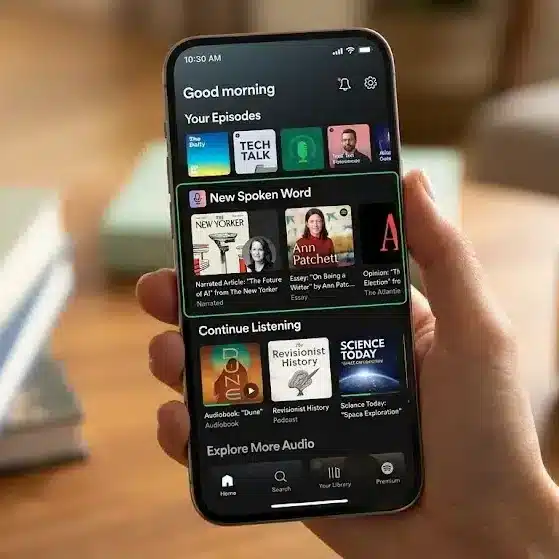
Spotify is taking another major step in its evolution from a music streaming platform into a full-scale audio media ecosystem. The company has officially launched narrated magazine articles, signaling a deeper investment in spoken-word content and expanding the boundaries of what users can consume inside the Spotify app.
The new feature allows listeners to stream professionally narrated long-form journalism from some of the world’s most recognizable magazines and media brands. More than 650 English-language articles are now available on Spotify, opening the door for users to experience magazine storytelling in audio format alongside music, podcasts, and audiobooks.
The rollout represents more than just another content category. It highlights Spotify’s broader ambition to dominate audio consumption across every part of daily life — from commuting and workouts to evening relaxation and bedtime listening.
The company says the narrated articles initiative is designed to meet changing user behavior, especially among audiences increasingly turning toward passive listening experiences over traditional reading.
Spotify’s Spoken-Word Strategy Continues to Expand
Over the last several years, Spotify has aggressively expanded beyond music streaming. Podcasts became the company’s first major spoken-word focus, followed by audiobooks. Now, narrated journalism appears to be the next piece in Spotify’s growing audio ecosystem.
The newly launched feature includes stories from leading publications such as:
Rolling Stone
The Atlantic
Vogue
Variety
Billboard
Vibe
GQ
Wired
Vanity Fair
Pitchfork
Spotify says the collection has been curated internally by its Audiobooks division and focuses on stories related to entertainment, culture, technology, music, fashion, and social trends — categories that already resonate strongly with Spotify’s user base.
The move places Spotify in direct competition with emerging audio journalism platforms while also creating a unique bridge between traditional publishing and modern streaming behavior.
Industry analysts believe the feature could significantly increase user engagement inside the Spotify ecosystem by reducing the need for users to leave the app for long-form content consumption.
Why Spotify Is Betting Big on Audio Journalism
Spotify’s latest expansion reflects a broader industry shift toward multitasking-friendly media experiences. As digital audiences become increasingly busy and mobile-first, audio has emerged as one of the fastest-growing content formats globally.
Narrated articles allow users to consume in-depth journalism while driving, exercising, cooking, studying, or commuting — activities where traditional reading becomes difficult.
Spotify appears to understand this behavioral trend extremely well.
According to company executives, the goal is not simply to create another content category but to develop stronger listening habits around spoken-word content overall.
Colleen Prendergast, Licensing Lead at Spotify Audiobooks, explained that narrated articles are intended to complement the company’s existing audiobook and podcast strategy.
She noted that listeners already visit Spotify for entertainment, education, commentary, and storytelling. By adding shorter-form long-form journalism into the mix, Spotify believes it can gradually increase user engagement with audiobooks and spoken content over time.
This approach also reflects Spotify’s broader strategy of becoming an “always-on” platform embedded into users’ daily routines.
Narrated Articles Designed for Shorter Attention Spans
One of the most interesting aspects of Spotify’s new feature is the format length.
Unlike full-length audiobooks that often require hours of listening commitment, each narrated article is under two hours long. This shorter duration makes the content easier to consume in single listening sessions.
The format appears specifically designed for modern attention spans and fragmented media habits.
Instead of asking listeners to commit to a 12-hour audiobook, Spotify is offering digestible yet intellectually engaging audio experiences.
This could especially appeal to younger audiences who prefer quick but meaningful content consumption.
The rise of TikTok, YouTube Shorts, and short-form social media has changed how audiences engage with content online. However, there remains strong demand for high-quality journalism — provided it can be consumed conveniently.
Spotify’s narrated article strategy attempts to merge depth with accessibility.
Premium Users Get Access Through Existing Audiobook Plans
Spotify has integrated the new Articles feature into its existing audiobook ecosystem rather than launching it as a separate subscription product.
Premium users in eligible audiobook-supported markets can access narrated articles using their monthly audiobook listening allowance.
Meanwhile, free-tier users are not entirely excluded. Spotify says they can purchase individual narrated articles for $1.99 each.
This pricing strategy gives Spotify flexibility in monetizing spoken-word journalism while also encouraging free users to upgrade to Premium subscriptions.
It also creates a potentially valuable new revenue stream for media publishers participating in the initiative.
For publishers facing declining web traffic and shrinking advertising revenue, narrated content licensing may offer an additional monetization opportunity.
A New Discovery Channel for Magazine Publishers
Spotify’s recommendation algorithms and personalization systems have long been one of the company’s biggest strengths.
Now, publishers could benefit from those same discovery mechanics.
Spotify says its personalization tools will help surface magazine stories directly to listeners most likely to engage with them.
For example:
Music fans may receive narrated artist profiles from Rolling Stone or Billboard
Entertainment audiences may be recommended Variety interviews or Vanity Fair deep-dives
This level of contextual targeting could help publishers reach entirely new audiences beyond traditional web readership.
In many ways, Spotify is positioning itself not just as a streaming platform but also as a distribution engine for digital journalism.
That could become increasingly important as traditional publishers struggle with search traffic volatility and social media algorithm changes.
Spotify Wants to Become an “Audio Companion”
The launch closely aligns with messaging Spotify executives delivered during the company’s recent Investor Day presentation.
Executives repeatedly emphasized Spotify’s transformation into a broader AI-driven media and spoken-word platform rather than just a music app.
Spotify co-CEO Alex Norström described the company’s vision as becoming a “trusted companion” throughout users’ daily lives.
Instead of encouraging binge listening, Spotify wants users to integrate audio into every part of their routine.
Norström highlighted several everyday scenarios where Spotify aims to fit naturally into users’ schedules:
Morning commutes
Study sessions
Workout routines
Dinner preparation
Evening relaxation
Bedtime storytelling
This positioning reflects a major strategic shift.
Spotify no longer wants to be viewed solely as an entertainment destination. Instead, it wants to become a constant audio layer accompanying users throughout the day.
Narrated journalism fits perfectly into this vision.
AI and Personalization Are Central to Spotify’s Future
Another major theme from Spotify’s Investor Day was AI-powered personalization.
Co-CEO Gustav Söderström explained that Spotify is entering what he described as “the era of generation.”
According to Söderström, future media experiences will increasingly be shaped dynamically around user preferences, context, mood, and intent rather than simply selected from static catalogs.
This could have significant implications for narrated journalism.
In the future, Spotify may use AI to:
Recommend articles based on listening habits
Curate personalized journalism playlists
Adapt narration styles to user preferences
Create contextual listening experiences throughout the day
Blend podcasts, articles, and audiobooks into seamless recommendations
Spotify has already experimented heavily with AI-driven recommendation systems and AI-powered DJ experiences.
The addition of narrated articles may provide another content layer for future personalization initiatives.
Spotify’s Audiobook Business Continues Rapid Growth
Spotify’s audiobook business remains relatively new compared to its music streaming operation, but the company says growth has been strong.
Since launching audiobooks just over two years ago, Spotify has expanded the service into 22 markets globally.
The company also revealed that audiobook listening hours have increased by 60% year over year.
That growth likely encouraged Spotify to broaden its spoken-word offerings further.
In addition to audiobooks, Spotify has introduced several features aimed at improving user engagement, including:
Page Match
Recaps
Follow Along features
These tools help users track progress, revisit content, and engage more deeply with long-form listening experiences.
Narrated articles now become another extension of this broader spoken-audio strategy.
The Rise of Passive Content Consumption
Spotify’s move also reflects broader changes happening across digital media.
Consumers increasingly prefer passive content experiences that fit into busy lifestyles.
Audio offers several advantages over text-based content:
Convenience
Listeners can consume content while multitasking.
Reduced Screen Fatigue
Many users are actively trying to reduce screen time.
Accessibility
Audio makes journalism more accessible for visually impaired users and those with reading difficulties.
Emotional Engagement
Narration can create stronger emotional connections than plain text.
The popularity of podcasts already demonstrated the massive demand for conversational and narrative audio formats.
Narrated journalism may now become the next major category within spoken-word media.
Could Narrated Journalism Become the Next Big Media Trend?
Spotify’s entry into narrated journalism could accelerate broader adoption across the publishing industry.
Many media organizations have already experimented with audio storytelling, but Spotify’s scale gives the format mainstream exposure.
If the initiative proves successful, other platforms may quickly follow.
Potential competitors could include:
Apple Podcasts
Audible
YouTube Music
Amazon Music
Substack
News publishers launching direct audio apps
Some analysts believe narrated journalism could evolve into a major standalone subscription category in the future.
For publishers, this creates opportunities to repurpose existing editorial content into additional formats without producing entirely new material.
What This Means for the Future of Journalism
Spotify’s latest move also raises important questions about the future relationship between journalism and technology platforms.
Historically, publishers relied heavily on websites, search engines, and social media for distribution.
Now, streaming platforms may become an entirely new traffic and engagement channel.
This transition could reshape how journalism is consumed in the coming years.
Instead of reading long-form investigative pieces on websites, audiences may increasingly listen to them during daily routines.
This could influence:
Writing styles
Story structure
Narrative pacing
Audio-first editorial production
Advertising models
Publishers may eventually begin creating stories specifically optimized for narration rather than traditional reading.
The Challenge of Balancing Journalism and Platform Dependency
Despite the opportunities, some concerns remain.
Publishers have previously become heavily dependent on tech platforms such as Facebook and Google, only to face traffic declines after algorithm changes.
Spotify’s growing role in journalism distribution may eventually create similar dependency risks.
Media companies will likely need to balance platform partnerships carefully while maintaining direct audience relationships.
Additionally, monetization structures for narrated journalism are still evolving.
Questions remain around:
Revenue sharing
Licensing fees
Listener payouts
Data access for publishers
Ownership of audience relationships
As the format matures, these issues may become increasingly important.
Spotify’s Broader Battle for User Attention
At its core, Spotify’s narrated articles strategy is ultimately about one thing: attention.
Streaming platforms are competing aggressively for consumer time across multiple content formats.
Music alone is no longer enough to sustain growth.
By integrating podcasts, audiobooks, AI experiences, and now narrated journalism, Spotify is attempting to maximize the amount of time users spend inside its ecosystem.
The longer users remain on the platform, the greater the opportunities for:
Subscription retention
Advertising revenue
Content discovery
Cross-promotion
Personalized engagement
Narrated articles provide another tool in Spotify’s effort to dominate audio consumption globally.
Early Reactions From the Industry
Initial reactions to Spotify’s announcement have been largely positive among digital media observers.
Many see the move as a smart evolution of audio storytelling.
Publishing executives are also likely watching closely to evaluate whether narrated content can drive additional engagement and revenue.
Some experts believe the initiative could especially benefit younger audiences who are more accustomed to consuming information through audio and video rather than traditional reading.
Others caution that success will depend heavily on narration quality, content selection, and recommendation algorithms.
Spotify’s existing strengths in personalization may give it a competitive advantage here.
Will Users Actually Listen to Magazine Articles?
One major question remains: will mainstream audiences embrace narrated journalism at scale?
Podcast success suggests there is significant appetite for spoken storytelling. However, long-form journalism occupies a slightly different consumption category.
User adoption may depend on several factors:
Quality of Narration
Professional voice acting and engaging delivery will be crucial.
Story Selection
Highly compelling and culturally relevant stories are more likely to succeed.
Discovery Experience
Spotify’s recommendation engine must effectively surface content users actually want.
Listening Convenience
Seamless integration into existing routines will matter significantly.
If Spotify can execute well across these areas, narrated journalism could become a major new growth category.
Spotify Is No Longer Just a Music App
The launch of narrated magazine articles further reinforces a reality that has become increasingly clear over the past few years:
Spotify is transforming into a broader audio media company.
Music remains foundational to the platform, but spoken-word content is rapidly becoming equally important to its long-term strategy.
Podcasts helped Spotify establish credibility beyond music streaming. Audiobooks expanded its role in long-form storytelling. Now, narrated journalism pushes the company deeper into informational and editorial content.
The boundaries between streaming, publishing, and media consumption are becoming increasingly blurred.
Spotify appears determined to sit at the center of that transformation.
Final Thoughts
Spotify’s expansion into narrated magazine articles represents a significant milestone in the evolution of digital audio.
The move combines several powerful trends shaping modern media consumption:
The rise of passive listening
Growing demand for multitasking-friendly content
Expansion of spoken-word entertainment
AI-driven personalization
The search for new publishing revenue streams
Whether narrated journalism becomes mainstream remains to be seen. However, Spotify’s massive global reach gives the format a strong opportunity to scale quickly.
As audiences continue shifting toward audio-first experiences, platforms capable of blending entertainment, education, storytelling, and journalism into seamless daily routines may define the future of media.