Podscribe Radio Advertising Measurement | Full Attribution & Verification Explained
Podscribe has introduced a new suite of tools aimed at bridging the long-standing gap between traditional broadcast media and digital analytics. The newly launched Radio Measurement Capabilities promise to deliver deeper insights, real-time verification, and precise attribution for radio advertising—an area historically considered difficult to measure.
With advertisers increasingly demanding accountability and performance metrics across all channels, Podscribe’s latest innovation signals a major shift in how radio’s effectiveness is tracked, validated, and optimized.
For decades, radio has remained one of the most powerful mass-reach mediums. Yet, despite its widespread influence, it has struggled to keep pace with digital platforms when it comes to measurable performance.
Unlike online advertising—where impressions, clicks, and conversions can be tracked in real time—radio’s analog, one-to-many broadcast structure has made it challenging to connect ad exposure directly to consumer actions.
Podscribe’s new solution aims to change that narrative.
“Radio has always driven impact, but proving that impact hasn’t kept pace,” said Matt Drengler, Head of Partnerships at Podscribe, in an official statement. “We’re bringing a digital-looking, digital-feeling measurement layer to radio so advertisers can finally evaluate performance with the same confidence they have in their online channels.”
What Are Radio Measurement Capabilities?
At its core, Podscribe’s Radio Measurement Capabilities are designed to provide advertisers with:
Accurate attribution modeling
Campaign verification tools
Incrementality measurement
Performance analytics across markets
The system integrates advanced technologies—including machine learning and Bayesian modeling—to deliver insights that were previously unavailable in traditional radio advertising.
Why Radio Measurement Has Lagged Behind
Radio’s measurement challenges stem from its infrastructure. Unlike digital platforms that rely on user-level data and tracking pixels, radio broadcasts are distributed broadly without direct user interaction.
Key limitations of traditional radio measurement:
Lack of real-time tracking
Limited visibility into audience behavior post-exposure
Difficulty linking ads to conversions
Fragmented reporting across markets and stations
This has often forced advertisers to rely on indirect metrics such as reach estimates, surveys, or generalized attribution models—methods that lack precision and immediacy.
How Podscribe Is Changing the Game
Podscribe’s approach introduces a data-driven, technology-first framework to radio measurement. By combining multiple data sources and advanced analytics, the platform creates a comprehensive view of campaign performance.
Core Innovations Include:
1. Machine Learning and Bayesian Modeling
The platform continuously updates its understanding of campaign performance using Bayesian statistical methods. This allows:
Dynamic adjustment based on incoming data
Improved accuracy over time
Better estimation of incremental impact
2. Multi-Source Data Integration
Podscribe aggregates data from several inputs, including:
Media Monitors for tracking ad airplay
Direct logs from audio publishers
Agency-provided campaign data
This multi-layered approach ensures a more reliable and complete dataset.
Real-Time Verification: Ensuring Ads Actually Air
One of the standout features of the new system is its verification capability, which confirms whether ads were broadcast as planned.
Verification features include:
Monitoring live radio broadcasts
Confirming exact airtime and station details
Identifying the specific creative used
Sharing audio clips of aired ads with stakeholders
Conducting spot checks before full campaign measurement
This level of transparency provides advertisers with proof of execution—something that has long been missing in radio campaigns.
Attribution That Mirrors Digital Precision
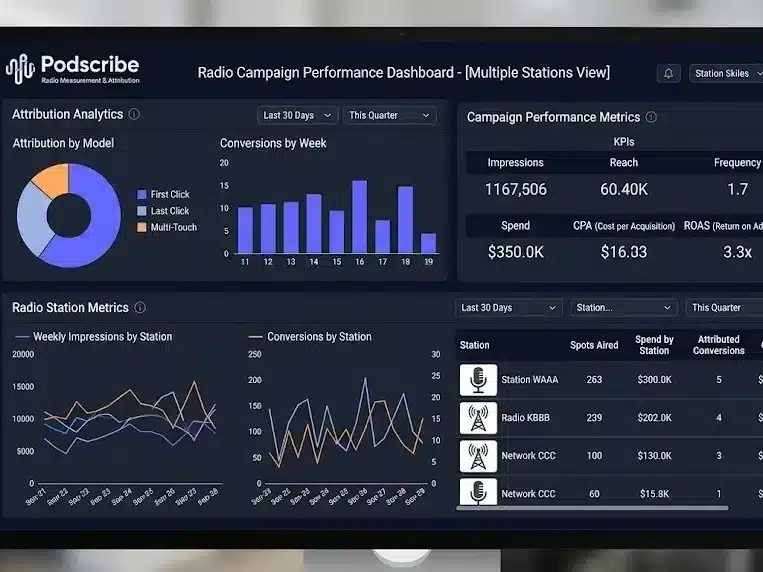
Beyond verification, Podscribe’s solution offers detailed attribution analysis, allowing advertisers to measure the direct impact of radio campaigns on business outcomes.
Metrics tracked include:
Website visits
Customer sign-ups
Product purchases
Mobile app downloads
Granular insights available by:
Designated Market Area (DMA)
Radio station
Genre
Campaign timing
The system also compares campaign performance against baseline metrics to determine conversion lift, giving brands a clearer picture of ROI.
From Local Campaigns to National Reach
Podscribe emphasizes that its Radio Measurement Capabilities are built to scale.
Whether advertisers are running:
Small, single-market tests
Regional campaigns
Nationwide advertising initiatives
…the platform can adapt to different campaign sizes and complexities.
It also supports all audio publishers and buying models, making it versatile across the advertising ecosystem.
A Phased Approach for Advertisers
Recognizing that not all advertisers are ready to adopt full-scale attribution immediately, Podscribe offers a flexible onboarding strategy.
Step-by-step adoption model:
Start with Airchecks
Verify ad placements
Review broadcast accuracy
Gain initial transparency
Layer on Measurement
Add performance tracking
Analyze conversion data
Optimize campaigns
This phased approach allows brands to build confidence before committing to comprehensive measurement solutions.
Introducing Smart Columns: Simplifying Data Analysis
Alongside its radio measurement launch, Podscribe has also rolled out a reporting enhancement called Smart Columns.
What Smart Columns Do:
Automatically display relevant metrics for each campaign
Eliminate manual customization
Reduce data clutter
Improve reporting efficiency
This feature is particularly useful for marketers managing multiple campaigns, as it streamlines analysis and focuses attention on actionable insights.
Industry Implications: A Shift Toward Accountability
Podscribe’s latest innovation comes at a time when advertisers are demanding greater transparency across all media channels.
Key trends driving this shift:
Increased scrutiny on ad spend ROI
Growth of omnichannel marketing strategies
Demand for unified measurement frameworks
Rising competition between traditional and digital media
By bringing digital-style analytics to radio, Podscribe is helping to level the playing field.
What This Means for Advertisers
The introduction of Radio Measurement Capabilities could significantly impact how brands allocate their advertising budgets.
Potential benefits include:
Improved ROI visibility
Better campaign optimization
Enhanced trust in radio advertising
Data-driven decision-making
Advertisers who previously hesitated to invest heavily in radio due to measurement limitations may now reconsider its role in their media mix.
Challenges and Considerations
While the technology marks a major advancement, adoption may still face some hurdles:
Integration with existing marketing stacks
Learning curve for new analytics tools
Data privacy considerations
Dependence on accurate input data
However, the long-term benefits are likely to outweigh these initial challenges.
The Future of Audio Advertising Measurement
Podscribe’s move reflects a broader evolution in the advertising industry—where every channel is expected to deliver measurable outcomes.
As audio consumption continues to grow across:
Podcasts
Streaming platforms
Satellite radio
Traditional broadcasts
…the demand for unified measurement solutions will only intensify.
Podscribe’s innovation positions it at the forefront of this transformation.
Final Thoughts
The launch of Radio Measurement Capabilities by Podscribe marks a significant milestone in the evolution of advertising analytics.
By combining verification, attribution, and advanced modeling into a single platform, the company is addressing one of the most persistent challenges in media measurement.
For advertisers, this could mean a new era where radio is no longer a “black box” but a fully accountable, performance-driven channel.