Descript’s Orwellian Ad Campaign Goes Viral: Why Businesses Must Embrace Video Now
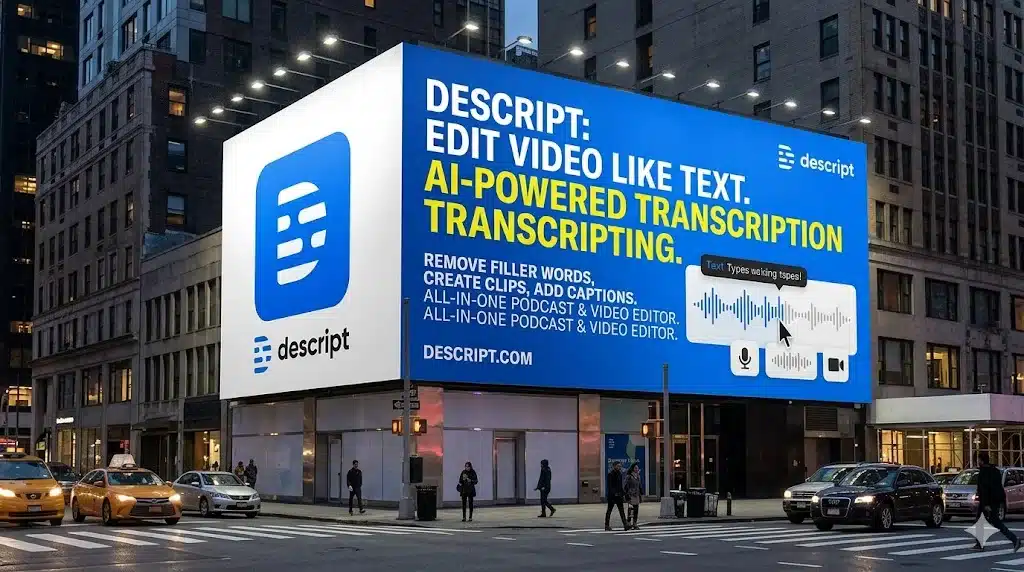
Descript has rolled out its first-ever outdoor advertising campaign — and it’s anything but conventional. Taking over the bustling Montgomery Street Station in San Francisco, the company has embraced a deliberately unsettling, dystopian aesthetic to deliver a message many brands would hesitate to state so bluntly: businesses need to produce more video content — now.
Described internally as “Orwellian” and “intentionally dystopian,” the campaign uses provocative visuals and exaggerated messaging to confront commuters with a reality that many marketers already sense but rarely articulate so starkly.
This isn’t just a campaign. It’s a statement — and perhaps even a warning.
Most brands aim to attract, inspire, or entertain. Descript, however, has taken a radically different approach — choosing to unsettle its audience instead.
According to Head of Product Laura Burkhauser, the discomfort is intentional and central to the campaign’s message.
“The imagery is meant to feel uncomfortable because the truth behind it is uncomfortable,” she explained in a detailed blog post accompanying the launch.
At its core, the campaign highlights a growing tension in today’s content ecosystem:
The overwhelming volume of digital content
The increasing pressure on creators and brands
The struggle to maintain quality while scaling output
By leaning into this tension, Descript is attempting to reflect the anxiety many creators and marketers feel — but rarely see represented in advertising.
The Visual Language: Dystopia Meets Marketing Reality
Inspired by Orwellian Themes
The campaign’s artistic direction draws heavily from dystopian motifs often associated with Nineteen Eighty-Four. Stark visuals, exaggerated typography, and almost oppressive messaging dominate the station’s ad spaces.
These aren’t the polished, aspirational visuals typical of tech advertising. Instead, they feel urgent, loud, and deliberately overwhelming.
Key characteristics of the campaign include:
High-contrast, unsettling artwork
Messaging that feels more like a warning than a pitch
A sense of urgency bordering on alarm
Minimal traditional branding cues
The artwork, created by Miriam Martincic, plays a crucial role in amplifying the campaign’s emotional impact. Her designs transform the station into a kind of immersive narrative — one that commuters don’t just see, but experience.
A Hidden Message: The 500-Word Essay Few Will See
A Campaign Within a Campaign
Perhaps the most intriguing aspect of Descript’s advertising effort is something most commuters may never notice.
Tucked away in a less-trafficked corner of the station — described by Burkhauser as “where no human is really supposed to be” — lies a 500-word essay that expands on the company’s philosophy.
This unconventional placement adds another layer to the campaign:
It rewards curiosity and exploration
It mirrors the idea that meaningful content often goes unnoticed
It reinforces the brand’s philosophical stance on creativity
The essay dives deeper into why Descript believes video is no longer optional, but essential in modern communication.
The Emotional Core: Why This Campaign Feels Personal
Beyond Marketing Metrics
Unlike traditional campaigns focused on ROI, impressions, or conversions, Descript’s messaging taps into something more human — the emotional drive behind creation itself.
Burkhauser’s reflections suggest that the campaign is rooted in a deeper belief:
People don’t start creating to maximize shareholder value — they start with an idea, a feeling, a need to express something meaningful.
This perspective resonates strongly in today’s creator economy, where individuals and brands alike are navigating:
Creative burnout
Algorithm-driven pressure
The fear of being invisible without constant output
By acknowledging these realities, Descript positions itself not just as a tool, but as an ally to creators.
The Bigger Message: Why Video Is No Longer Optional
The Shift in Digital Communication
At the heart of the campaign lies a clear, strategic message: video is becoming the dominant form of communication in the digital age.
Several trends support this shift:
Social platforms prioritizing video content
Increased engagement rates compared to text or static images
Growing demand for authentic, human-centered storytelling
The rise of short-form video formats
For businesses, this creates both opportunity and pressure.
Descript’s campaign essentially argues:
If you’re not creating video, you’re falling behind
If you’re creating video poorly, you’re being ignored
If you’re overwhelmed, you’re not alone
Industry Reactions: Bold or Risky?
A Divisive Yet Effective Strategy
The campaign has already sparked conversations across marketing circles, with reactions ranging from admiration to skepticism.
Supporters argue:
It cuts through the noise in a saturated ad landscape
It reflects real emotional truths about content creation
It positions Descript as a thought leader
Critics question:
Whether the unsettling tone might alienate potential users
If the message is too heavy-handed
Whether subtlety might have been more effective
But perhaps that’s exactly the point.
In an era where most ads are instantly forgotten, Descript has created one that people are actively discussing.
Google Discover Angle: Why This Story Matters Now
Tapping Into a Cultural Moment
This campaign arrives at a time when conversations around content creation are intensifying globally.