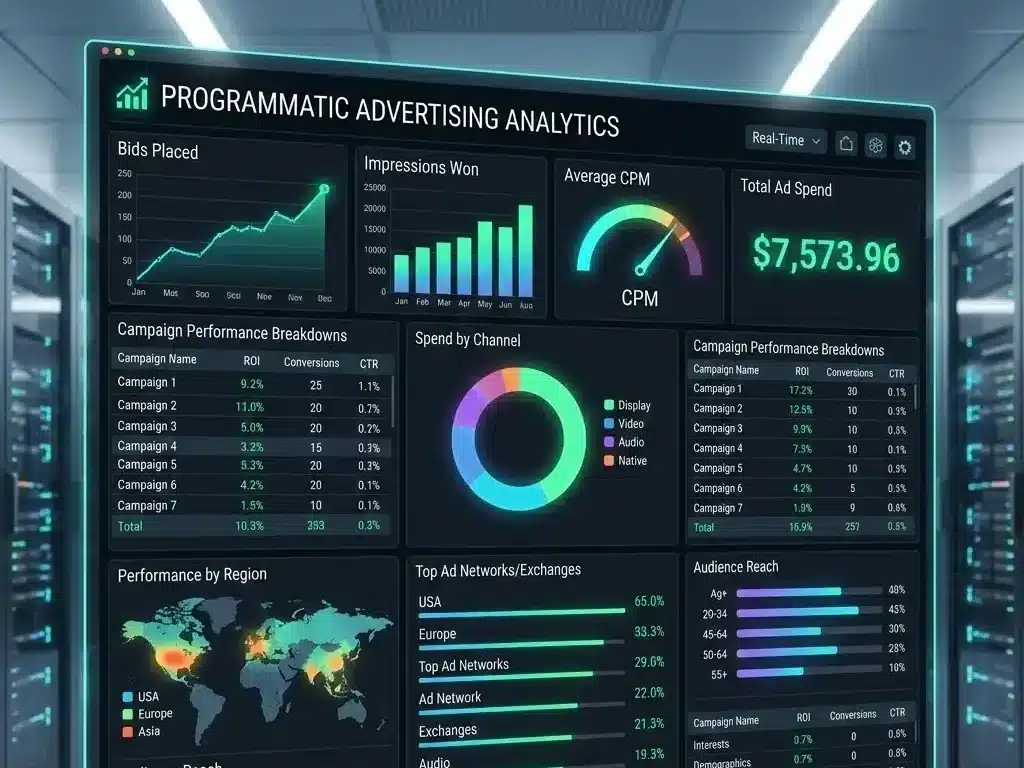
Media Quality Overtakes Cost Control in Programmatic Advertising, ANA Report Reveals 20-Point Performance Gap
The Association of National Advertisers (ANA) has declared that media quality — not just cost efficiency — now determines programmatic advertising performance.
The ANA’s latest quarterly benchmark report shows a widening performance gap between advertisers who prioritize disciplined quality governance and those still chasing low CPMs. The message is unmistakable: cost control alone is no longer enough.
As marketers navigate rising CPMs, tightening transparency standards, and evolving inventory channels, the programmatic ecosystem appears to be entering what the ANA calls an “accountability era.”
Below is a comprehensive breakdown of what the findings mean for advertisers, agencies, publishers, and the broader ad-tech market.
Quality Governance Converts More Budget Into Real Results
The ANA’s Q4 benchmark reveals a striking improvement among advertisers enforcing strict quality standards.
Key Performance Highlights:
56.7% of programmatic spend from quality-governed advertisers converted into benchmark-qualified impressions in Q4.
This marks a significant increase from 50.7% in Q1.
Lower-performing advertisers converted just 37.5% of budgets into qualified impressions.
The performance gap between disciplined and undisciplined advertisers has widened to nearly 20 percentage points.
What Are Benchmark-Qualified Impressions?
The ANA defines benchmark-qualified impressions as those that are:
Fraud-free
Measurable
Viewable
Free from made-for-advertising (MFA) inventory
In other words, these impressions represent media that actually delivers business value rather than vanity metrics.
The widening gap underscores a growing truth in digital advertising: execution quality now determines outcomes.
Programmatic’s Accountability Era Has Officially Begun
“Programmatic has entered an accountability era,” said Bob Liodice, CEO of the Association of National Advertisers.
According to Liodice:
“Transparency and efficiency are now table stakes. What separates winners is disciplined execution. Advertisers that actively govern quality are converting more of their budgets into benchmark-qualified impressions, seeing measurably stronger results.”
This signals a major evolution in programmatic maturity. Where early adoption focused on scale and automation, the new era prioritizes:
Governance frameworks
Trusted supply chains
Publisher consolidation
Quality-adjusted performance metrics
Rising CPMs Test Advertisers — But Quality Strategies Win
The Q4 report also revealed notable shifts in pricing dynamics across channels.
CPM Trends in Q4:
Overall CPMs rose from $5.74 in Q3 to $7.08 in Q4
Web and mobile app inventory primarily drove increases
This finding disrupts the long-standing obsession with “cheap impressions.” It proves that higher CPM does not automatically mean lower ROI — if quality improves conversion efficiency.
The Crackdown on Made-for-Advertising (MFA) Sites Continues
Another major takeaway is the sustained decline in exposure to MFA inventory.
Q4 Findings:
Median exposure to MFA sites: 0.45%
Slight decline compared to Q3
Significant improvement compared to earlier industry averages
MFA sites are typically characterized by:
Low-quality content
High ad-to-content ratios
Aggressive monetization tactics
Auto-play videos
Intrusive ad formats
These environments often meet technical standards but degrade user experience — ultimately harming advertiser outcomes.
The ANA’s benchmark now confirms that reducing MFA exposure directly improves performance metrics.
Private Marketplaces Now Dominate Programmatic Buying
One of the most notable structural shifts is the consolidation toward private marketplaces (PMPs).
Q4 Programmatic Environment Breakdown:
92%+ of median programmatic spend flowed through private marketplaces
Advertisers sharply reduced supply access
Investment consolidated toward trusted publishers
Open marketplace buying became more selective
Even when buying via open exchanges, advertisers relied heavily on:
Inclusion lists
Performance filters
Publisher whitelisting
Inventory quality scoring
This marks a decisive move away from scale-first, reach-maximization strategies.
Programmatic Platforms Expand Beyond Digital — Radio Joins the Ecosystem
The programmatic transformation is not limited to display and video. Platforms such as:
Amazon Ads
AudioGo
Triton Digital
StreamGuys
StackAdapt
are making over-the-air radio inventory as accessible as digital ads.
This convergence signals:
Greater cross-channel integration
Expansion of addressable inventory
Increased complexity in quality governance
As channels diversify, disciplined execution becomes even more critical.
User Experience Now Impacts Measured Performance
For the first time, the ANA benchmark extended beyond fraud and brand safety to include user and ad experience signals.
Newly integrated metrics include:
Ad clutter levels
Ads-to-content ratio
Ads-in-view frequency
Page refresh behavior
The findings suggest that even technically compliant impressions can:
Undermine performance
Reduce engagement
Damage brand perception
This reinforces a broader shift in advertising: consumer experience directly influences ROI.
Execution discipline separates leaders from laggards
The ANA report clearly states:
“Structural inefficiencies continue to decline. But performance is now determined by execution quality.”
Why Cost Control Alone Is Failing
For years, marketers equated programmatic success with driving down CPM. However, this approach now reveals critical flaws:
Problems with Cost-Only Optimization:
Exposure to low-quality inventory
Higher fraud risk
Poor conversion rates
Inflated impression counts
Hidden user experience penalties
In contrast, quality governance includes:
Supply path optimization
Inventory vetting
Publisher consolidation
Performance-based bidding
Ongoing compliance audits
The ANA’s data shows that disciplined quality control drives stronger business outcomes — even in challenging economic conditions.
The Strategic Implications for 2026 Media Planning
The report signals a turning point for digital strategy heading into 2026.
What Marketers Should Prioritize:
Shift KPIs from CPM to cost per qualified outcome
Implement structured media governance frameworks
Increase private marketplace investment
Audit MFA exposure quarterly
Integrate user-experience metrics into buying models
The takeaway is clear: Programmatic has matured beyond automation — it now demands accountability.
Industry Reaction: A New Competitive Divide
The nearly 20-point performance gap is not just statistical noise. It signals a new competitive divide between:
Governance-driven advertisers
Scale-driven advertisers
Brands that adopt disciplined execution strategies will likely:
Achieve stronger ROI
Improve conversion efficiency
Enhance brand equity
Reduce waste
Those who fail to adapt may continue bleeding budget into technically compliant but commercially ineffective impressions.
A Broader Industry Transformation
The ANA’s benchmark represents more than quarterly data. It reflects:
The normalization of transparency standards
Increased advertiser control
Declining structural waste
Sophisticated buyer behavior
With digital channels expanding into audio, CTV, retail media, and beyond, execution complexity will only grow.
The winners will not necessarily be those who buy cheapest — but those who buy smartest.
Final Takeaway: Quality Is Now the Currency of Performance
The ANA’s findings remove any ambiguity:
Media quality is measurable.
Quality governance improves ROI.
Cost control without oversight fails.
Execution discipline defines market leaders.
Programmatic advertising is no longer about automated scale alone. It is about accountable scale with verified quality. As advertisers prepare budgets for the coming quarters, one principle stands above all:
Quality is no longer optional — it is the engine of performance.