Podcasts Match Radio in Spoken-Word Listening Time, Edison Research Reports
The battle for America’s ears has entered a decisive new chapter.
Fresh data from Edison Research reveals that podcasts are now virtually tied with traditional AM/FM radio in total spoken-word listening time — a dramatic transformation that signals a generational and technological shift in how audiences consume news, sports, commentary, and personality-driven shows.
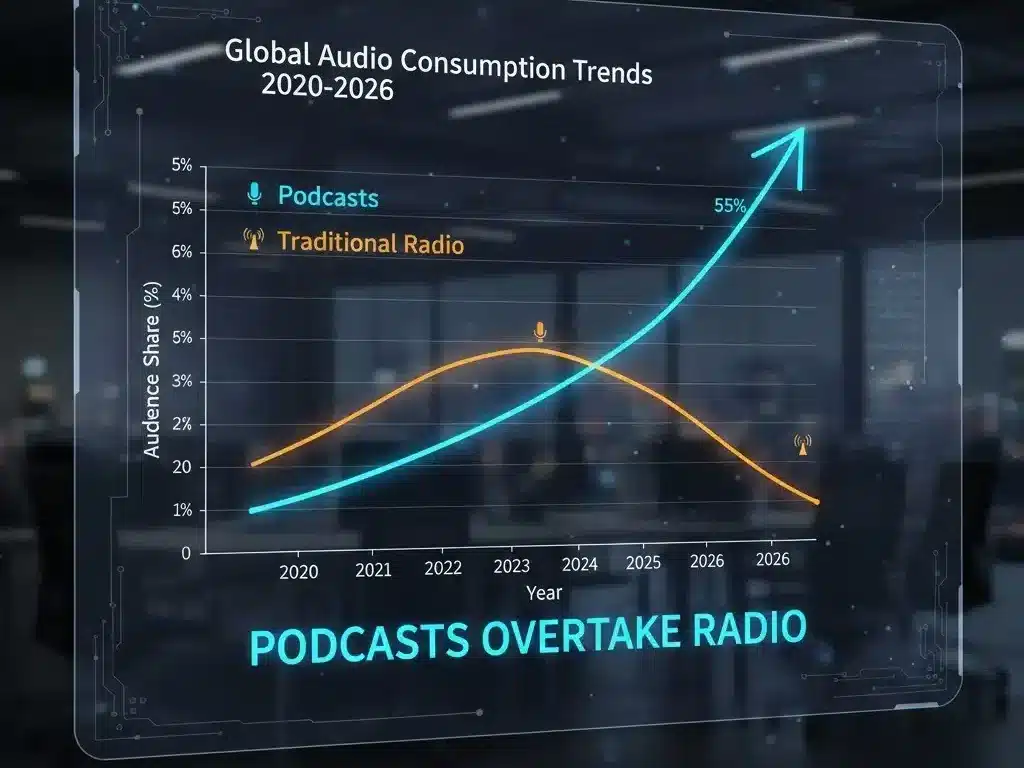
What began as a niche, on-demand experiment a decade ago has evolved into a dominant audio force. Today, podcasts command four out of every ten minutes spent listening to spoken-word content in the United States — nearly equal to broadcast radio’s share.
The numbers tell a powerful story. The cultural implications tell an even bigger one.
Americans are listening to more spoken-word content than ever before.
According to Edison Research, spoken-word audio consumption has increased by 28% between 2017 and 2025. This growth reflects a broader transformation in media habits following the pandemic, when audiences gravitated toward news updates, sports analysis, cultural commentary, and personality-led discussion formats.
Key Highlights From the Latest Data:
Spoken-word listening is up 28% since 2017
Podcasts now account for 40% of spoken-word listening time
Broadcast radio’s share has dropped to 39%
In 2015, radio held roughly 75% of spoken-word listening
A quarter of all daily audio consumption is now spoken-word
This is not incremental growth. It’s structural change.
Spoken-word content now makes up one-quarter of all daily audio listening time — a staggering share in an industry long dominated by music.
From “Serial” to Streaming Giants: The Podcast Explosion
To understand this transformation, we need to rewind to 2015.
That year, the breakout success of Serial introduced millions of Americans to on-demand storytelling. The investigative crime series became a cultural phenomenon, effectively waking the mainstream audience to podcasting’s power.
Back then, podcasts accounted for just 10% of spoken-word listening time among Americans aged 13 and older.
Fast forward to the end of 2024:
Podcasts now claim 40% of spoken-word listening time
Radio has fallen from 75% share in 2015 to 39%
Audiobooks and other spoken formats make up the remainder
In less than a decade, podcasting has quadrupled its share of spoken-word consumption.
The message is unmistakable: on-demand audio is no longer an alternative — it’s a primary medium.
Why Radio’s Dominance Is Slipping
There are only 24 hours in a day.
As podcast listening increases, something else must give. For traditional AM/FM radio — especially talk radio — that “something” has been share of time spent.
Radio still commands massive reach. But its portion of spoken-word listening has steadily declined as audiences shift toward personalized, mobile, on-demand experiences.
Major Factors Driving the Shift:
On-demand convenience
Binge-listening culture
Algorithm-driven discovery
Mobile-first consumption habits
Younger audience migration
Unlike traditional radio, podcasts allow listeners to:
Pause and resume anytime
Skip ads
Choose hyper-specific niches
Engage with personality-driven content
Consume across platforms like mobile apps, YouTube, and streaming services
Radio remains powerful in live news, commuting, and local markets. But podcasts have captured cultural momentum.
“Podcasting Is the New Talk Radio”
Few industry observers have tracked this shift as closely as Steve Goldstein, CEO of Amplifi Media.
For years, Goldstein has argued that podcasting represents the evolution of talk radio. The latest data reinforces his position.
“Podcasting is the new talk radio.”
That statement once sounded aspirational. Today, it sounds factual.
Goldstein suggests that in key advertiser demographics — particularly ages 18–34 and 25–54 — podcasts likely already surpass traditional talk radio.
This matters enormously for brands.
The Age Factor: A Generational Divide
One of the most significant drivers behind the shift is audience age.
Traditional talk radio, much like cable news, has seen its median audience age rise over time. Meanwhile, podcasting has cultivated younger, digitally native creators and audiences.
Demographic Reality in 2025:
Talk radio skews older
Podcast audiences skew younger
Younger hosts are building multi-platform brands
Advertisers prioritize 18–34 and 25–54 demos
Podcasting’s growth is not just about format — it’s about generational identity.
Younger listeners want authenticity, long-form depth, cultural relevance, and creator-driven storytelling. Podcasts deliver that in a way legacy radio often struggles to replicate.
Why Repurposing Radio Content Isn’t Enough
As traditional broadcasters attempt to compete, many have adopted a straightforward strategy: convert existing radio talk shows into podcast formats.
But Goldstein warns that this approach has limits.
Simply repackaging terrestrial radio content does not automatically attract younger audiences.
While some radio programs successfully expand their reach via podcast distribution, success requires more than uploading archives.
It demands:
Fresh format thinking
Talent development
Platform-native strategy
Social and video integration
The Rise of Podcast Personalities
Much of podcasting’s growth stems from personality-driven shows.
Unlike traditional broadcast radio, which often emphasizes station branding, podcasting elevates individual hosts into powerful personal brands.
Many of today’s podcast stars:
Built audiences independently
Leverage YouTube for video distribution
Expand into streaming platforms
Develop direct-to-fan monetization
Increasingly, podcast creators are scaling their content into video ecosystems like YouTube and premium streaming platforms such as Netflix.
Podcasting is no longer audio-only. It’s an omnichannel ecosystem.
Post-Pandemic Media Habits Changed Everything
The pandemic fundamentally altered content consumption patterns.
During lockdowns:
Commuting declined
Home media consumption surged
News demand spiked
Long-form storytelling flourished
Even after life normalized, the listening habits remained.
Audiences discovered podcasts during extended time at home — and many never returned exclusively to traditional radio.
On-demand flexibility became permanent.
Advertisers Are Following the Shift
Where audiences go, advertising dollars follow.
Podcasting’s appeal to key demographics makes it increasingly attractive for brands seeking:
Engaged listeners
High completion rates
Host-read endorsements
Targeted niche audiences
Unlike traditional broadcast advertising, podcast ads often feel conversational and integrated into the content itself — boosting effectiveness.
If podcast listening continues to outpace radio in younger demographics, the advertising realignment could accelerate.
Is Radio in Decline? Not Exactly.
It’s important to clarify: radio is not disappearing.
Broadcast radio still:
Reaches millions daily
Dominates in-car listening
Plays a key role in live news and emergencies
Maintains strong local presence
However, its dominance in spoken-word share is no longer secure.
Instead of a collapse, what we’re seeing is equilibrium — a balance between legacy and digital formats.
The Bigger Picture: Audio’s Expanding Universe
The audio industry in 2025 is not a zero-sum game.
Spoken-word growth suggests consumers are expanding their audio diets rather than merely swapping one format for another.
The ecosystem now includes:
AM/FM radio
Podcasts
Audiobooks
Smart speaker content
Streaming talk platforms
The fight is not just for time — it’s for cultural relevance.
What Comes Next?
If current trends continue, podcasts may soon overtake radio outright in spoken-word share.
Critical factors to watch:
Smart speaker adoption
In-car streaming integration
Video podcast dominance
Creator economy monetization
AI-driven content personalization
The next decade could bring further fragmentation — or consolidation around powerful podcast networks.
One thing is certain: the definition of “radio” has changed forever.
The Takeaway for Media Leaders
For broadcasters and digital publishers alike, the message is clear:
Develop original podcast-native content
Invest in younger talent
Expand into video platforms
Focus on community building
Adapt to on-demand culture
The companies that treat podcasting as a side project risk falling behind.
The companies that treat it as the future of talk will define the next era of audio.
Final Analysis: A Historic Media Inflection Point
Ten years ago, podcasting was considered experimental. Today, it stands shoulder-to-shoulder with broadcast radio in spoken-word listening time. The transformation is not merely technological — it’s cultural. Audio storytelling has entered its streaming age. And as the data from Edison Research confirms, podcasting is no longer emerging. It has arrived.