Audio Still Beats Video for Podcasts in 2026, New Industry Survey Finds
Even as video podcasts flood platforms like YouTube, Spotify, Instagram, and TikTok, audio-first podcasting continues to outperform video for a significant portion of brands, according to a newly released industry survey.
A fresh report titled “State of Podcast Agencies 2026” by podcast hosting and analytics company CoHost reveals that while video has become more visible, audio remains the most effective format for many podcast agencies and their clients — especially when measured by performance, ROI, and audience engagement.
The findings highlight a podcast ecosystem that is evolving rapidly but not abandoning its roots, as agencies balance video experimentation, AI adoption, and tightening marketing budgets.
One of the most striking insights from the report is the size-to-impact ratio of podcast agencies.
Key Findings on Agency Size
Over 75% of podcast agencies operate with 10 or fewer employees
Many serve mid-sized businesses and enterprise-level brands
Agencies often function as strategic partners, not just production vendors
Despite their lean structures, these agencies are shaping how brands approach:
Podcast format decisions
Distribution strategies
Measurement and ROI
Adoption of AI tools
This suggests that expertise and flexibility now matter more than headcount, particularly in a podcasting landscape that has grown increasingly complex and competitive.
The Video Podcast Boom — and Its Limits
Video podcasts have exploded in visibility over the past two years, driven by:
YouTube’s dominance in podcast discovery
Spotify’s investment in video
TikTok and Instagram Reels fueling short-form clips
Yet the report makes one thing clear: visibility does not always equal performance.
Audio vs Video: What the Data Shows
Nearly 40% of agency clients do not produce full video podcast episodes
Among agencies offering video services:
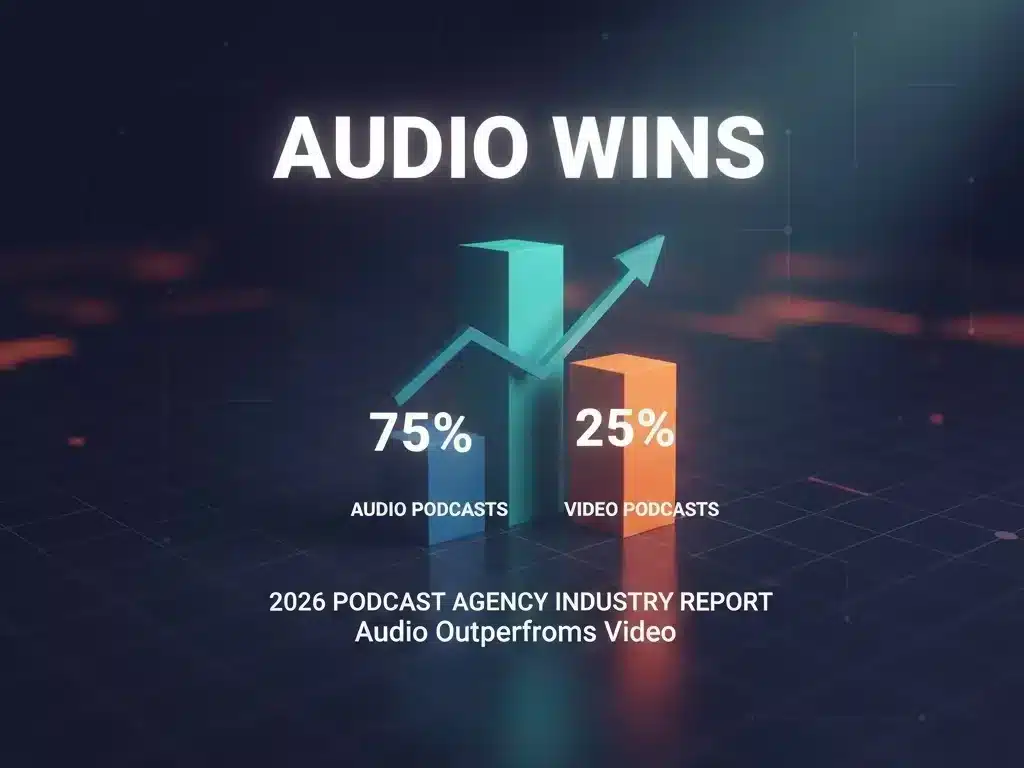
35% say audio-only podcasts perform better
28% say video podcasts outperform audio
The rest report little or no difference
These numbers challenge the assumption that video is a guaranteed growth lever for podcasts.
Why Audio-Only Podcasts Still Perform Strongly
According to agencies surveyed, audio continues to win in several key areas:
Advantages of Audio-First Podcasting
Easier consumption during multitasking (commuting, workouts, chores)
Lower production costs
Faster publishing cycles
Greater consistency over time
Stronger listener loyalty
Many agencies report that audience retention and episode completion rates are often higher for audio-only shows — a crucial metric for advertisers and brand partners.
“Video expands reach, but audio builds habits,” one agency respondent noted in the report.
Video as a Tool — Not a Default Strategy
While agencies acknowledge video’s strengths, the consensus is clear: video works best when it serves a specific goal.
Where Video Podcasts Excel
Discoverability on YouTube and social platforms
Short-form clips for TikTok, Instagram, and LinkedIn
Visual storytelling for interview-heavy or personality-led shows
Brand credibility and executive visibility
However, agencies caution against treating video as mandatory.
Common Pitfalls of Video Podcasting
Higher production costs
Increased editing and publishing time
Inconsistent output due to resource strain
Poor ROI if video isn’t distributed strategically
The report emphasizes that storytelling, consistency, and audience value matter more than format — whether audio or video.
Podcast Budgets Remain Tight in 2026
Despite podcasting’s growth, client budgets remain modest across the agency landscape.
Typical Podcast Spend
Most common seasonal budget: $5,001 to $15,000
Larger budgets remain the exception, not the rule
Top Constraints Identified by Agencies
Limited budgets (29%)
Difficulty proving podcast ROI
Internal client alignment issues
Long timelines for measurable results
As marketing leaders demand clearer accountability, agencies are becoming more selective about recommending high-cost formats like video unless the business case is clear.
ROI Pressure Is Reshaping Podcast Strategy
The challenge of measuring podcast success continues to influence format decisions.
Shifting Success Metrics
While downloads remain the most common metric today, agencies say brands are increasingly asking for:
Lead generation impact
Audience quality over quantity
Brand affinity and trust signals
Attribution to revenue or pipeline
This has led agencies to focus less on flashy formats and more on strategies that demonstrate long-term value.
Thought Leadership and Trust Take Center Stage
Another major shift highlighted in the report is how brands perceive the value of podcasting.
Top Benefits of Podcasting (According to Agencies)
Relationship building
Thought leadership
Industry authority
Brand storytelling
Community building
This marks a move away from podcasts as short-term marketing campaigns and toward long-term trust-building platforms.
Audio-first podcasts, in particular, are seen as effective tools for:
Executive visibility
B2B influence
Niche audience engagement
Authentic brand communication
AI Becomes Core Infrastructure for Podcast Agencies
Artificial intelligence is no longer optional in the podcast agency world.
AI Adoption Snapshot
92% of podcast agencies now use AI tools
Up from 86% the previous year
Adoption spans nearly every stage of production
Common AI Use Cases
Transcription
Show notes and summaries
Episode descriptions
Audio cleanup and enhancement
Editing assistance
Content repurposing ideas
AI has allowed small teams to scale output without scaling headcount, freeing human talent for strategy, creative direction, and client management.
AI as a Productivity Booster, Not a Creative Replacement
Importantly, agencies do not see AI as a replacement for creative judgment.
How Agencies View AI
Tool for efficiency, not originality
Support system, not decision-maker
Accelerator of workflows, not storytelling
Among the small minority not using AI, concerns include:
Accuracy limitations
Data privacy risks
Client confidentiality
However, resistance to automation itself is minimal, suggesting AI will only deepen its role in podcasting.
Analytics and Attribution: The Next Frontier
Looking ahead to 2026 and beyond, agencies agree on one priority: better measurement.
Top Future Priorities
Advanced listener analytics
Improved attribution models
Cross-platform performance tracking
Smarter content repurposing
Clearer business outcome reporting
While downloads remain the industry standard today, agencies believe deeper insights will ultimately determine podcasting’s place in brand marketing strategies.
What the Survey Really Tells Us About Podcasting’s Future
The findings from CoHost’s report point to a podcast industry that is:
More strategic
More data-driven
Less trend-chasing
Still deeply rooted in audio-first thinking
Rather than format wars or technology hype, the next phase of growth will be driven by agencies that can:
Use audio as a foundation
Deploy video selectively
Leverage AI responsibly
Deliver measurable results
Final Takeaway
Despite the rise of video podcasts, audio remains the backbone of podcast success for many agencies and brands. Video may boost reach and visibility, but it does not replace the fundamentals that make podcasts work: strong storytelling, consistency, and audience trust.
As budgets tighten and accountability rises, audio-first strategies paired with selective video and AI-powered efficiency appear to be the winning formula heading into 2026.