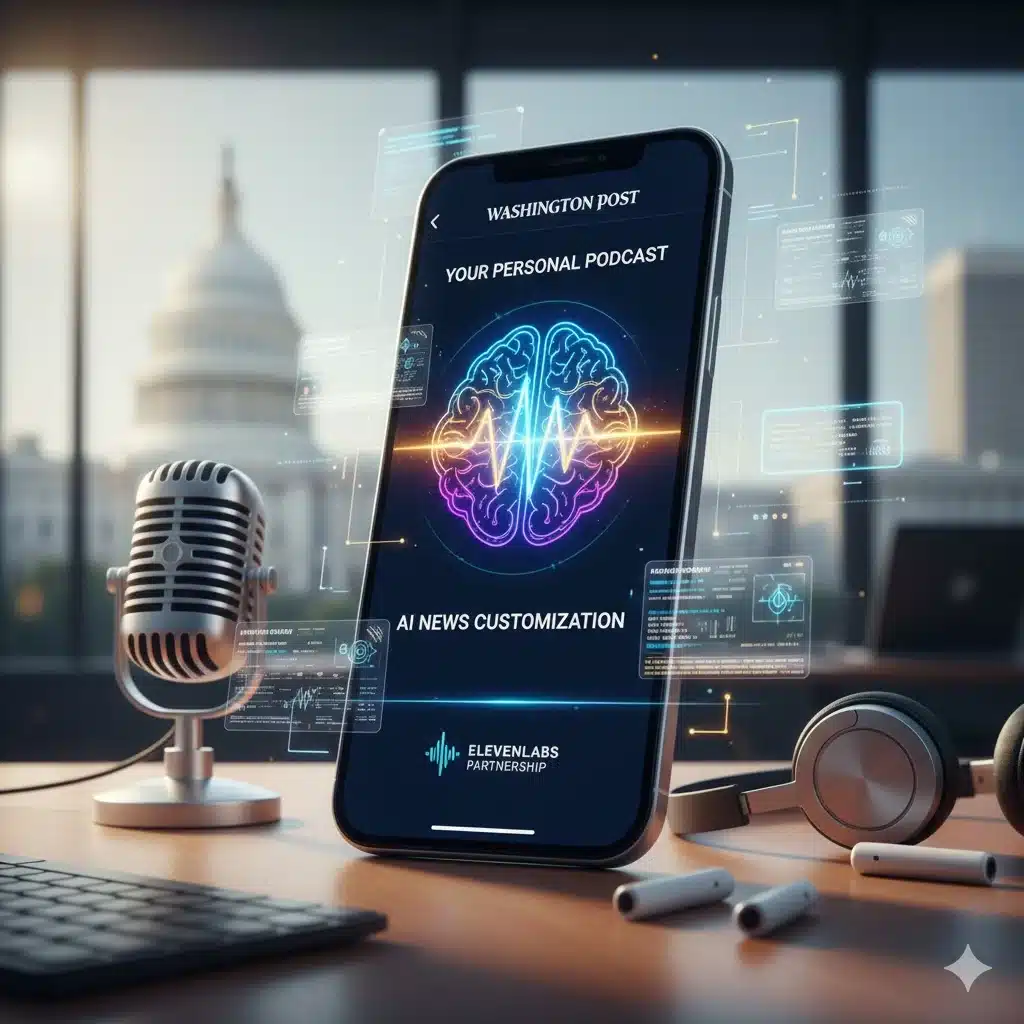
Washington Post Launches AI-Powered “Your Personal Podcast” for Customized Daily News
The Washington Post has taken a groundbreaking step in the future of digital journalism, unveiling a first-of-its-kind tool that blends artificial intelligence, personalized media, and podcasting. The newly launched “Your Personal Podcast” promises a news experience curated entirely around each user’s interests — all narrated through realistic AI-generated voices.
This innovative feature redefines how audiences engage with news, offering real-time updates, customizable listening options, and individualized storytelling. As major media companies experiment with artificial intelligence, the Washington Post has positioned itself at the forefront of this transformation.
The Post’s latest creation allows any registered user on their website or mobile app to generate a bespoke audio news program — almost like having a private newsroom, editor, and podcast host in your pocket.
How It Works
The AI system analyzes:
Articles you’ve recently read
Topics you follow (politics, tech, sports, entertainment, etc.)
Audio stories you’ve listened to before
Your evolving news habits throughout the day
Based on this data, it automatically assembles a short podcast of roughly four curated stories, delivered by AI hosts with natural, conversational voices.
Human-Like Banter — Without Human Hosts
The podcast features two AI-generated presenters who discuss the stories with realistic tone, pacing and commentary. These hosts can be adjusted according to user preference, including:
Voice style
Gender
Speech pacing
Mood and energy levels
Episode length
The result is a modernized news experience that adapts as fast as the news cycle itself.
Built With ElevenLabs: The Technology Behind the Audio Transformation
“Your Personal Podcast” builds on the Washington Post’s expanding partnership with ElevenLabs, the AI audio company known for hyper-realistic text-to-speech voices.
Prior to this launch, ElevenLabs already powered the Post’s audio versions of written articles — but this new release takes the collaboration several steps deeper.
The new system:
Compiles articles in real time
Narrates them using custom AI voices
Structures them in podcast format
Adds conversational transitions and host exchanges
Lets users tailor their listening experience
This represents a shift from simply reading articles aloud to building a completely AI-produced broadcast.
A New Direction for News Delivery: Why The Post Is Investing in AI Audio
While The Washington Post already produces well-known podcasts — including “Post Reports,” “The Seven,” “Try This,” and “Impromptu” — this new feature isn’t meant to replace traditional programming. Instead, it aims to reach audiences who may prefer news they can listen to on the go, instead of reading.
Expanding to Younger, More Diverse Audiences
According to Bailey Kattleman, the Post’s Head of Product and Design, this project was built with one major goal:
To widen the Post’s reach to younger, more diverse audiences who aren’t consuming news through traditional reading habits.
Younger demographics increasingly consume information through:
TikTok
Short-form video
Audio platforms
AI voice assistants
The Washington Post believes personalized audio may appeal to these audiences and create habit-driven news consumption rather than volume-driven metrics.
The App Experience: Where Users Can Access Their Custom Podcast
The “Your Personal Podcast” tool lives inside the Listen tab of the Washington Post’s app. Once inside, users can:
Generate a fresh episode any time
Update topics they care about
Select or modify AI narrator voices
Adjust the length or depth of coverage
Allow the feed to refresh as stories develop
Episodes can change multiple times per day, reflecting breaking news, trending stories, and new developments on user-followed topics.
AI Interactivity: Pause, Ask Questions & Shape the Content
In a future enhancement, the Post is exploring integration with its generative AI assistant, “Ask the Post AI.” The concept would allow listeners to:
Pause the episode
Ask questions via voice prompts
Request clarification on a detail
Ask for additional context
Or even change the direction of the episode
For example:
“Explain the background of this Supreme Court case.”
“Give me more international reactions.”
“Add more tech stories today.”
“What does this mean for local policy?”
This level of interactivity could make news consumption feel more like a conversation than a broadcast.
Six Months in the Making: Challenges Behind the Scenes
Building this AI-powered news tool wasn’t a small task. The Washington Post reportedly spent six months developing the platform, with several major challenges:
1. Making AI Voices Sound Human
Voice tone, emotional inflection, pauses and conversational flow had to feel natural — not robotic or monotone.
2. Ensuring Content Accuracy
With AI narration, maintaining factual precision and proper attribution was essential.
3. Creating a Seamless Listening Style
Unlike a simple newsreader, this is meant to feel like a professional, produced podcast, complete with transitions and host interaction.
4. Maintaining Trust
The Post needed a system that respected journalistic rigor and preserved editorial integrity.
Despite these hurdles, Kattleman calls the final product an “experimental but exciting new category of audio journalism.”
Is It a Podcast? The Debate Begins
Not everyone is convinced that “Your Personal Podcast” qualifies as a true podcast. Purists argue that:
Podcasts are traditionally human-created
Episodes are static, not dynamically generated
Host personalities are central to the medium
Because the Post’s tool produces episodes on-demand using AI hosts, critics say it blurs the line between:
Podcast
News briefing
AI audio content
Personalized media feed
Still, the Washington Post believes consumers — especially younger ones — may embrace it without worrying about definitions.
What This Means for the Future of News & AI Media
“Your Personal Podcast” may be the first major step toward an era where:
Newsrooms produce dynamic, personalized broadcasts
AI hosts become standard
Audio news evolves beyond traditional formats
Readers transition into listeners as a primary mode of consuming information
If successful, this could become a blueprint for the entire media industry — from newspapers and broadcasters to tech giants and independent creators.